Content checklists for PA pros (one good, one bad)

Online content matters. Why? Your target audience may come across it e.g. think the oft-quoted 93% of MEPs use Google daily to learn about policy-related issues.

But content needs to tick the following boxes:

  • It needs to be relevant
  • It needs to be interesting
  • It needs to be clear and ideally concise
  • It needs to be published in channels audiences are likely to use
  • It needs to be marketed so that audiences actually find it

Unfortunately, too much PA-related output in Brussels does not tick these boxes, largely because far too little thought is out into producing it: no it’s not a case of stick something up and the hoards will come.

Outlined below are a couple of checklists, the first showing a smart process, the second showing the prevalent non-process (use it at your peril.)

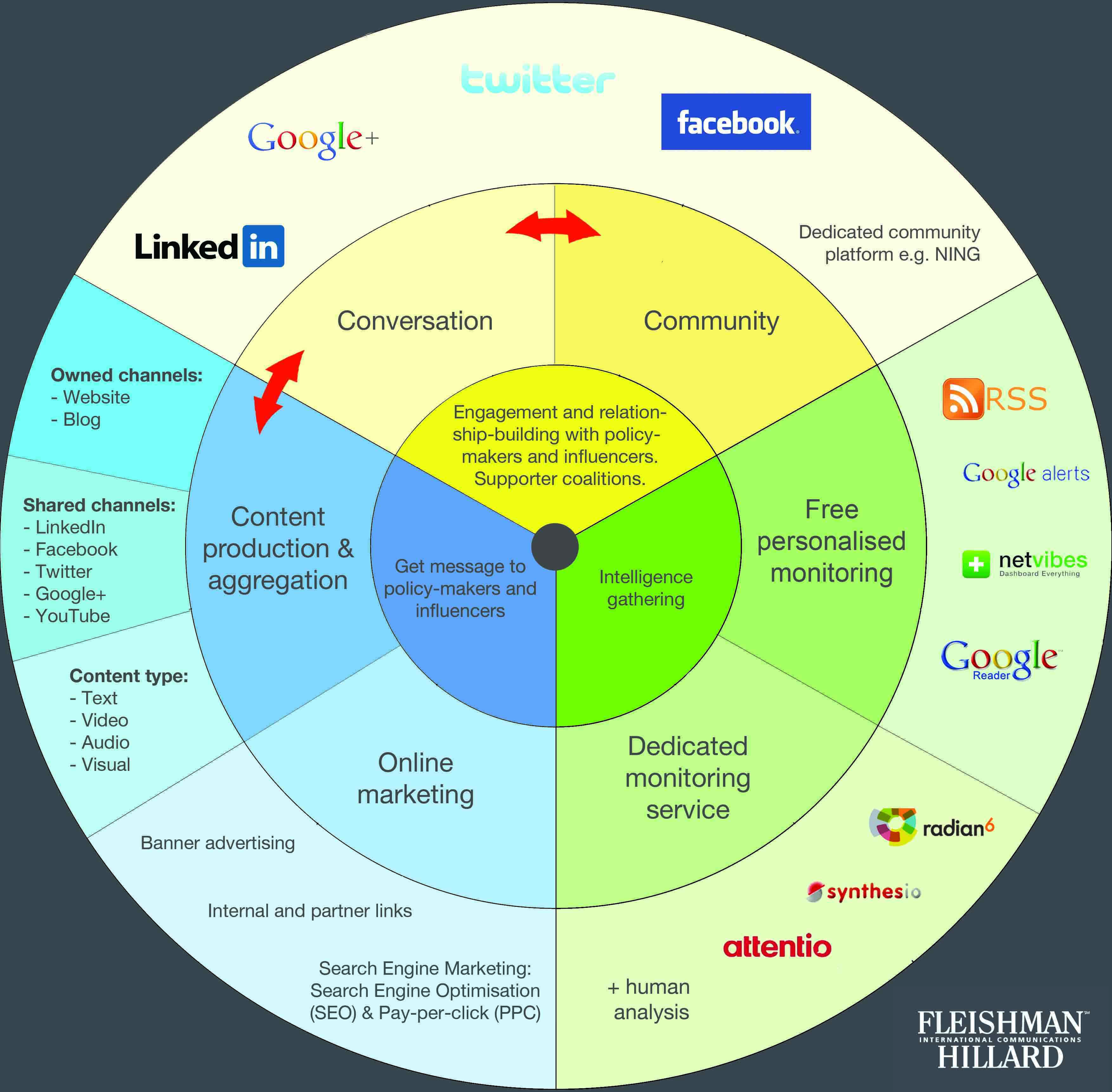
Digital and Public Affairs “wheel”


The activities of the Public Affairs professional in Brussels (and most other places, for that matter) can be summed up in three core activities:

  1. Gathering intelligence.
  2. Getting a message to policy-makers and influencers.
  3. Engaging with stakeholders and building relationships and coalitions.

Each of these activities can be supported online, and the purpose of the wheel is to exhibit this. It contains the three core activities at the centre, and moving out, online communications activities, and in the outer circle, the tools and tactics that support these.

Caveats:

  1. These could be placed in an order (1-6) starting with monitoring, through to content production, marketing and ending with community, which would in principle represent the correct way to approach most online endeavours, but it may not always be the case, plus I didn’t want to over-engineer.
  2. Yes, there’s plenty of overlap, hence the arrows. There should probably be more arrows, but again, didn’t want to over-engineer.
  3. Yes, there are far more tools and approaches, but this is specific to PA in Brussels, hardly the most advanced digitally, so this is fine for starters I think.

The wheel is by no means final, so would appreciate scathing criticism or (preferably) constructive suggestions for improvement.

Digital, comms, Brussels: some old posts revisited

I’ve dug up a few posts from before I even started at Fleishman-Hillard which may be interesting to anyone into digital, comms, issues and agency life in Brussels.

It’s personally been interesting to revisit stuff I’d even forgotten I’d written: plenty of naive remarks, lots of things which I’d now think were to bleedin’ obvious to even mention, lots of stuff that really hasn’t changed, and other stuff that has (e.g. I mention at one point that access to content remains search-centric but I’d now say that access to content is driven more by referrals.)

Anyway, here goes:

Shaping the debate: 1999 vs. 2009

Why the Brussels PA bubble isn’t embracing the web

Don’t listen to smug online consultants

Agencies and the commodity temptation

Reaching a legislator before and now

Being an online communications consultant in Brussels: annoying conversations

Can an eCampaign alone shift public opinion?

What to do about angry commenting trolls: ignore them

Replicating the marketing journey in issues communication

The bane of the online communications consultant

Countering fragmentation in Brussels by integrating and aggregating

Public Affairs and LinkedIn: big potential

Whatever the issue, Public Affairs professionals in Brussels will usually seek to do two things: obviously, communicate with policy-makers, whether directly or through what we in PR-speak call “influencers”; and build coalitions of support, ideally in both Member States and Brussels (note: how to manage the Member States and Brussels nexus – in particular how to identify and harness activity at national level to drive political developments in Brussels – is arguably the greatest bane of the Brussels-based PA professional).

With the advent of digital, PA professionals got rather excited about prospects for the latter: the online space would allow them to build pan-European coalitions with ease and speed, and on the cheap. These coalitions of people interested in very specific issues (web-speak: micro-communities) – so far often scattered and unaware of each other – would finally have a single place in which to unify and mobilise their activity, which when fed into the policy loop would help drive political developments far more effectively.

It didn’t happen, however:

  • People across the EU may have been active on issues online, but on different platforms (and communicating in different languages) i.e. like-minded people may have been producing lots of good material and doing stuff which policy-makers and influencers would have taken note of, but their activity remained as splintered as before.
  • When anyone did try to set up an online community to join the dots, it was hard to get people to join: raising awareness of a one-stop online community was difficult, and even if likeminded people were informed, getting them to join (and stay active) in a dedicated community was (and remains) nigh on impossible.

Enter LinkedIn Groups, and we finally have a community platform that ticks the following boxes:

  • It’s pan-European and has critical mass (or getting there.)
  • It’s credible.
  • People are already on it so no one has to join something new and unfamiliar.
  • People check their LinkedIn regularly, so will likely check the community and be active on it more than they would on a dedicated platform.
  • It has all the required features (aggregation, discussion, sharing) to enable what’s required of an online coalition i.e. being a single unifying hub for good information scattered in lots of different places (blogs, sites, Twitter feeds, whatever), and allowing like-minded people to meet, engage, share, mobilise and – in particular – consolidate their activity.

Needless to say, a group has to be managed very efficiently if it’s to act as a single hub and drive cohesive action on an issue, but the potential’s there.

The telephone was once pretty useless too, so what?

I recently heard for the umpteenth time that someone who had signed up to Twitter and didn’t gain a following of a million within a few weeks had given up, claiming it doesn’t work as a channel to raise awareness and engage on policy-related issues because it’s not credible and 140 characters is only enough for a bit of mindless babble.

I doubt it. There are two reasons it wouldn’t have worked (beyond the fact that it always takes a bit more time than you think): either tweets were dull or irrelevant, or, on the given issue, there aren’t enough people interested in it active on Twitter YET i.e. there’s no critical mass. A telephone too was pretty useless when hardly anyone one had one.

So two points:

  • A channel is just a channel: it’s not the nature of it that determines whether it works or not but what you transmit on it. Does an annoying telemarketer trying to sell you something utterly useless make you think the phone is a worthless communications channel?
  •  A channel is just a channel: it’ll work if there’s enough critical mass i.e. lots of people on it, meaning people in your sector/area of interest/issue, actively using it. Fact of the matter is, in most areas, they aren’t all on Twitter yet.

And a third:

  • Enough with the “only 140 characters”: it’s enough for a quick exchange and to drive traffic somewhere else where you have as much space as you like to delve deeper (a blog, for instance.)

Measuring success in Public Affairs

Know what happens to a marketer whose big programme does not result in a rise in sales? They’re in trouble. They may very well lose their job. What happens if a PA professional’s big programme still results in overwhelming loss in that ultimate of KPIs i.e. the outcome of the regulatory issue it’s trying to affect? Nothing much, in many cases (but not all cases, by any means).

Why the disparity? Because a marketing programme needs to fit into a neat sales funnel that lists all activities ultimately leading to the sale, and each activity is eminently measurable. If something is clogging the funnel, which then results in fewer sales than expected, it’s easy to detect exactly where the fault lies. There’s no PA equivalent of the sales funnel, however.

Result? In some cases, PA professionals can get away with not succeeding because:

  1. Often, the activities they conduct aren’t linked to ultimate success due to the lack of a funnel, so their achievement is often measured in fairly subjective terms, usually based on output. Lobbyist X is great, in just 3 months he/she got us meetings with 12 MEPs and high-level officials, produced 4 position papers which our board thought were great, and hosted an event which 3 journalists came to!”
  2. If a marketer doesn’t sell, there’s nowhere to hide, yet the PA pro has more pretexts: the public fell for the NGO narrative and politicians felt compelled to support their position; the media misrepresented us; we only had 3 months and so only met with 12 MEPs and high-level officials and wrote 4 position papers (as if to say if the bastards had given us 6 months, we’d have had 24 meetings and published 8 position papers: that would have done the trick!)

What’s the solution? Not a PA funnel that’s quite as neat as a sales funnel, because frankly, we PA pros have a valid point regarding the number of variables that affect regulatory outcomes. You can be brilliant and on the right side of an issue and still lose due to any number of factors. A brilliant marketer will usually get it right (assuming the product isn’t a dud).

However, output should never be a measure of success. The fact that it is, helps explain why some PA activity is poor. I see it all the time in digital, for instance. God-awful websites, excruciating videos, social media outreach that reaches no-one other than 12 spammers. And yet the programme is deemed a success because it ticked the website, video and social media boxes.

So step one to bridging the gap to more accountable communications disciplines like marketing is to produce indicative KPIs which connect output to success more cogently:

  • As a result of our meeting, MEP X tabled an amendment that supported our position (which, in truth, most tend to measure already, albeit not as part of a clearly defined measurement dashboard incorporating a number of KPIs).
  • As a result of our social media outreach, we built a coalition in country X and shifted a constituency into our camp, resulting in MEPs supporting our position.
  • As a result of our position paper, we were able to get meetings with 8 perm reps, which subsequently shifted Council’s position in our favour as measured by ABC.

It’s by no means an easy (or entirely scientific) exercise to extend this across far more PA activities (the sample KPIs above, for instance, require plenty of work). Yet I’m sure more specific metrics can be developed, which would ultimately make PA pros and their output more accountable, resulting in less bad PA and presumably more success in terms of affecting regulatory outcomes.

Brussels and digital: a different crowd now

I presented to a clever and vocal crowd at the Euractiv “Federations Workshop” this week on how to integrate digital in traditional PA practices (presentation at the bottom of this post, although much of it is just images and may thus not make much sense – feel free to get in touch if you have questions.)

Some thoughts:

  1. In the past, when I did this sort of thing, there were always people in the crowd with no digital experience. Now, it’s rare that no one at least produces content for a website. This crowd was especially savvy.
  2. Similarly, there always used to be doubters in the crowd. No longer: everyone sees the value, but would just like pointers on how to do it better.
  3. Amongst people who think they’re beginners, there are often some fairly sophisticated users of social media. At EurActiv, some attendees were making impressive use of Twitter, LinkedIn Groups, and social media measurement platforms.
  4. I often tend to run through common “stumbling blocks”. At EurActiv, I mentioned lack of internal support and resistance from IT and/or legal as issues, but not a single attendee had any sort of internal stumbling block. Great news, as this (and lack of resources) used to be cited as the primary reason for not embracing digital.

Fish and LinkedIn

Short post. My colleague Aaron – who loves fish (policy, not eating it, he’s a devoted vegetarian) – sent a note around this week stating that he had found scores of groups on LinkedIn that discuss fish policy. He heartily recommended that everyone look up their issues on LinkedIn and see what sort of discussions were taking place, and who was involved in them, as it was a great way to follow developments and build relationships with people who matter.

Hear, hear.

I’d take it one step further. If there are no existing groups (or the existing groups are run by dim-wits), set up your own. It requires a fair bit of work to keep it going and to attract lots of likeminded people, but it may very well be worth it.

Pet hate: “there’s no digital element in this”

There always is. ALWAYS. And thanks to input from my clever colleagues, Aoife and James, from now on, in order to make this very, very clear, I’ll explain digital to PA crowds solely in terms of how it can be used in support of traditional PA activities and will always avoid supposed jargon like content and engagement.

Meaning what? Summarising PA very neatly in 4 categories – i) getting your message to policy-makers and influencers; ii) building relationships with policy-makers and influencers; iii) building and mobilising alliances and networks of support; iv) intelligence monitoring – I’ll then move on to explain how each of these four categories can be enhanced using a variety of digital tactics.

Fingers crossed it’ll get more of the nay-sayers onboard.

PA pros: search engines and referrals 101

How do people discover stuff? Educate themselves? Make up their minds?

Ever increasingly, they:

  • Use a source they know and trust (a magazine, daily paper, website, whatever)
  • AND they use a search engine to look up whatever it is they want to know about
  • AND they read (or otherwise consume) whatever their peers recommend, increasingly via online recommendations (Facebook, Twitter, Google+)

Yet PA dinosaurs will often feed you variants of the following: MEPs only care about the FT, they’ll only listen to you if you get face time, policy-makers don’t trust the web. And so forth.

No.

80% of MEPs use interest group websites and 99% of MEP offices conduct research on policy matters using a search engine. Would you not want them to find your stuff? There are things you can do to help ensure that they do. It involves something collectively known as Search Engine Marketing.

Scores of MEPs (and their assistants) are avid Twitter and Facebook users. Their friends and followers include people who work in the same areas they do. They trust these people, so when these same people post something or recommend an article (i.e. referrals) they take note. Would you not want them to be recommending your stuff? Well in that case, make your stuff really interesting, and make sure it can be shared with ease.