One of my very favourite clients, Helen Dunnett, was interviewed last week by Euractiv. She spoke as eloquently as ever about the state and potential of online communications in the Brussels bubble. Read it here.
Category: Communications
A PR nightmare
 One of your planes about to sink into the sea, name clearly visible on the side, with passengers in life-vests being rescued from a wing. Worst possible nightmare PR scenario?!
Photos like the one on the left are doing the rounds on the web and in newspapers around the world. The Guardian has a whole 18 of them.
I checked the US Airways site quickly to see how they were communicating around this. The story is on the homepage, they’ve got a number for support, and a statement from the CEO. So a few boxes have been ticked. I do think they should have hidden their flight booking form though, just to highlight that their focus now is on getting to the bottom of this rather than selling tickets.
Bringing social media content together in one place: the Intel benchmark
I recently wrote about how Friendfeed could be a useful tool for organisations who publish material on a number of social media sites but want to bring it all together in one place. In a similar vein, but this time with content published by 3rd parties, I came across this post by Jim at Insight, in which he showcases a site – Consumer Electronics Insider – which his team has built for Intel. It’s a simple, nice-looking, custom-made aggregator which picks up relevant material from blogs, Twitter, YouTube and Flickr and presents it on the one site.
There are admittedly some limitations to Intel’s site:
- There should be more basic information: what exactly is Consumer Electronics Insider; how is the various content collected – is all material picked up via keywords and RSS or are the content producers hand-picked?
- The material is split by platform but not content topic, so it works OK for browsing but not if you’re looking for anything specific.
- They are not fostering a community by enabling comments and conversation on their actual site, just showcasing material in loads of other places. Although I’m sure this is deliberate on their part, I think it’s a lost opportunity, as aggregators can be a good way to build a community.
Nonetheless, I like Consumer Electronics Insider. The web is a big and daunting place, and aggregators can facilitate access. So for organisations who appreciate that endorsements or even just mentions by 3rd parties in social media provide valuable word of mouth marketing for free, making it easier for people to find relevant content online is a smart tactic.
Adapting media relations to the Internet age: more to it than bloggers
Most PA and PR professionals have understood that the web is important, which is great. However, they often get very excited about bloggers and then seem to stop there, as if the web had nothing more to offer. This is a mistake. No only do they lose track of the many other online tools at their disposal, but their lack of a “bigger picture” focus also results in them treating blogger relations as nothing more than an extension of media relations.
I’ll be writing about this again in future, but here’s a first few points I’d highlight. Simply treating blogger relations like media relations, and approaching bloggers like you would journalists, is a mistake. Sure, there’s room for building relationships with bloggers just like there is with journalists, but whereas journalists write for a living, bloggers write because they want to. What’s the difference? Journalists have deadlines, and need to satisfy readers and editors, and thus appreciate good pitches. On the other hand, bloggers write about whatever they want to in their own time. Result? While a good, relevant and tailored pitch is likely to interest a journalist, it’ll hardly ever interest a blogger. It might even annoy them, and worse, they could publish your email address on their blog accompanied by a rant about how annoying PR people are.
To entice a blogger you’d need much more time and patience. In short, you’d need to listen and engage in their community i.e. comment on their blog (relevant comments – not “here’s a link to my press release”) and perhaps even have your own blog which taps into and contributes to that same community. Or an alternative would be to seek bloggers’ expertise to enrich your story i.e. involving them, whether by testing your product, completing your experts survey, or whatever. That’s more likely to get them interested than a mere press release. Read my previous post on this for more detail. Or even better, read Brian Solis’ book on blogger relations.
Moving beyond blogger relations, what I think can actually add more value to your communications efforts is the integration piece i.e. how you can use online tools to improve media relations and vice-versa. What could this mean in practice?
You can enrich your press releases: rather than just giving your take on an issue and providing a quote, have a more complete press offering where you have video interviews with stakeholders that you’ve filmed with a basic hand-held camera and uploaded to YouTube, and include hyperlinks to other relavant material.
In addition, you should look more at the “pull factor” i.e. making it easier for the press to receive updates from you automatically rather than simply pushing it to them when they might not even be interested. The standard functionality here is RSS, which is now available on most sites, and allows people to subscribe to updates at the click of their mouse. In future, Twitter is also likely to take off, so journalists can simply choose to receive tweets from PR professionals (and vice versa). To anyone not acquainted with Twitter, it’s a microblogging platform that allows you to issue short entries (140 characters max.) which will automatically be picked up by anyone who “follows” you i.e. who has linked to you on Twitter.
There’s also another element to the “pull factor”. The web empowers individuals and organisations, meaning that they’re less reliant on intermediaries, like say journalists, than ever before to find the content they want. Online, you’re the publisher, so PR and PA people should shift some of their focus from pitching stories to the press to actually making it easier for people to find the story if they actually go looking for it. This first involves producing good quality content that people would want to find, link to, and even spread. Second, you should then bring in a techie who can tell you how to produce content or adapt existing content so that it is optimised for search engines i.e. SEO (Search Engine Optimisation), meaning that your content will appear high in Google and other search engines if a user enters a relevant search item. Many people underestimate the importance of SEO. It sounds dull, it’s techy; surely nothing to do with good PR? No, in truth over 90% of sites accessed online are done so via a search engine, so having a high ranking in Google is invaluable. And a lot of it you can do yourself, by using the right keywords and titles in your content.
As for the other side of the coin, using media relations to improve your online content, at the basest level, this can simply involve showcasing news stories other than your own by hyperlinking to them. But you can also take it a step further. This may be a bit unconventional, but why not get the journalists you have an established relationship with to help improve your content via a comments feature? Or even interview them and put a video snippet on your site? I’ve interviewed journalists for a client, and they tend to really appreciate being on the other side for a change, they have a good take on the issues, are effective communicators, and are often well-respected (depending on the publication they work for).
In the near future, I’ll be writing more detailed posts on what a PR/PA professional can do to a) produce more appealing content online; and b) how to lead people to it.
Showcasing your expertise through ebooks
Some posts by US marketer David Meerman Scott on free ebooks (i.e. books available in their entirety online , whether to be read online or printed), which he’s also written about in more detail in The new rules of viral marketing (itself an ebook), have got me convinced that organisations should be publishing a lot more of them. Not reams and reams: 15-30 pages is enough, nicely laid out both for reading online or if printed, and easy to read.
What’s the point? Like any publication, ebooks can showcase expertise. Done well, they can enable stakeholders to understand your position on a given issue – imperative for the array of companies, agencies, associations and pressure groups in Brussels – and perhaps even win them over. Or if you’re looking to win new business, prospects who have read a relevant and high-quality publication you’ve produced are more likely to trust that you’re capable of producing good work for them. And so on.
Expertise can be showcased in a number of ways, but ebooks have some great benefits:
- Like any publication, they’ll always be available. Unlike books and reports however, they won’t gather dust on a shelf, but can be sent time and time again, be uploaded to any site anywhere by anyone, and be saved on social bookmarking sites so other users find them easily.
- Unlike traditional publications, they’re free to publish (apart from the time to write them of course).
- What’s more, they’re easy to publish – type it up, get someone to brush it up to look decent, and upload it.
- As alluded to in the first point, they’re free and easy to distribute. Put download buttons on your site, send a link around – and if the content is good, it may go viral. David Meerman Scott’s ebooks have been downloaded hundreds of thousands of times and he states that he’s never spent a penny on promoting them.
If you’d like to see what a few ebooks look like, take your pick from this list of ebooks on social media compiled by Chris Brogan, or wait until February, when an ebook I’m writing with ZN on online communications in Brussels should be available!
On multiple online platforms? Try Friendfeed
A post by US blogger par excellence Robert Scoble made me finally have a look at Friendfeed. It’s been fairly big across the pond for a while now, but no one seems to be talking about it in Europe. What it is is one aggregator that allows you to publish updates from all social media and social networking websites you’re active on in reverse chronological order via RSS.
I can see real value in Friendfeed for companies and other organisations in Brussels once they begin to become active in social media (I have high hopes for 2009). Say an organisation has a blog, publishes video interviews on YouTube, and pictures from events on Flickr, these can all be relayed via Friendfeed so people don’t have to go from place to place to see the content. Anyone interested can subscribe to the single feed rather than three, and a feed can be made available on the organisation’s website. Result? More people will find, view, and comment on your content.
Improving Blogactiv, the EU blog platform
Blogactiv is a blogging platform set up by EurActiv, Brussels’ foremost online news provider. On its homepage, Blogactiv states that: “complementing EurActiv’s independent and neutral coverage of EU Affairs, Blogactiv will become the premier source of content on the future of Europe”. I genuinely hope so. The lovely chaps behind Blogactiv deserve it, but more pertinently, having one platform that showcases the best that the European blogosphere has to offer is a very enticing proposition indeed. Done well, it will help readers search through the clutter, improve bloggers’ outreach, and facilitate dialogue across multiple blogs. However, there are a couple of things that I think they should develop.
1. They should focus on being an aggregator – i.e. allow people to write their blog on any platform, and at the flick of a switch, post the same content on Blogactiv as well – rather than be a platform where people create their blogs from scratch. This will help attract existing bloggers, those who prefer other platforms; or those who want their own URL, or want to be able to choose their own plugins (applications that allow users to add functionalities to their blogs – anything from a calendar, picture album, to a connection with Facebook or Google Maps). Take a look at Nosemonkey’s must read EU blogs Universe, and it’s clear that plenty of good blogs are being written on European themes and that these are not on Blogactiv. If it was really easy to connect to Blogactiv, and the bloggers in question could perceive added value in connecting, I’m sure most would. Eventually, the goal could even be for Blogactiv to be so popular that bloggers could connect by invitation only (or in the spirit of the web, if selected by fellow bloggers).
2. Blogactiv should have more traffic by now, given its favourable circumstances (namely, being linked to Euractiv, which has hundreds of thousands of visitors). In a recent entry, Nosemonkey mentioned that posting content on Blogactiv has not brought him much traffic. I had a similar experience: I set up a mirror of a client’s blog on Blogactiv, and only got about 10% of the traffic. Indeed, a quick look at compete.com (see image below) shows that traffic is pretty  static at a few thousand, which spread over a number of blogs is not very much. How could the figures be improved? First and foremost, by having more high-quality content, and here, again, the aggregator approach could be key. Also, the EurActiv connection should be leveraged far more: good blog posts should link to relevant news stories on EurActiv and vice-versa (and to Blogactiv’s credit, they said at a recent lunch they hosted that this is in the pipeline); and I’d not insist so much on keeping EurActiv and Blogactiv separate – if I were EurActiv, I’d be loud and proud, and mention Blogactiv in all outgoing material (from newsletters to business cards).
A benchmark in transparency
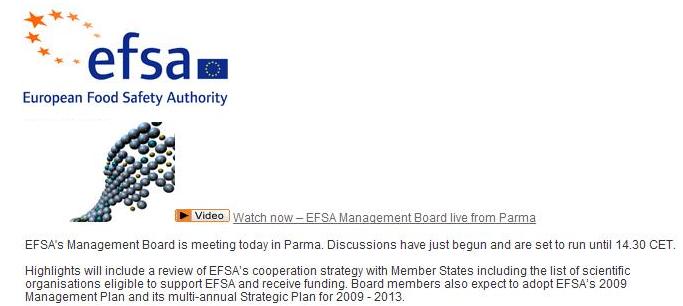
The European Food Safety Authority, an independent agency funded by the EU, held its Management Board meeting yesterday, and allowed anyone to follow it via a live stream available from its homepage.
Sure, there are plenty of “so whats?” Showing its meetings might just be a ploy to highlight its independence from the EU, and who know what takes place at other meetings. And food safety is probably not quite as contentious as other issues being discussed at a European level (CAP, finance, budgets, enlargement, security and so on). In any case, I was impressed that they made the effort – it’s not as if anyone was twisting their arm (I assume) – and hope it’s the start of a trend.
Trade associations should make more of their websites
Trade associations mainly serve their members by: 1. keeping them informed of developments in Brussels; and 2. lobbying and communicating on their behalf. Both these functions could be developed considerably through the smart use of online tools, even by the most cash-strapped association.
If you look at pretty much any Brussels-based trade association’s website, it’s immediately apparent that they’re not making the most of the tools at their disposal. I picked about 15 associations from Euractiv’s list of Euractors and looked at their sites, and apart from a few exceptions, they all use their sites to: present their mission statement, structure, board and secretariat staff; describe their industry/sector and activities; publish press releases; and promote their events and publications.
This is really a wasted opportunity. Here are three areas within which I think they should be adopting more web tools (measured against an association’s priorities and activities of course):
Publications Sites tend to have a list of publications and an order form, but more should be done to make the content accessible. If the publications are intended to be read by as many people as possible, but the association is not that interested in making money off them, all should be made available as eBooks that are easy to download and easy to forward. If the publications are meant to make money, I think they should be published on Google Books, where users can read but not download, allowing them to verify that the content and quality matches their expectations. This would not deter purchases: nobody would read a whole book online, and most buyers want these type of books for reference, available from a nearby book-shelf at their whim.
Events Most associations host events and yet their sites only tend to promote them and nothing much else. Where’s the integration? Following events, a lot more material should be made available and promoted (podcasts or videos of attendee interviews, presentations), and it should be really easy to spread. Getting this material isn’t difficult. A simple dictaphone or basic handheld camera is enough. Editing can be done for free (Audacity for audio only; Window Movie Maker for video), and hosting can be done on free web platforms like YouTube. What’s the point? It extends the lifespan of an event; it improves outreach and gives attendees a record of what they saw.
Plus seeing as associations place such value on events, I’m guessing they’d like to host more of them but can’t afford to. Why not move them online? One big annual conference and four smaller online events, with all the functionalities of a “real” event other than the coffee breaks (presentations, Q/A?). This is not expensive or difficult to set up, and could potentially attract more attendees than live events (no travel).
News Presumably, most associations have a newsletter, email updates, maybe some activity in members only areas that we can not see. Nevertheless, I’m pretty sure they’d want to be doing more. I’m guessing many members feel daunted by anything emanating from Brussels, and the trade association’s role as a knowledgeable gatekeeper of news and other information is vital. What could they do? Very few trade associations use a blog to update members or anyone else who might be interested with material that is in the public domain, it seems. I think near-instant updates via a blog could be invaluable, much better than email updates, which get lost in cluttered inboxes, or newsletters, which require a certain number of articles. The advantage of blogging in this respect is that you can report just one story at a time, whenever you want, and all stories are stored in one place. And the blog can be short – “check out this really important document” (publicly available only of course); or longer – “we attended a hearing at the Parliament this afternoon. Points X, Y and Z were raised. We’ll be doing A and B”. And if members really want the news in their inboxes, they can subscribe to blog updates via email.
As for news aimed at the press, associations’ press rooms are usually very dull, containing little more than basic info and press releases. Far more could be done at little cost to both spruce up the content and improve reach. Like what? For starters, linking to other relevant stories on the web (a site should be a source for more relevant content than that which you write yourself), short video clips, easy bookmarking to make it easier for people to spread and find material, and RSS, so that users can request updates in a reader or via email. Some of these things, like enabling bookmarking and RSS, take minutes to set up and are free.
_______________________________________________________
Of course, online communications goes a lot further than this. There’s online monitoring, social media engagement, pay-per-click advertising, eCampaigning and so on. These tactics would probably be a step too far for most trade associations given their scope and resources, but they have no excuse for not taking advantage of a number of cheap and cheerful web tools that could really add value to their work and delight their members.
Selling social media
I just came across a good post from a few months back by Chris Brogan on selling social media internally. It’s marketing-focused but very relevant to all comms crowds – and I assume some people will find it interesting as I see from my site stats that my posts on selling digital to clients in PA are quite popular.
Two points stand out for me as particularly relevant as selling points to a PA crowd that is uncomfortable with social media:
- Internally, social media tools can be used to help with status information, training, project collaboration.
- Building an online social media component to most marketing and PR efforts ensures a better reach for the media created.
The point about using social media tools as an internal tool can, as Chris states, be helpful for a variety of processes. Even more importantly, it’s a lot less daunting and thus an easier sell when you say: “let’s try out this really basic tool internally (a blog perhaps?) and if we’re all comfortable with it after a few months, we can try it out on a relevant client project.” The second point is a great sell as well because it allows you to focus on regular media relations, which traditionalists of course value and feel comfortable with. So what you’re doing is not selling social media as something new and different, but as a set of tools that can add value to your traditional media relations by improving reach and quality e.g. a good 30 second YouTube interview with the person quoted in your press release .
 Steffen Moller