Nuclear energy debate: it's in the angle

An organisation called Forum Nucleaire, made up of a number of  companies that invest in nuclear energy, has launched a campaign aimed at kick-starting a debate on nuclear energy in Belgium.

Their angle is unusual. It’s not, as one might expect: “nuclear is cheap, nuclear is clean, nuclear is not dangerous if safety standards are adhered to, oil is a lot worse, we rely on Middle-East or Russian oil, and in any case – it’s running out.”

Instead, they highlight that the debate is a complex one and acknowledge that there are good arguments on both sides. By doing so, they are hoping that people will want to learn more and make an informed decision on whether they support nuclear energy or not, instead of agreeing with the hype, which tends to be anti-nuclear.

Seems smart. Attract goodwill by opening up and admitting that there’s a viable position which does not necessarily support your commercial interests. And seek to raise the level of debate so that it is more rational (without presenting a rational view).
Learning from Obama: Labour and Tories online

Thomas Gensemer, a consultant who worked on Barack Obama’s online strategy during his campaign for the Presidency, talks about Labour’s and the Tories’ online offerings in this short clip.

The two key elements to take away are:

  1. The need to be authentic and have something to say: it’s not about the technology (it never is) but how it allows you to share a message or contribute to a conversation. This is a lesson for anyone engaging in political, advocacy and other communications online: don’t do Twitter (or whatever) because everyone else is on it; do it if you’ve got something interesting to share, can fit it within your wider communications and remain coherent, and appear eager and honest (let others be the judge of this).
  2. Limited focus on mobilisation of activists and other supporters. The Obama campaign worked because it made it really easy for people to create, share and spread material; to find and arrange events, and so on. This got people excited and provided the Obama campaign with scores of highly active volunteers. However, Labour and the Tories still aren’t making it really easy for their supporters to engage and get involved. As Gensemer puts it: it isn’t easy to find “5 things to do” on the sites, although all the elements are there somewhere. They should be the centrepieces of the sites however, not an afterthought.

Comparing the EU blogging platforms

EUobserver have taken a leaf out of Euractiv‘s book and launched a blogging platform. It looks nice, but I’m not sure they’re going about it the right way. As I’ve written before, Blogactiv is a great resource, but I believe it could be even better if it was an aggregator that took in posts from blogs set up elsewhere rather than forcing bloggers to set up shop on the Blogactiv platform, as this no doubt alienates some bloggers (established ones in particular). EUobserver have actually gone one step further by having a by invitation only policy i.e. not even allowing people to set up a blog (unless it’s really well hidden – in which case, sorry EUobserver). This approach, plus the fact that they’re not doing anything differently from Blogactiv, I think will mean that their effort won’t take off.

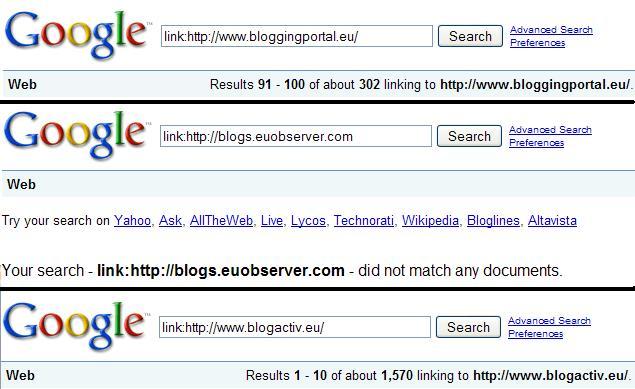
Not convinced? Blogginportal.eu is an aggregator that pulls in material from blogs that in some way cover EU related affairs. It was set up in people’s spare time, it’s still in beta, and doesn’t get any traffic via established news portals like EUobserver and Euractiv. Nonetheless, it’s been linkedblogging-platforms to 300+ times although it was launched less than a month ago (see left). EUoberserver has no link:tos yet (guess I may be first with this post – and credit, they’ve just started) and Blogactiv have managed just 1,570 in over a year.

Sure, links referring to a site isn’t a scientific measure of a site’s success, plus the bloggers whose own content is fed to blogginportal.eu (me included) will probably provide the bulk of links in the google search.

Nonetheless, I strongly believe that the aggregator approach will win hands down in the long run.

Redefining pharma: GlaxoSmithKline take the lead

GlaxoSmithKline have pledged to cut prices of their pharmaceutical products in poor countries, to pump profits back into medical care, and to share details of patented products. This is an amazing development, but frankly, it’s bizarre that no pharma company has done anything like this before.

So why have GSK done it?

  1. Let’s give them the benefit of the doubt and acknowledge that maybe they’ve done it in part because it’s the right thing to do.
  2. In the long-run, it might very well be commercially rewarding. When most people think pharma, they think profit-driven behemoths. What a waste, given that it would be so easy for pharma to develop a positive image of itself. After all, it has played a large part in developing the standard of life we all take for granted; it’s an industry that cures diseases, prolongs life expectancy and saves lives. Who else can claim that? By being the first to make this sort of pledge in their industry, GSK are carving out a position for themselves as the “nice guy” of pharma that may very well stick for decades, even once the others have caught up. In an age where people expect companies to be ethical and to give something back, this will mean that plenty of people will pick GSK over their competitors when purchasing a product or making an investment.
  3. As mentioned in the Guardian article linked to above, the open-source approach would likely improve R&D by allowing the best minds to work on products simultaneously no matter where they work, rather than keeping everything in-house. It’s worked in the software industry, why couldn’t it do so elsewhere? So others might have access to GSK’s trade secrets, but GSK will improve their products and as the “nice guy” of pharma will be most consumers’ brand of choice.

Hats off to GSK, and let’s hope other pharma companies follow suit immediately rather than trying to fight it off for as long as possible. They’d only be postponing the inevitable.

Retailers setting the standards

I was told today that a German supermarket chain refuses to purchase fruit and vegetables unless they contain 70% fewer pesticides residues than the maximum residue levels recommended by the EU (looked it up and it seems it’s more than one.)

It’s easy to see why they do it as it’s a win-win for them. While their customers appreciate that they are looking out for them, they don’t actually lose out on any count: in the case of massive retailers, as supermarket chains tend to be, the pressure is on the suppliers to provide whatever they want, at their own cost.

Some observations:

  • It seems that retailers are increasingly “showing that they care” by going beyond what regulation requires of them.
  • In doing so they are dictating the pace of regulation, meaning that rather than play catch-up with regulation, they are setting the agenda. Regulators want to show that they care as much as a voter’s local hypermarket and so often step up to ensure that stringent regulation is put in place that matches that which retailers are doing. And the cycle continues.
  • As mentioned above, it’s easy to see why they do it: 1) consumer sensibilities being what they are, retailers need to show that they care about their concerns – health, safety and environment above all; 2) most of the cost of this falls onto suppliers who dream of getting a deal with Tesco or Carrefour etc. and will do whatever it takes to please.

Is this a good thing? Potentially, yes. The highest standards for health, safety, protection of our surroundings and so on is pretty high on most of our wish-lists. However, it’s easy to see this getting a little out of hand i.e. a little too political. I don’t have a dozen case studies at my fingertips, but returning to the example from the opening paragraph, I know that maximum residue levels for pesticides in fruit and veg in Europe are the lowest in the world already, and that lowering them by a further 70%  raises all manner of problems for farmers expected to provide enormous quantities of high-quality produce.

Moral of the story? The big retailers are arguably one of the major players in shaping the current regulatory environment: they can potentially do a lot of good, but they should act responsibly rather than as if they were trying to win a popularity contest.

Obama: not losing the online momentum

white-house-site4 Yet another Obama and the web post. Zzzzzzz. Many apologies, but the subject matter is too good to let go.

Much has been said about the positioning of the blog on the White House website. It’s right there, in first place in the first submenu (see image). It’s nothing more than a symbolic gesture however as the blog only informs and does not do what a “real” blog does (engagement via comments or trackbacks, references to other blogs etc.) And I understand that: their blog is for information purposes only; the White House can’t suddenly start blogging as if they were a political commentator, it’d be ridiculous, inappropriate, totally out of their remit, time-consuming and bound to get out of hand.

No, what really shows that the Obama administration gets the web is what’s still going on on barackobama.com. In addition to an exceptional candidate, the success of the campaign for the Presidency was based on two factors which were both web-enabled: 1) mammoth donations; and 2) mobilisation of supporters.

The latter is still taking place via the site, as people can meet likeminded supporters, organise events, find events near them, all via the site. That’s what makes it special: it’s not the fancy web gimmicks, it’s the grassroots mobilisation on the ground that’s being enabled simply by making the logistics easier. Seems basic, but it’s pretty revolutionary in a sense: everyone had assumed that people were too busy and politically apathetic to engage in participatory politics, but that was plain wrong – all they needed was a leader to rally around and the organisational aspect taken care of somewhat.

What’s more, the Democrats are now being far-sighted enough to build on the momentum from the campaign by keeping it going rather than resting on their laurels. Good for them.

Reputation management in a day

The smart people at We are Social had an interesting post up describing a conversation that took place on Twitter about their client (@stephenfry). It was claimed that he didn’t write his own tweets, which he in fact does, but within a day the whole thing had been cleared up and the person making the claim, none other than Robert Scoble (@scobleizer), had retracted the claim and apologised.

How? We are Social were scanning Twitter for comments about their clients, caught the relevant tweet, responded on Twitter immediately, and Scoble obviously did the right thing and apologised. Case closed.

This incident is a great case-study in how effective monitoring and quick reponse via social media can speed up reputation management. Of course, in this case all people concerned actually work in social media, which helps, but generally, social media monitoring and rapid response is becoming part of the communications mix for a number of organisations and politicians, in an attempt to nip untruths and other damaging stories in the bud. On the political front, Barack Obama’s presidential campaign was, as ever, at the forefront with Fight the Smears.

And if we look into our crystal ball?

  • All organisations and politicians will have a social media monitoring set-up as well as a social media presence which will permit them to address issues directly and instantly.
  • Reputation and crisis management will be web-led.
  • PR agencies or even internal comms teams dealing with reputation and crisis management will be given a lot less time to clear up the mess..!

Twitter is an AMAZING learning tool

I’ve blogged about Twitter a few times, but have only really started using it a lot over the last few days (@steffenmoller). Although I’ve banged on about the value of Twitter as a learning tool – i.e. you hook up to the right people who share your interests and they provide you with insights and links that you wouldn’t have found yourself – I’m amazed by the extent to which this is the case.

I use Netvibes a lot, which allows me to view the latest posts and updates from a variety of blogs and news sites (100+). I update it regularly by adding new blogs and love it, but I have to say I’ve read far more interesting material over the last couple of days via links and hints from people I’m following. And I’m only following 28 people so far: what will it be like once I’ve found hundreds if not thousands of people that I want to follow? I think today is the day I really understand what all the fuss is about and think Twitter has raised the bar for how professionals of the future will be expected to interact and the knowledge they’ll be expected to possess.

The might of Greenpeace

Another tale heard this week that’s worth sharing. Greenpeace campaign against overfishing in Europe. Beyond the risk that we’ll actually run out of fish, overfishing is a bad thing as it upsets complex marine ecosystems. However, these same ecosystems actually also rely on fishing to keep numbers of some fish to reasonable levels. If there are too many of a certain species, that also places marine life at risk. So there’s a delicate balance to be maintained.

And that’s where the interesting element of Greenpeace’s policy comes into play. Although they campaign against overfishing in Europe, they deliberately tend not mention any particular species. They’ve gathered that they have so much of an impact on European consumer habits that were they to declare that any particular species were at risk, the demand for it could drop so dramatically that fishermen would stop fishing for it. Result? A swing the other way –  and a marine ecosystem at risk because of too many of a particular species just a few years after an outcry over too few.

An interesting story, which highlights:

  • The might of Greenpeace. What they say and do really does have an impact.
  • How long the aftermath of a scare-story can linger. Once numbers have levelled off again, Greenpeace could easily say “it’s OK, you can start eating it again.” But that story isn’t nearly as interesting and wouldn’t gain any coverage compared to “fish X at risk; stop or else”. As a result, the latter would linger on for far longer than needed.

Lobbying at its most intriguing

A friend told me a story this week which gives some real insight into how sly lobbyists can be. A few years ago in California, Toyota and the US big 3 (GM, Ford and Chrysler) lobbied hard against stricter regulation governing emissions. This seemed odd at first. Toyota have spent years and billions in developing cars that produce fewer emissions – surely they’d want stricter emissions regulations as this would enable them to exercise their competitive edge?

Not quite. As ever, Toyota are a forward-thinking company (see my previous post):

  1. They understood that they have a competitive edge over the big 3 globally because they produce cars that are more environmentally friendly.
  2. They understood that the prospect of losing out on a huge market like California might finally move the big 3 to start investing more in hybrid technology and other less petrol-guzzling alternatives.
  3. Conclusion? They prefer having to compete with the big 3’s SUVs in California than have them invest in R&D which might in a few years make them viable competitors in the global hybrid car sector.

That’s clever. What I’d be curious to know is:  Toyota and the big 3 presumably sat down and co-ordinated their efforts at some point. Did the big 3 know they were being duped? And could the Toyota execs and lobbyists keep the smirks off their faces?