Three angles favoured by corporate communicators (which don’t work)

I’ve often heard corporate communicators representing organisations under attack cite one of these three approaches and declare that they’ll turn a corner as long as they aggressively pursue it:

  1. No one understands what we do. “We’ve been too quiet and have not explained exactly what we do – when people understand how we operate, they’ll be supportive.”
  2. Fact vs. fiction. “There are too many falsehoods being perpetuated by critics. We need to rebut these far more actively, ideally using 3rd parties.”
  3. Draw a line the sand. “By being too quiet, we’ve let critics get away with murder. Enough is enough. Let’s send in the artillery and attack the opposition.”

The truth:

  • 3 is unlikely to work: belligerence makes things worse.
  • There’s nothing inherently wrong with 1 and 2, but they don’t work in isolation. If both are practiced simultaneously, and with great skill, they’ll buy some time.

So what does work?

  • If 1 really is true i.e. “no one understands what we do”, a campaign outlining how the organisation operates is not enough. There are probably deeper cultural realities that need addressing: why does no one know what it does? Presumably, they’ve appeared secretive, conceited or combative over the years (possibly all 3). Beyond information provision, a more deep-rooted change in tone and manner is vital: transparency, humility and a willingness to answer questions need to be palpable, with real people at the forefront, not just the polished spokesperson.
  • If there is no truth at all in 1 i.e. if the organisation in question operates in a space in which no amount of cultural change and information provision can improve a damaged reputation, the communicator is fairly powerless. Reputational enhancement can only come about through significant business change i.e. dropping an unpopular product or service, or adapting the operating model or parts of the supply chain. Clearly, these sorts of big decision are C-suite remit and thus (usually) beyond the communicator’s jurisdiction. Unless real change is likely, the communicator is left fighting fires and attempting to stall the inevitable.

Digital Public Affairs services: 3 + 3 (seen vs. unseen)

I developed the digital public affairs wheel a couple of years ago, which does a decent job of summarising how digital can support the three main components of execution in Public Affairs i.e. intelligence gathering, message delivery and relationship/coalition building. What it misses is the background stuff i.e. the unseen work which makes the execution actually work. To this end, I think the following 3 + 3 split works quite nicely i.e. you still have the execution (the “seen”) but in parallel we have the “unseen.”

digital public affairs

“How would we target a digital audience?”

Heard recently: “how would we target a digital audience?”

Although there’s far more overlap these days, most communications specialisms still focus on an explicit audience: public affairs on stakeholders who impact policy-making, brand marketing on end-consumers, and so forth.

But there’s no such thing as a “digital audience.” Digital is horizontal, straddling every communications discipline, and should therefore be ingrained in each.

The fact that the question is still asked, however, helps to explain why some communications professionals still feel comfortable omitting digital from their toolkit: if a “digital audience” is something entirely different, it’s for someone else to worry about.

The work you wish you’d done

A thought raised by a colleague in a meeting earlier this week: “why only show our own case studies? Let’s also showcase the work we wish we’d done.”

I like this. Sure, it’s someone else’s work, but you exhibit the following by showcasing it:

  1. You’re curious enough to look beyond your own backyard
  2. You’re humble enough to admit others might have done it better
  3. You know where to set the bar for excellence (and presumably, it’s the bar for where you want to go)

What’s the work I wish I’d done?

Here’s a start:

Making digital work in Public Affairs: hold off on campaigning, focus on government relations for now

What should the Public Affairs professional seek to do? Two things mainly:

  • Help build solid relationships with policy-makers through the practice we call government relations – and ultimately try to gain their support.
  • Try to shift the pin on issues more broadly i.e. get public opinion on side so that government relations becomes less necessary (in theory, at least).

Usually, digital is seen as part of the toolkit for the latter i.e. “shifting the pin”.  And for good reason: it’s got unlikely candidates elected to political office and it’s made poorly funded activist campaigns take off and beat the big boys. It’s quick, access is mostly free and it’s ubiquitous. It’s a great storytelling medium and it’s the best and most cost-effective mobilisation channel ever devised. It’s TV, radio, telephone, water-cooler and soapbox in one.

What’s not to love? In Public Affairs, especially in Brussels, two things:

  • Plenty of Brussels dossiers are technical and don’t interest that many people, so there’s actually no pin to shift.
  • More importantly, even when there is pin shifting to do, structural issues within organisations get in the way. The Public Affairs function tends to cover government relations and little else and has the people and budget to do just that. Unfortunately, shifting the pin takes a variety of skill-sets (campaigning, creative type stuff etc.) which organisations may have collectively somewhere amongst their marketing and communications people, but not in PA. Plus it costs lots of money: usually far more than PA folk are given.

Is this a long-winded way of saying that digital in PA is obsolete? Not quite. I would argue that without the right people and budgets, there’s no point in trying to shift the pin. But sometimes the right people and budgets are available, and down the line, when we’ll see PA and other marketing and communications functions at the same table, there will be an upsurge in shifting the pin type activities.

While we patiently wait, I’d focus on where digital can support government relations. It doesn’t have to be big and flashy, but it can help drive an agenda. How? I’d centre on three things in particular:

  • Highly targeted content which mirrors what the government relations team is saying and doing. We’re not talking fluffy content stating that organisation X is saving penguins 5,000 miles off, but rather, exactly the same storyline recited to decision-makers but told through an alternative channel. Then ensure it reaches the intended audience through highly targeted paid media i.e. search engine and social advertising.
  • Social media (Twitter mainly, but possibly also LinkedIn and at some point Facebook, depending on the issue) but only when used as an alternative channel to engage with main targets. If they i.e. policy-makers and key influencers aren’t active, don’t bother: social networking for GR purposes is useless if no one you care about is at it, clearly. And get people who build offline relationships to replicate online i.e. don’t hand it off to the intern.
  • Use a listening platform to do three things: learn more about your targets’ constituents, track stakeholder activity so you know you’re picking up the vital exchanges for social media engagement, and track uptake of your GR activities (see my previous post for further details on this.)

Online listening and government relations

In government relations, online listening is often only used to conduct traditional media monitoring. I’d argue there are other ways of using online listening platforms that are more directly related to GR activities, such as:

Pin-point research

For instance, when looking to carry clout with MEP X, assess the issue, company or sector’s saliency in their constituency by carrying out searches specific to that constituency only. Who is talking about it? What’s trending? What’s the prevailing sentiment? The insights can be used to target more narrowly.

Tracking a select group of online stakeholders vs. key issues

“We only care about max 100 people,” GR professionals will spout: a small hotchpotch of politicians, officials, media, analysts etc. In addition, they only care about the 100’s view on the few issue(s) that matter to the organisation in question. Given this, online listening is deemed too broad to be of interest. In this case, set up alerts to be notified only when any of the 100 mention the organization or any of the issues of interest. It’ll probably only be a few times per day if that, but will allow you to cut through the clutter and pick up highly relevant material only.

Identifying new influencers

Maybe it’s not just 100, but 101? But the 1 you’ve never heard of because they’re a new online influencer based beyond the usual sphere of interest, and yet they’re communicating around your issues and appear to be increasingly influential. Listening platforms will allow you identify them.

Assessing the impact of own activities

By aggregating mentions of terms, online listening platforms can help determine trends over time: people spoke about company X & issue Y this much in June, but less so in July. And so forth. If you’re trying to convince Brussels and a couple of national capitals of something or other through GR, you can track the impact you’re having by measuring trend development even among a highly select group. For instance, you’re spreading “message x” in Brussels and 3 national capitals. Use your platform to track the diffusion of “message x” in Brussels and the 3 national capitals week by week, and only among the select group of stakeholders you care about. And in contrast, track the rise/fall of your opponent’s “message y”.

NB: listening platforms can do lots more, but the thoughts I list relate strictly to supporting the government relations function. 

5 core components of digital PA

digitalPAvisual

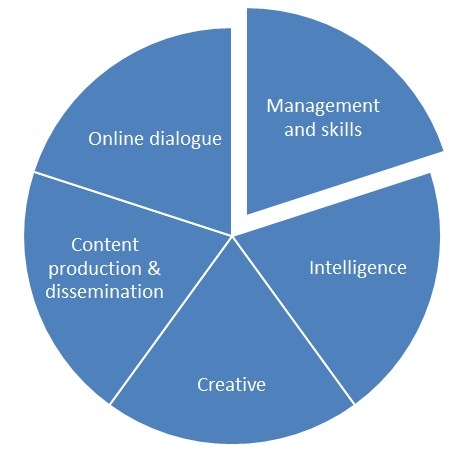
Last year, I produced the digital PA wheel, which, building from three core components of traditional public affairs (intelligence gathering, information provision, relationship building), showed how each can be supported by a variety of digital and social channels, tools and methods.

While I still think the wheel is valid, I think it’s missing a few things, and will be developing the visual on the left further, resulting in an updated digital PA wheel (or matrix perhaps.)

What’s different now?

Management and skills

All organizations are affected by the speed and ubiquity of social media. All functions within them, including public affairs, will require new skills and processes, and sometimes updated technology and resourcing, in order to manage. Although not strictly a communications discipline, a competent digital public affairs professional should be able to advise on how the PA function should adapt. In the commercial world, the term social business is usually applied to describe this area of digital and social competence.

Creative

In PR and corporate communication, digital often owns creative. Not sure whether it’s because creative output channels are frequently digital, or perhaps digital types tend to be more comfortable with creative simply because they have embraced a medium that is manic and unkempt, much like the creative process. Or perhaps no one else wanted it.

Creative has tended to be imbedded in content, and although I think content is its closest ally in the mix, I think it deserves a separate category. Developing a creative concept, whether for a single visual or catch-phrase, or a full-on campaign, should not be an afterthought, even in PA. For starters, the process should involve multiple iterations, concepts should be underpinned by data, and they should be tested. And although process can’t produce creativity, organizations should have a method, from how they structure a creative team through to how they brainstorm, plan and implement.

Intelligence beyond monitoring

Although not detailed in the visual above, intelligence in PA should go beyond monitoring, which has tended to be the core of the offering. Granted, it remains key, but the multiple new tools and methods we have at our disposal to collect and break down data can provide ammunition for the PA professional, from influencer identification through to identifying data that will enable tailoring of message almost per single audience member (e.g. data specific to a decision-maker’s constituency?)

New content formats ≠ creativity

Scores of PA professionals are creative now, it appears, given that they film talking heads or ask a designer to decipher some data and represent it in visual format.

There’s a discrepancy between creativity and publishing in content formats that traditional audiences aren’t accustomed to, however.

By all means, experiment with new content formats, but creativity doesn’t lie in format, but rather, in developing a smart, relevant, snappy, memorable, thought-provoking and possibly funny (depending on the subject matter) creative concept. If it’s good, it can be translated into whatever format you want, whether in written, spoken or visual form.

In short, the creative process is not deciding on a content format, but rather, developing a creative concept, and it will likely be a lengthy, arduous and frustrating process.

Online grassroots campaigning to support Public Affairs: once overhyped, now largely ignored

Even just a couple of years ago, a fair few people in the Brussels bubble were getting excited about the prospect of online grassroots campaigning.

Their logic was as follows:

  1. Regulation increasingly reflects public sentiment
  2. Public sentiment lives beyond the bubble
  3. Being able to showcase public support in member states is thus key to success
  4. However, building, showcasing and/or somehow aggregating support is very difficult
  5. The web is by nature cross-border and quick: a silver bullet for mobilisation, surely

The concept is no longer in vogue, given that, clearly, it was highly unrealistic in the first place: the assumption amongst a fair few PA pros was that there are people out there willing to be mobilised on any issue overnight as long as you looked hard enough.

This ignores the following:

  • Many organizations are either too unpopular or too obscure to rack up support overnight
  • Many regulatory issues are highly technical, making it difficult to create a “narrative” that makes mobilisation realistic
  • What’s more, even with suitable issues, many decisions will likely be based on consensus rather than who has most friends, especially if the Commission is the key player, making the whole premise pointless in the first place

BUT (and it’s a large BUT) that’s not to say there aren’t instances where it can be very valuable to showcase support or that it can’t ever work:

  • It can if the issue has a very clear public interest angle and the EP is a key player e.g. see the recent fish discards campaigns
  • Clearly, if an organization is popular, it’d be easier to drum up support
  • And in some cases, mobilisation can even work for an unpopular or obscure organization if it goes about it sensibly i.e. keeping expectations realistic and giving it time; and usually focusing on a single key constituency, rather than “general public”

As a side-note, personally, I’m pleased people aren’t seeing it as a silver bullet any longer. On one level, it shows we’re moving from hype to maturity. On another, it means investments in digital PA are being funneled into areas where it is more likely to provide a real benefit, such as analytics, content strategy and search.

What Public Affairs could learn from Borgen

To anyone who hasn’t seen (or indeed heard of) Borgen, you’re missing out. Think The West Wing but better: the characters are compelling yet not all exactly the same as on TWW i.e. bright and fast-talking yet quirky, high-strung and useless at personal relationships. Plus it lacks the syrupy moments featured too frequently on TWW.

What could Public Affairs practitioners in Brussels learn from Birgitte, Kasper, Bent et al?

Reflect public sentiment

PM Nygaard succeeds when her views are somewhat reflective of prevailing public sentiment. However many times they fail, some Public Affairs practitioners still believe in wars of attrition: say it enough times and you’ll wear them out and win. Doesn’t work that way: you need to show your world-view is the prevailing one – or at least that you’re moving towards it – not just repeat insular clap-trap a thousand times.

Put yourself about

Whenever our heroes need to win an argument, they raise the noise levels and put themselves about, usually starting with a feature interview on the fictitious TV1. Public Affairs folk take note: don’t hide in case you put a foot wrong, or think everything is decided face-to-face. Get out there.

Timing

In Public Affairs, things are often put off, even when the legislative calendar makes it pretty clear when stuff should happen: “we need to consult everyone before we decide on anything: we’ll do so at the next meeting” (in 3 months’ time). In Borgen, Birgitte and her band of merry men and women meet at any time, day or night, and put a plan into action there and then.

Express emotion not “messages”

I’m tired of “messaging”. Birgitte doesn’t always need it, why should we? She often wins by talking from her gut and showing emotion.

Hire smart communications people

Kasper, the brilliant sidekick, is a comms guy. He gets policy inside out but his job is to package it. In Public Affairs, comms is frequently treated like an afterthought or left to the most junior person in the room (if they even get into the room in the first place).

Leave the Bubble

In an early episode, Birgitte visits Greenland, and only then truly understands the issues facing it. Who says Public Affairs folk can’t leave Brussels once in a while and visit local communities, factories, trade unions, churches, farms etc. and get a sense of real world issues?

Work with opponents

Our crafty protagonists will often work out deals with parties or individuals that in no way share their world-view in order to get things done. In Public Affairs, we often refuse outright to even acknowledge the other side, let alone work with them on compromise measures.  More of it please.