Fish and LinkedIn

Short post. My colleague Aaron – who loves fish (policy, not eating it, he’s a devoted vegetarian) – sent a note around this week stating that he had found scores of groups on LinkedIn that discuss fish policy. He heartily recommended that everyone look up their issues on LinkedIn and see what sort of discussions were taking place, and who was involved in them, as it was a great way to follow developments and build relationships with people who matter.

Hear, hear.

I’d take it one step further. If there are no existing groups (or the existing groups are run by dim-wits), set up your own. It requires a fair bit of work to keep it going and to attract lots of likeminded people, but it may very well be worth it.

Pet hate: “there’s no digital element in this”

There always is. ALWAYS. And thanks to input from my clever colleagues, Aoife and James, from now on, in order to make this very, very clear, I’ll explain digital to PA crowds solely in terms of how it can be used in support of traditional PA activities and will always avoid supposed jargon like content and engagement.

Meaning what? Summarising PA very neatly in 4 categories – i) getting your message to policy-makers and influencers; ii) building relationships with policy-makers and influencers; iii) building and mobilising alliances and networks of support; iv) intelligence monitoring – I’ll then move on to explain how each of these four categories can be enhanced using a variety of digital tactics.

Fingers crossed it’ll get more of the nay-sayers onboard.

PA pros: search engines and referrals 101

How do people discover stuff? Educate themselves? Make up their minds?

Ever increasingly, they:

  • Use a source they know and trust (a magazine, daily paper, website, whatever)
  • AND they use a search engine to look up whatever it is they want to know about
  • AND they read (or otherwise consume) whatever their peers recommend, increasingly via online recommendations (Facebook, Twitter, Google+)

Yet PA dinosaurs will often feed you variants of the following: MEPs only care about the FT, they’ll only listen to you if you get face time, policy-makers don’t trust the web. And so forth.

No.

80% of MEPs use interest group websites and 99% of MEP offices conduct research on policy matters using a search engine. Would you not want them to find your stuff? There are things you can do to help ensure that they do. It involves something collectively known as Search Engine Marketing.

Scores of MEPs (and their assistants) are avid Twitter and Facebook users. Their friends and followers include people who work in the same areas they do. They trust these people, so when these same people post something or recommend an article (i.e. referrals) they take note. Would you not want them to be recommending your stuff? Well in that case, make your stuff really interesting, and make sure it can be shared with ease.

There are policy folk on Twitter, I promise

At the risk of sounding like an anorak, I get a kick out of asking PA professionals how many of their “stakeholders” are on Twitter, hearing them say “none” and then asking them for a short list of their most important “stakeholders” i.e. MEPs in relevant committees, commission officials in relevant DGs, relevant people at perm reps, in the media etc.

Shock horror, we then discover that many of them in fact are on Twitter. Some even use it properly. They follow and are followed by lots of their peers in their same sector. They are active every day. They ask and answer questions and provide information (and want some in return).

So once again: if you’re a PA pro, following the right people on Twitter and generally being interesting and/or relevant will provide you with access to lots of people who matter, it may make them like you, and what’s more, it will supply a stream of information that you might only get elsewhere the following day.

I’m proud to say FH gets it, but once I leave the building, I shan’t be holding my breath.

15 consequences of multiple channels (media fragmentation) for the communicator (yes, Brussels too)

  1. Greater audience fragmentation (i.e. audiences get their information from more channels than before)
  2. More “competition” to get message to target audience i.e. far more material available from a variety of sources
  3. Audiences are arguably better informed than before
  4. More content production required
  5. Publication on multiple channels required
  6. Greater differentiation of output (content complexity and length, channel type, style, tone) required
  7. Mass marketing / spray & pray doesn’t work
  8. Harder to stay “on message”
  9. More people have a voice thus more people “matter” e.g. think Wikipedia edits, not just pesky bloggers
  10. Greater need to respond to challenges, comments, questions etc. = time, effort + risk
  11. Less prep time for responding
  12. Responses required in different fora, in different tones, and the communicator needs to sound like a real person (shock, horror)
  13. More complex to monitor noise
  14. More complex to measure
  15. Different media training required

(Perhaps it’s not surprising that some PA professionals stick their head in the sand and refuse to admit digital is relevant.)

PA and digital: five questions (visual)

I developed this simple visual for the introduction to an article I recently wrote for the EACD (to be published some time this autumn). The point here isn’t to answer the questions in detail: in short, the answer to all is yes. The point of the visual is to (once again) state that digital is relevant across the field, whether you’re doing “traditional” PA which is heavily government-relations centric (i.e. lobbying and related activities) or you’re embracing a wide-ranging approach to PA that includes further elements of the communications suite.

(p.s. apologies, realise the light green text isn’t clear – looked OK in word and on paper).

Brussels policy blogging: don’t bother if…

There’s a real shortage of blogs that deal with a specific policy area, written by experts in that same area operating in Brussels. Given this dearth, given that policy-makers use the web to inform themselves on policy issues, that a blog is a highly flexible medium that allows for anything from a short two-liner to a full-on analysis, that a blog can allow for an ongoing narrative that no other medium could allow for, lots of organisations trying to communicate their views on a variety of issues are losing out by relying only on tried and tested position papers, meetings and the like (I’ve previously written about the reasons for the shortage of policy blogs in Brussels over on Public Affairs 2.0 – if you click through, I recommend that you read the comments too.)

Still, some blogs do get launched, and in this post, rather than argue for more policy blogs, I’d like to make another point, possibly born out of the frustration at seeing a number of valiant efforts fail. Despite the undoubted value of blogging – if done well – don’t even bother if:

  • You aren’t allowed to talk about anything interesting (or don’t want to, or can’t legally do so.) You work on topical and/or contentious issues and have views, so EXPRESS THEM: that’s what people care about. Blogging about your CEO’s pet CSR initiative and about how useful your product or service is a waste of time. It’s not going to “educate policy-makers and their influencers” – it’s going to make them never ever visit your blog again.
  • No one can really be bothered to write. Blogging sounds like a good idea, you sort of see the value, but you sure as hell aren’t going to write; nor are any of your colleagues. A blog needs to be fed regularly and requires an author (or authors) who are real people and who represent the organisation. Yes it’s an effort; yes it’s a commitment. If you see it as an add-on which your agency can run for you, don’t bother.
  • You’re going to write in a vacuum. A blog offers an opportunity to connect to other people and sources. Whether you just link through to lots of good 3rd party content, or even better, connect to others writing about the same issues in Brussels or (more likely) at national level by linking to their content, you’ll add credibility to your blog, drive traffic and hopefully even build relationships. Just writing about your own stuff is a wasted opportunity.
  • You aren’t going to market it properly. Don’t think people will magically show up. Sure, good content is the clincher, but you need to constantly promote your blog. That can mean anything from advertising to SEO to everyone within the organisation simply just referring to it whenever they can.

How many organisations actually have the will and flexibility to avoid all of the above? Sadly, not that many (unless they’re facing a crisis.)

“All we need is more face-time with MEPs”

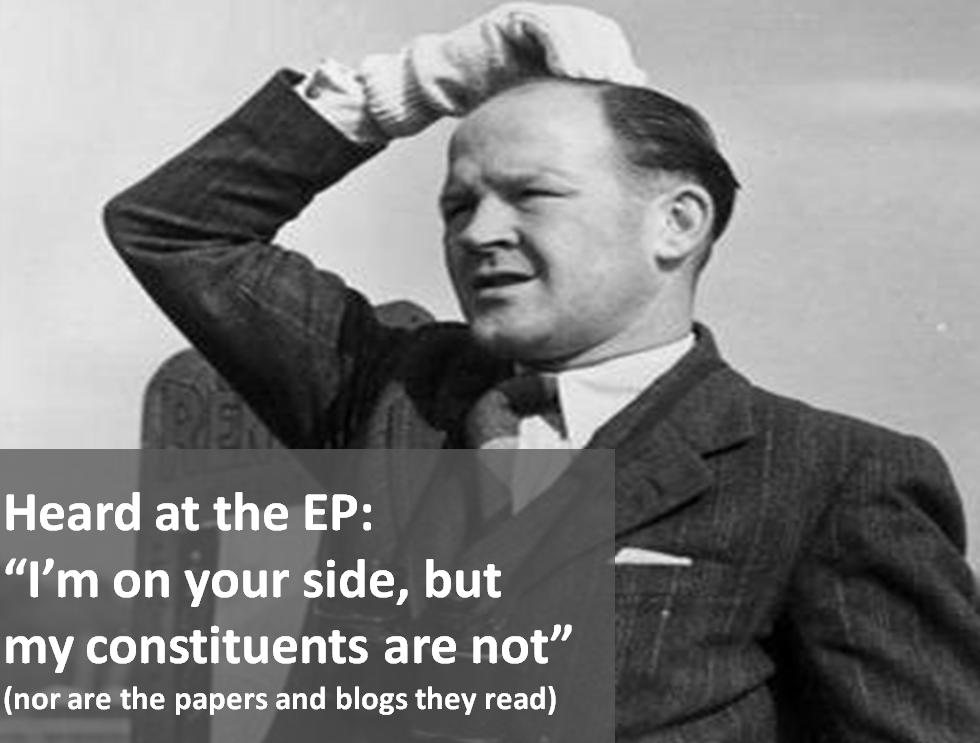
Heard this week in Brussels. Perpetrator? A lobbyist for arguably the most hated industry in Europe. When, when, when will PA professionals realise we’re in 2011, not 1981. If you’re universally loathed, many a policy-maker – even those who side with you at heart – will not care what your report says, how many people you employ or what percentage of European GDP will go down the pan if they don’t let you carry on with business as usual. And while they keep chipping away at your business, you carry on trying to get as much face time as possible and your only KPI remains “number of meetings with policy-makers.” What do you think? That they didn’t hear you the first time? That leading a war of attrition will bore them into submission? Have you thought of teaming up with your leadership, business units, corporate comms, marketing and whoever else matters to overhaul your reputation? Probably not. Your loss.

Three challenges of digital PA

I just re-read my last post and wanted to expand a little on the challenge that is PA and digital in Brussels especially. Using the full array of digital is tricky on a number of levels, of which I’d cite three in particular.

1. Limited “critical mass” on most issues

Digital is always relevant in some way. Even with an audience of 20, the 20 will use Google to access information and will expect an organisation to have good material on their website (or at least relevant and up-to-date material). So content and search are always essential.

However, the true and game-changing value of digital lies in the speed and ease of engagement, and on this front i.e. engaging on issues online, there isn’t much going on. Part of the reason is that on a number of issues, the number of players involved is tiny, and even a successful online micro-community requires at least say 30-50 people who are highly active (ideally far more). Plus the community should include a suitable array of players. On issues, this would be, say, government (national and Brussels), industry and civil society. Yet on many issues which PA professionals work on, at least one significant player will be absent online (i.e. perhaps industry and some national-level civil society are active, but no one on from the government side, or vice versa). Online engagement then becomes like a concert where a headline act has failed to show up: a bit pointless.

Another element has an impact on the limited mass on Brussels issues: the paucity of links between online conversations at national and EU level. I’m not going to get into why it’s the case (language, parochialism, basic lack of knowledge of what others are doing etc.) but the fact of the matter is that if PA issues were seen in a pan-European light, digital might offer a platform for broader conversations and help build up critical mass. As it stands, Brussels issues too often remain Brussels issues, unaffected by activity at national level.

2. The nature of (some) issues

I’ve touched upon this in the paragraph above to some extent: niche regulatory issues discussed in Brussels are often not of interest to larger groups of people, meaning that the critical mass needed for active conversation online is simply non-existent.

The point about the nature of the issues goes a step further though. In many cases, PA professionals don’t want to or simply don’t have the consent to engage on issues “in public” – which the web essentially is even if a conversation is confined to a micro-community. And it’s not because they’re shady operators trying to elude the public, but because there are often complex legal, competitive and political ramifications that need to be resolved before an organisation can go public.

3. The PA professional

I can’t count the number of times a condescending PA pro has implied that digital is irrelevant in Brussels and should be left to the marketers and consumer PR folk, the fallacy being that digital is a mass market medium. It’s not, and anyway, digital is only part of the parcel of how a broader, more integrated approach to PA is increasingly required to ensure success in Brussels (see a previous post on this here.)

However, these developments require an appreciation of and an interest in integrated communications as a discipline: the ability and willingness to analyse a wider set of audiences, to explore and utilise new channels. Too often, the PA professional does not view him or herself as a communicator, but rather, would prefer to be defined as a political scientist, policy counsellor, regulatory expert, or a lawyer even. Undoubtedly, the skills required to be any of these remain key to PA success, but on their own, they’re not enough if the people in question fail to embrace communications more holistically, whether on or offline.