Develop a content strategy to succeed in Public Affairs

As PA professionals, we know our issues. Intelligence is our lifeblood: we understand the multitude of factors which determine how an issue might progress over time, we know who’s who, and so forth. However, we’ve developed a habit over the years of going straight from knowing our stuff to delivering it. We’ve kidded ourselves into thinking we’re not like marketing, corporate communications or consumer PR folk who need to tell a good yarn.

Meaning what? That our output often isn’t adapted to our audiences. We provide a 100 page document when someone wants 10 bullet-points. We talk about clean air when people would rather hear about the economy. We try to get a meeting when our target audience is looking us up on-line.

So what should we do about it? Learn from the marketers, corporate communicators et al: use insights to better analyse our audiences, differentiate the message, develop a gripping and relevant storyline, test the message, vary the output, vary the channel. In short, develop a content strategy which turns your intelligence into a compelling narrative, and then deliver.

PA and corporate communications converging: comparing London and Brussels

One of the running themes of this blog is that PA as we once knew it – the government relations centric model – is being superseded by one where government relations lives side by side with a range of other communications disciplines. An organisation’s reputation, often beyond Brussels, is increasingly important in determining how that organisation is perceived by decision makers, as is the extent to which it is aligned with public opinion on any given issue.

However, when I was asked just last week by a London-based Public Affairs professional to what extent corporate communications and PA are converging in Brussels, my reply was: probably not as much as in London.

That is not to say that I’ve done a volte-face on the statement above. However, the extent to which corporate communications and PA converge is not consistent: it depends on the nature of the issue. The more the issue is in the public domain, the greater the convergence, and the fact of the matter is that fewer issues are in the public domain in Brussels than in London.

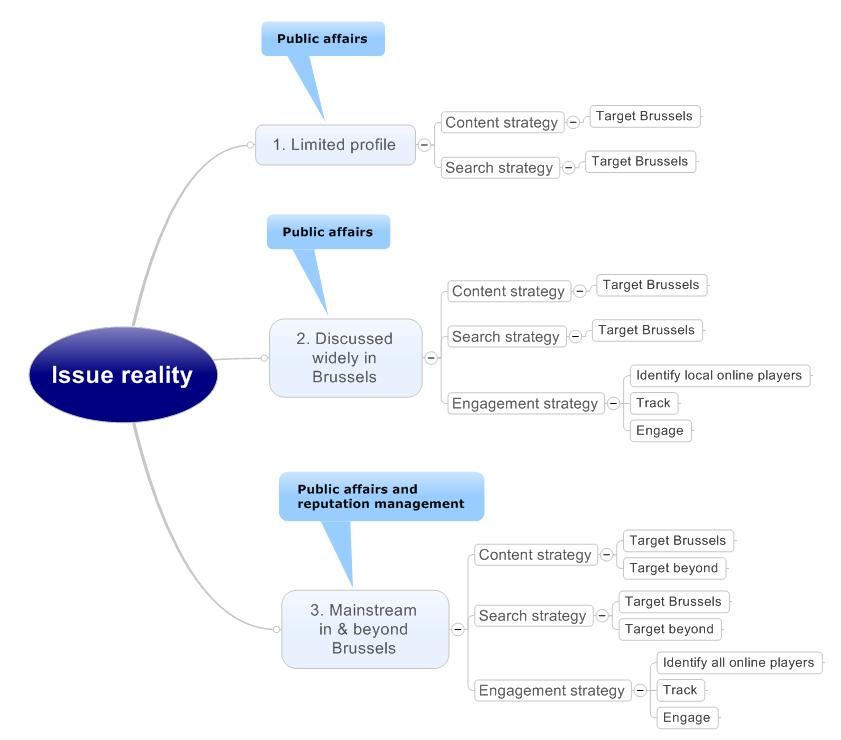
In a previous post, I outlined three issue realities and the appropriate digital response, and I think the same separation is pertinent here. The three are, in short, the very technical issue which only a few policy wonks know about, the slightly less technical issue which is being discussed widely in policy circles, and the issue which affects a lot of people and has people talking beyond policy circles.

Arguably, only the latter reality requires highly proactive corporate communications, and the fact of the matter is that more issues fall into that bracket in London than in Brussels.

Why? Generally, because there is less interest in and scrutiny of the legislative process in Brussels than there is in London. Here are a few reasons why that might be:

  • Many of the meatier issues which tend to attract public interest are beyond the EU’s remit (immigration, tax, social security, most foreign policy etc.) Instead, the EU deals with many highly technical and – in the eyes of most people – dull dossiers.
  • MEPs have low profiles nationally and in their constituencies: they don’t necessarily need to prove themselves to their electorates based on issue alignment and so probably make decisions based on facts and figures more so than their MP counterparts, who are perennially busy courting voters.
  • The way legislation is put together in Brussels is based heavily on compromise and attaining the lowest common denominator in a drawn-out process, which is frankly less interesting (slow; fewer dog-fights).
  • A red thread here is the fact that the UK media has little interest in EU affairs, meaning most stuff passes under the radar in any case.
Anything I’ve left out?

Public Affairs and Digital: 3 realities

This is how I’d summarise the realities of organisations operating in the Brussels regulatory space and how they need to apply digital, developed a little further than done in my previous post entitled Digital in PA: two client types.

Couple of points:

  • There may be plenty of overlap – an issue may be mainly 1 with a bit of 2 looming; or an organisation may be dealing with an issue that’s 1 but overall very much fit into 3 due to issues beyond the PA bubble.
  • Most organisations operating in Brussels probably think it’s all about 1 but should be thinking a lot more about 3 (read my post on the “constituent consumer”).

“We can’t do that”

Was just inspired by Nicholas over lunch. He said he’s fed up of hearing people say “we can’t do that”. So am I, so I thought I’d list some “we can’t do thats” I particularly detest. Feel free to add more:

  • We can’t do communication, our remit is just government relations (since when is government relations not communications and no it’s not your remit, your remit is success, and that might require stuff beyond GR.)
  • We can’t do digital, we’re not ready for it (well get ready.)
  • We can’t do digital, our boss/board/member is conservative (digital doesn’t have to be whacky geo-location stuff, it can just be content creation and you’ve done that for years. In any case, your audience isn’t conservative, so who cares if your boss/board/member is? Check FH’s MEP survey if you’re not convinced.)
  • We can’t do digital, our industry is conservative (so what?! Same reasoning as boss/board/member fits in nicely here too.)
  • We can’t do digital, our audience is older (we’re not saying develop an app aimed at 4 year olds on Facebook. Every demographic uses the web in some way.)
  • We can’t do digital, we don’t have internal support (prove value to them and use facts and figures e.g. the aforementioned MEP survey.)
  • We can’t do digital, we don’t have the resources (no one is saying do a global blogger engagement programme; digital is huge – start small and then scale.)
  • We can’t do digital, we only have an audience of 50 (no it’s never just 50; in any case, if it were just 50, they’ll still look you up online.)

Speaking about PA and digital: 10 things that resonate with audiences

I spend a lot of time presenting these days, both to internal and external audiences. I’m usually asked to speak about some variation of this theme: how is digital impacting Public Affairs in Brussels. Here are a few of the points which resonate most with audiences:

  • An entirely vacuous point: slides with good pictures and no more than five words are infinitely better than text-heavy slides. No surprise I guess, but it’s certainly been confirmed.
  • PA is shifting from being government relations centric: it’s embracing a broader set of communications disciplines, especially around reputation (and digital is key to reputation.)
  • Digital PA does not involve an entirely different toolkit to digital marketing or online PR.
  • You don’t need to “pick” a channel but first decide who you want to reach and what you want to say. Channels come last (and sometimes a mix-mash of channels is best e.g. a blog feeds conversation on Twitter etc.)
  • Producing good content – compelling stories – is key to success, and digital allows for frequent and diverse content production.
  • Content needs to be simplified and be more value-based rather than just technical.
  • NGOs have driven the agenda on many issues because they’re better at content.
  • Basic video output, especially involving 3rd parties, is easy to produce and highly effective.
  • It is possible to micro-target using digital i.e. yes you can target regulators, not just spray and pray, if done right.
  • You can measure everything, from the number of views on a Wikipedia entry to amount of visits on your blog from the European Commission.

Heard in Brussels: “we need to do something different”

The conversation then usually proceeds like this:

  • Yes indeed, you’re stuck in a rut, you’re not shifting the pin on your issue at all and your organisation is losing out.
  • What can we do?
  • Technical argumentation in the bubble with the same stakeholders isn’t working: you probably need to look beyond the bubble.
  • Where’s that?
  • Outside Brussels.
  • ?!?
  • Presumably there are people affected by the issue beyond Brussels? Involve them in this and make your arguments value-based, not technical; emotional, not technocratic.
  • How do I do that?
  • Identify who might be affected, see what resonates with them, reach out, engage, befriend; talk to your PR people elsewhere, your marketers… and then feed into the communications loop in Brussels. Decision makers will usually side with the most “popular” position so if you can somehow show it’s yours, you’re more likely to succeed.
  • No thanks, I’ll stick what I know best (usually followed by something like: “our organisation is not ready for such a shift”.)

I’ve spoken about how PA is shifting before here. James has too over at Bubble to Beltway here. The question is: why are organisations who ultimately know the same-old isn’t working (as mentioned, the conversation always starts with “we need to do something different”) very often unwilling to then do anything different?

Probably a mixture of the following:

Comfort zone. Public Affairs in Brussels is not strictly a communications discipline in many respects: it’s more like political counsel. Developing a value-based narrative or building a coalition beyond traditional stakeholders might seem second nature to marketers, corporate communicators and PR people; to PA professionals it’s a little daunting.

Self-importance. Let’s be honest: we’re a bit smug. We somehow think PA is too cerebral for emotional argumentation or non-traditional outreach. How many agencies in town have a clear PA vs. PR hierarchy? Plenty. Frankly, it’s damaging: time to get off the high-horse.

A compelling case. Maybe this is where consultants (me included) fail. To get PA professionals out of their comfort zone, a really compelling case is required. It should be apocalyptic – do this or die – but more than that, it needs to be backed up by data: this will work because of a, b and c. That means more research before the proposal is made, mocking up campaigns and programmes, potential outcomes, step by step scenarios and very clear resource allocation.

Reaching decision-makers online: two key points

I am often asked something along the following lines: “I need to convince 50 key decision-makers in Brussels about our position. My colleagues deal with others (stakeholders at national level, media, customers etc.) I’m sure digital/online/the web/social media (take your pick) is important to them because their audiences are big, but is it relevant to me given that my remit is just the 50?”

Quick answer: yes, it’s always relevant, but how and why varies according to the nature of your issue and how the 50 operate online.

My two key points are as follows:

99% of MEPs use online search to conduct research on policy and 80% read interest group sites (FH’s EP Digital Trends Survey, 2011). Your audience of 50 will fit in there so you need good online content when they look you or your issue up i.e. you need a content strategy first and foremost. And here’s the first key consideration in your strategy: content type, should your arguments be more technical or value based? Is your dossier highly technical and not of interest to anyone beyond the bubble? In that case, keep your arguments technical (but do simplify, not all readers are experts.) Is your dossier linked to a mainstream issue that at least some part of the public knows or cares about? Then your audience of 50 won’t care about technical argumentation because they’ll likely align with public opinion no matter how good your meticulously researched data is. You have to – as far as possible – show that you reflect public interest and make your argument more value-based (health, safety, environment, personal freedom, personal gain, human-interest etc.) And it’s imperative to hook up with the aforementioned communicators targeting other audiences and look at how, together and over time, you can work at enhancing brand and reputation. Yes, that means looking outside the Brussels comfort zone.

The other part is: how do you then deliver the content to the 50? Online at least, the only words on people’s lips seem to be social media, but that’s only part of the equation. The key is being found through search: all decision makers search via Google, few tweet or use Facebook to interact with constituents, let alone interest groups. So a search strategy is usually step number one. Step two is to assess if social media engagement with the 50 is viable. How? See if the 50 blog or tweet, and then assess how they do so. If they use them infrequently and as one-way channels, don’t bother. If you spot one or more of the 50 sharing information and thoughts with others, then make an effort to connect and tentatively provide value back.

Originally, this post was meant to include the image below and a couple of bullets. Went overboard, but here’s the visual anyway:

Campaigning to achieve PA goals: pay heed to the constituent-consumer

PA professionals are increasingly having to look beyond their government relations comfort zone. Campaigning more widely around their issues, and the practice of informing, engaging and building a wider support base than previously required – whether via on or offline channels – is ever more important.

Why? In short, because the mechanics that dictate the political process have become far more complex. Until a few decades ago, the process was determined by a minority largely comprising politicians and big business. Joe Public was not especially bothered, because he was usually not opinionated about things taking place far beyond his backyard. His reality was structured according to a number of inevitabilities: the same which structured his parents’ and peers’ lives, say the Church everyone went to, or the party everyone in town voted for.

And now? A number of factors have ensured that this, rather static, reality has been radically transformed. Mobility has meant people move around and mix, exposing them to more outlooks and isolating them from the conformity which made everyone think and act the same, while ideology and religion are increasingly irrelevant in determining people’s beliefs and values.

Instead, a different set of values is taking hold, often based around issues like personal freedom, fairness, health, equality or the environment. In parallel, independence and the growing trend towards a strong sense of personal expression and rights, has emboldened people: they are now more demanding in asking “what’s in it for me?”

This is reflected in how they approach politics, and hence the term “constituent-consumer”. Citizens are less likely to select politicians based on age-old affiliations, but rather, they act like consumers: they shop around, and either look for matching values (Politician X thinks we should save the whales, just like me) or someone who is likely to lead to personal gain (Politician Y is more likely to cut stamp duty on my new house – or Politician Z is anti-business and thus more pro-Joe Public like me.)

As a result, politicians are having to pay heed to the constituent-consumer. And concurrently, PA professionals on a number of high-profile issues increasingly need to look at how they can win over the same constituent-consumer, knowing that no matter who they have on speed dial or how good their body of intelligence, they’ll be fighting a losing battle if they are on the wrong side of wider opinion. Which means engaging in reputation management and building sizeable coalitions far from the government relations comfort zone.

Mildly paranoid note/get out of jail card: I think my reference to the constituent-consumer in this context is my own, and a quick Google search has not revealed that scores of people have been using it for years. If it turns out I picked it up somewhere and am not referencing it, I promise, I’m not trying to pass something off as my own that’s clearly not. If indeed this term is someone else’s, please let me know and I will amend. Thanks.

Digital in PA: two client types

By and large, there are two client types when applying digital in Public Affairs in Brussels. Client type 1 is far more prevalent. They operate in a minute niche and have a very limited audience. It is imperative that they have a sound online presence and that their content is found by people looking for it; but they are unlikely to benefit from a highly proactive engagement approach because they lack the critical mass.

Client type 2 on the other hand is likely to have a far bigger audience. They too need excellent content and search strategies, but are also likely to be part of a wider conversation/debate. In the best case scenario, they reach their audiences because third parties are spreading their content, and they are making friends through dialogue and even mobilising supporters. Client type 2 is common, but in Brussels, much less so than client type 1.

I’ve really broken this down to basics so it’s fair to say that this is not set in stone e.g. reaching client type 1 can easily involve other more push-related tactics (newsletters, advertising in niche online publications, highly targeted social network advertising) and some engagement (especially content sharing.)

However, in many cases, it’s this simple, and I feel compelled to stress the point because: 1) conservative communicators in Brussels think client type 1 doesn’t need any digital at all – that’s rubbish, everyone needs a sound content and search strategy; 2) over-eager communicators think all clients fall into the type 2 category and insist that everyone needs to explore the depths of social media to engage in heated conversation – that too is rubbish, if there’s no one to converse with.

Moral of the story? As ever, think audiences, reach and influence; don’t be too conservative, and don’t get overexcited.

Threat vs. opportunity in digital

When organisations think digital (especially for PA purposes) there’s always too much focus on threats:

  1. We’ll avoid the digital space because we might put our foot in it by saying or doing the wrong thing.
  2. We need to understand who matters in the digital space because someone might be a threat to us.
  3. We need to have a full-on online content and SEO strategy so we’ll dominate the search rankings and keep threatening stuff at bay.

1 is a miserable excuse in anyone’s book. 2 and 3 are pretty valid. But why focus just on threats with all the opportunities on offer?

  1. Embrace digital as it’ll make your intelligence-gathering and research more complete, easier, cheaper and faster.
  2. Embrace digital as it’ll allow you to be in more places where your audiences are present (including policy-makers.)
  3. Embrace digital as you might find supporters willing to back you up.
  4. Embrace digital as it might make it easier for you to manage relationships.
  5. Embrace digital as it’ll make it easier for you to tell your side of the story (and quicker.)

In short, are you selling digital within your organisation or your client? Think more happy thoughts, not just impending doom.