Too often, communications efforts conducted in support of Public Affairs ends are treated as programmes and not campaigns, making them mundane and less likely to work.
Meaning what? Let’s imagine, in theory, that we’re trying to ban the Internet. What would a programme look like (utterly simplified and wildly hypothetical)?
Standard PA fare no doubt:
- After planning and strategising, we’d probably build a coalition of likeminded people and organisations (angsty parents, with the backing of responsible newspaper publishers and the music industry perhaps?)
- We’d develop a series of suitable messages and storylines about how the Internet has led kids astray and destroyed businesses, which we’d test and finalise, and distribute as content/storylines in a variety of channels (on and offline)
- We’d work with targeted media and bloggers to try to get our side of the story across in their publications
- Clearly, we’ll have identified make or break policy-makers (an eclectic mix of arch conservatives and anti-business types probably) and developed appropriate programmes for the coalition to engage with them
That’s all very well, but probably won’t help us stand out from the crowd and win over hearts and minds.
What would a campaign look like? Oddly enough, pretty similar, except we’d also have the following:
- A campaign name (short, memorable, punchy e.g. save our kids, but obviously much better and with no competition in search engines)
- A 10 (max) word catchphrase to describe the one main campaign goal
- A striking visual identity (logo, colours etc)
- Some milestone that represents an end date (X is happening – we have 60 days to save our kids!)
- A dedicated home online (i.e. not as a sub-page of a larger site, as you’d invariably have with a programme) as well as supporting channels (social media, probably)
- A champion i.e. an individual who “owns” and is the face of the campaign, be it a business leader, celeb, community leader, or a complete random elevated to champion status because they’re relevant (an aggrieved parent looking to save her cute, buck-toothed son from web wickedness)
Does it all sound a bit gimmicky and unsuitable to the oh so technical and cerebral dossiers most people think they work on? Perhaps, but the type of campaign you choose to run can vary greatly, depending on the nature of the issue. When there’s a clear, simple grassroots angle, you can go boisterous and colourful (like Hugh’s Fish Fight, say). But if your issue is less likely to capture the public imagination or is inherently unpopular, sure, be more staid and low-key. However, the principles remain the same: a campaign trumps a programme every time.
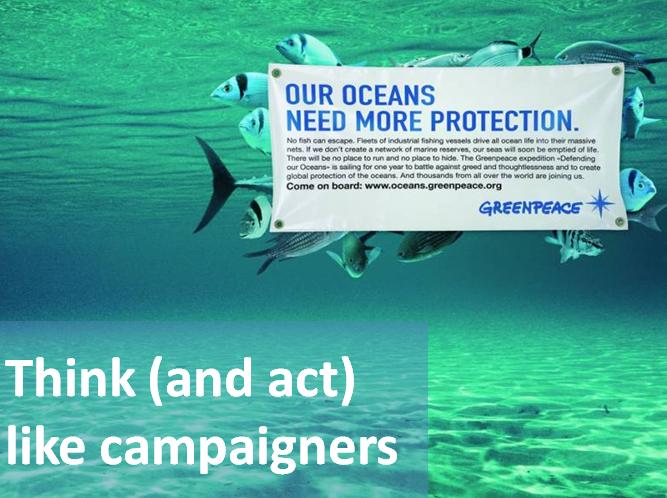
 Digital advocacy has been effective on issues that capture the public imagination because the web is an effective grassroots mobilisation tool. From whale hunting to GMOs, pressure groups and concerned citizens have expressed anger, spread the word and mobilised likeminded people. Were Greenpeace to announce a big-time campaign tomorrow on, say, mink farming in Europe, it could be web-centred, with offline elements operating around it.
 A little late in the day perhaps, but a quick after-thought I’d have to last month’s Copenhagen debacle is that campaigners hold more responsibility than they’d likely admit. Despite the urgency and apocalyptic tones that have been in use for years over the issue of climate change, by the time we got to 2009, the momentum in favour of doing something about it had decelerated in part because they weren’t going about their jobs in the right way.
 Steffen Moller
