
No idea if I made this up or stole it off someone (if so, apologies.) But I reckon these are four things that make work worth getting up for. And I’d add: if you don’t tick at least 2 out of 4, do something about it..
No idea if I made this up or stole it off someone (if so, apologies.) But I reckon these are four things that make work worth getting up for. And I’d add: if you don’t tick at least 2 out of 4, do something about it..
Public Affairs is the communications discipline that most easily gets away with being unstrategic: frequently (not always, clearly) it can be executed without being linked to clear business objectives and a corresponding, measurable plan of execution.
Why?
Detail
The amount of detail often inherent in issues managed by PA pros is far greater than it is in any other communications discipline. Simply being on top of it and understanding which issues and stakeholders matter and doing something about them, however spurious, can be seen as doing enough. Even when there is no way of truly demonstrating outcomes that benefit the organization’s bottom line.
Accountability
PA is often not expected to be as measurable as other disciplines, certainly in terms of true outcomes. This is largely because the ultimate outcome – impact on policy – is governed by so many external factors beyond a PA professional’s control. They are therefore often not held accountable for failure, certainly not compared to say a marketer, who is held entirely accountable if a hike in activity has not resulted in an increase in sales.
Culture
Many PA professionals have little to no experience of strategic communications, and operate in a space in which deep knowledge of policy and relationships are often seen as more important. Granted, both remain essential, but increasingly, influence has to be built up beyond the corridors of power and broadsheet media, and to do so, PA needs to adopt the staples of strategic communications (research, strategic planning, measurement and so forth). However, given that they view themselves as political beasts, not communicators, a number of PA pros are reluctant to do so.
Resourcing
The PA function often remains under-resourced, largely because it is frequently seen as a cost by the people who control the purse strings. Small PA teams thus too often spend their time doing the basics, or fire-fighting, rather than planning for the future.
A thought raised by a colleague in a meeting earlier this week: “why only show our own case studies? Let’s also showcase the work we wish we’d done.”
I like this. Sure, it’s someone else’s work, but you exhibit the following by showcasing it:
What’s the work I wish I’d done?
Here’s a start:
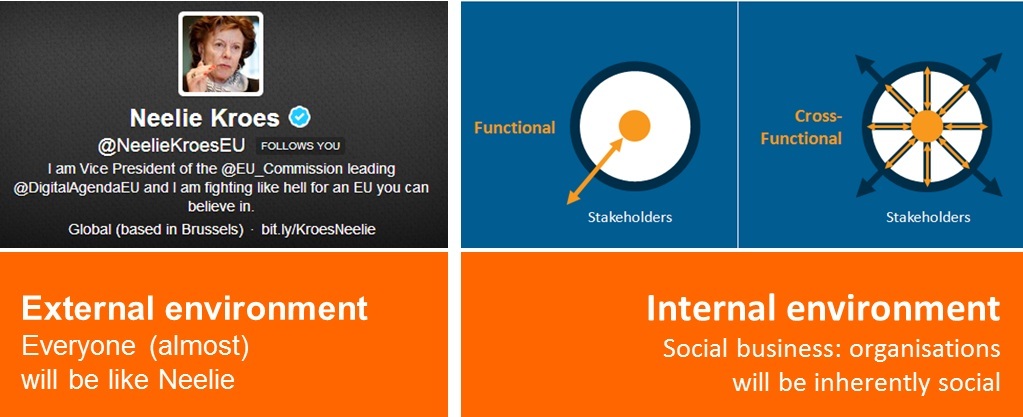
This is a visual that appears as an interlude or concluding slide in many of my presentations. Wild conjecture perhaps, but it summarises two areas where public affairs in 2025 will, I believe, look very different.
External environments
Now, policy-makers and those that influence them are often absent from social media, except some notable exceptions, especially in the tech sector (e.g. Neelie). In 2025, most of them will be active: social will be ubiquitous, and politicians in particular will be expected to engage in the name of transparency. Beyond what’s expected of them, they’ll probably be all over social in any case: generation Y will be at the helm. In public affairs, anyone seeking to build relationships with policy-makers and their ilk will thus need to be active too.
Internal environments
Now, communicators within organisations, including public affairs professionals, still largely control channels of communication. In 2025, social media will be omnipresent inside most organisations i.e. all employees will be active and highly connected and communications will not be able to exert full control. Nor should they. Why? Social isn’t just a means to communicate for purposes of communications (PA, PR, brand marketing etc.) It can also support innovation, product development, talent development and more through engagement with peers within and beyond an organisation. Meanwhile, being an “employee” will mean something far more fluid than at present. Depending on their networks and abilities not related to their core competence at work, employees with no specific PA remit may be your best PA people; those with no marketing remit your best marketers. PA and marketing (and whatever else) thus becomes an exercise in training and guidance as much as actual execution.
What should the Public Affairs professional seek to do? Two things mainly:
Usually, digital is seen as part of the toolkit for the latter i.e. “shifting the pin”. And for good reason: it’s got unlikely candidates elected to political office and it’s made poorly funded activist campaigns take off and beat the big boys. It’s quick, access is mostly free and it’s ubiquitous. It’s a great storytelling medium and it’s the best and most cost-effective mobilisation channel ever devised. It’s TV, radio, telephone, water-cooler and soapbox in one.
What’s not to love? In Public Affairs, especially in Brussels, two things:
Is this a long-winded way of saying that digital in PA is obsolete? Not quite. I would argue that without the right people and budgets, there’s no point in trying to shift the pin. But sometimes the right people and budgets are available, and down the line, when we’ll see PA and other marketing and communications functions at the same table, there will be an upsurge in shifting the pin type activities.
While we patiently wait, I’d focus on where digital can support government relations. It doesn’t have to be big and flashy, but it can help drive an agenda. How? I’d centre on three things in particular:
In government relations, online listening is often only used to conduct traditional media monitoring. I’d argue there are other ways of using online listening platforms that are more directly related to GR activities, such as:
Pin-point research
For instance, when looking to carry clout with MEP X, assess the issue, company or sector’s saliency in their constituency by carrying out searches specific to that constituency only. Who is talking about it? What’s trending? What’s the prevailing sentiment? The insights can be used to target more narrowly.
Tracking a select group of online stakeholders vs. key issues
“We only care about max 100 people,” GR professionals will spout: a small hotchpotch of politicians, officials, media, analysts etc. In addition, they only care about the 100’s view on the few issue(s) that matter to the organisation in question. Given this, online listening is deemed too broad to be of interest. In this case, set up alerts to be notified only when any of the 100 mention the organization or any of the issues of interest. It’ll probably only be a few times per day if that, but will allow you to cut through the clutter and pick up highly relevant material only.
Identifying new influencers
Maybe it’s not just 100, but 101? But the 1 you’ve never heard of because they’re a new online influencer based beyond the usual sphere of interest, and yet they’re communicating around your issues and appear to be increasingly influential. Listening platforms will allow you identify them.
Assessing the impact of own activities
By aggregating mentions of terms, online listening platforms can help determine trends over time: people spoke about company X & issue Y this much in June, but less so in July. And so forth. If you’re trying to convince Brussels and a couple of national capitals of something or other through GR, you can track the impact you’re having by measuring trend development even among a highly select group. For instance, you’re spreading “message x” in Brussels and 3 national capitals. Use your platform to track the diffusion of “message x” in Brussels and the 3 national capitals week by week, and only among the select group of stakeholders you care about. And in contrast, track the rise/fall of your opponent’s “message y”.
NB: listening platforms can do lots more, but the thoughts I list relate strictly to supporting the government relations function.
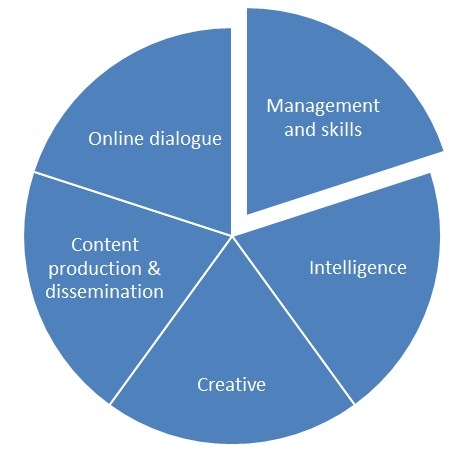
Last year, I produced the digital PA wheel, which, building from three core components of traditional public affairs (intelligence gathering, information provision, relationship building), showed how each can be supported by a variety of digital and social channels, tools and methods.
While I still think the wheel is valid, I think it’s missing a few things, and will be developing the visual on the left further, resulting in an updated digital PA wheel (or matrix perhaps.)
What’s different now?
Management and skills
All organizations are affected by the speed and ubiquity of social media. All functions within them, including public affairs, will require new skills and processes, and sometimes updated technology and resourcing, in order to manage. Although not strictly a communications discipline, a competent digital public affairs professional should be able to advise on how the PA function should adapt. In the commercial world, the term social business is usually applied to describe this area of digital and social competence.
Creative
In PR and corporate communication, digital often owns creative. Not sure whether it’s because creative output channels are frequently digital, or perhaps digital types tend to be more comfortable with creative simply because they have embraced a medium that is manic and unkempt, much like the creative process. Or perhaps no one else wanted it.
Creative has tended to be imbedded in content, and although I think content is its closest ally in the mix, I think it deserves a separate category. Developing a creative concept, whether for a single visual or catch-phrase, or a full-on campaign, should not be an afterthought, even in PA. For starters, the process should involve multiple iterations, concepts should be underpinned by data, and they should be tested. And although process can’t produce creativity, organizations should have a method, from how they structure a creative team through to how they brainstorm, plan and implement.
Intelligence beyond monitoring
Although not detailed in the visual above, intelligence in PA should go beyond monitoring, which has tended to be the core of the offering. Granted, it remains key, but the multiple new tools and methods we have at our disposal to collect and break down data can provide ammunition for the PA professional, from influencer identification through to identifying data that will enable tailoring of message almost per single audience member (e.g. data specific to a decision-maker’s constituency?)
Scores of PA professionals are creative now, it appears, given that they film talking heads or ask a designer to decipher some data and represent it in visual format.
There’s a discrepancy between creativity and publishing in content formats that traditional audiences aren’t accustomed to, however.
By all means, experiment with new content formats, but creativity doesn’t lie in format, but rather, in developing a smart, relevant, snappy, memorable, thought-provoking and possibly funny (depending on the subject matter) creative concept. If it’s good, it can be translated into whatever format you want, whether in written, spoken or visual form.
In short, the creative process is not deciding on a content format, but rather, developing a creative concept, and it will likely be a lengthy, arduous and frustrating process.
Clearly not always – messaging is useful, but it’s not the be-all and end-all:
Sure, develop messages, but don’t obsess, and more importantly, ensure processes and resourcing are able to deal with a far more fluid communications reality.
I mentioned in a post a couple of weeks back that I was slightly unsure of how to approach the presentation on reputation I was due to give at the Public Affairs Action Day.
In short, we all know reputation matters in Public Affairs, but there are multiple potential scenarios at play: some PA professionals struggle with reputational issues yet only have a PA remit, others can do more far-reaching reputation management beyond Brussels, while others have an excellent commercial reputation which they need to “translate” for a Brussels audience. And within each scenario, there are many nuances: trade association vs. company, for instance.
I ended up focusing on principles and ideas applicable across the board, but shied away from real “reputation management” seen as an exercise beyond mere communications. I also presented a few findings from Fleishman-Hillard’s imminent Authenticity Gap study, which compares how industries are expected to perform vs. how they actually do perform across nine drivers of reputation. Any questions, fire away.
 Steffen Moller