Online grassroots campaigning to support Public Affairs: once overhyped, now largely ignored

Even just a couple of years ago, a fair few people in the Brussels bubble were getting excited about the prospect of online grassroots campaigning.

Their logic was as follows:

  1. Regulation increasingly reflects public sentiment
  2. Public sentiment lives beyond the bubble
  3. Being able to showcase public support in member states is thus key to success
  4. However, building, showcasing and/or somehow aggregating support is very difficult
  5. The web is by nature cross-border and quick: a silver bullet for mobilisation, surely

The concept is no longer in vogue, given that, clearly, it was highly unrealistic in the first place: the assumption amongst a fair few PA pros was that there are people out there willing to be mobilised on any issue overnight as long as you looked hard enough.

This ignores the following:

  • Many organizations are either too unpopular or too obscure to rack up support overnight
  • Many regulatory issues are highly technical, making it difficult to create a “narrative” that makes mobilisation realistic
  • What’s more, even with suitable issues, many decisions will likely be based on consensus rather than who has most friends, especially if the Commission is the key player, making the whole premise pointless in the first place

BUT (and it’s a large BUT) that’s not to say there aren’t instances where it can be very valuable to showcase support or that it can’t ever work:

  • It can if the issue has a very clear public interest angle and the EP is a key player e.g. see the recent fish discards campaigns
  • Clearly, if an organization is popular, it’d be easier to drum up support
  • And in some cases, mobilisation can even work for an unpopular or obscure organization if it goes about it sensibly i.e. keeping expectations realistic and giving it time; and usually focusing on a single key constituency, rather than “general public”

As a side-note, personally, I’m pleased people aren’t seeing it as a silver bullet any longer. On one level, it shows we’re moving from hype to maturity. On another, it means investments in digital PA are being funneled into areas where it is more likely to provide a real benefit, such as analytics, content strategy and search.

Reputation and Public Affairs in Brussels: where to start?

I’m running a session on reputation this week at the Public Affairs Action Day and although it’s a subject I’ve been dealing with for years, I’m always slightly unsure of how to approach it in a Brussels context.

Meaning what?

The starting point, we can all agree upon: companies’ and industries’ reputation beyond Brussels is increasingly having an impact on what happens within the bubble.

That’s easy enough, yet the Brussels-based PA professional faces 1 of 3 fairly different scenarios:

  • Scenario 1: Poor company/industry reputation but reputation is owned and done (if at all) by someone far from Brussels (and the 2-person Brussels team is overworked as it is)
  • Scenario 2: Poor company/industry reputation but Brussels owns (or is a major player) in how reputation is defined and managed
  • Scenario 3: Good company/industry reputation to harness in Brussels

Clearly, there are multiple nuances within each scenario e.g. a company can have a better reputation than its industry or vice-versa. Alternatively, a company can have a great reputation full stop, while others have a sound commercial reputation yet are unpopular among regulators (think certain tech giants).

Although there’s always plenty of overlap, each scenario necessitates a different emphasis by PA pros:

  • Scenario 1: Here you’re not really doing reputation management in the traditional sense, but rather, tackling reputational issues in your Public Affairs work
  • Scenario 2: Is the nuts and bolts of reputation management i.e. ambitious, involving multiple stakeholders and multi-disciplinary (communications and beyond, ideally right to the core of how a business operates)
  • Scenario 3: Will centre on strategies that “translate” a great reputation into a narrative that carries weight with decision-makers and will likely involve mobilising or at least harnessing the people that have meant a company/industry has a good reputation in the first place

The conundrum is: do I do all 3 or just focus on scenario 1, which is the most common? My current thinking is probably doing all 3 but with more emphasis on 1.

What Public Affairs could learn from Borgen

To anyone who hasn’t seen (or indeed heard of) Borgen, you’re missing out. Think The West Wing but better: the characters are compelling yet not all exactly the same as on TWW i.e. bright and fast-talking yet quirky, high-strung and useless at personal relationships. Plus it lacks the syrupy moments featured too frequently on TWW.

What could Public Affairs practitioners in Brussels learn from Birgitte, Kasper, Bent et al?

Reflect public sentiment

PM Nygaard succeeds when her views are somewhat reflective of prevailing public sentiment. However many times they fail, some Public Affairs practitioners still believe in wars of attrition: say it enough times and you’ll wear them out and win. Doesn’t work that way: you need to show your world-view is the prevailing one – or at least that you’re moving towards it – not just repeat insular clap-trap a thousand times.

Put yourself about

Whenever our heroes need to win an argument, they raise the noise levels and put themselves about, usually starting with a feature interview on the fictitious TV1. Public Affairs folk take note: don’t hide in case you put a foot wrong, or think everything is decided face-to-face. Get out there.

Timing

In Public Affairs, things are often put off, even when the legislative calendar makes it pretty clear when stuff should happen: “we need to consult everyone before we decide on anything: we’ll do so at the next meeting” (in 3 months’ time). In Borgen, Birgitte and her band of merry men and women meet at any time, day or night, and put a plan into action there and then.

Express emotion not “messages”

I’m tired of “messaging”. Birgitte doesn’t always need it, why should we? She often wins by talking from her gut and showing emotion.

Hire smart communications people

Kasper, the brilliant sidekick, is a comms guy. He gets policy inside out but his job is to package it. In Public Affairs, comms is frequently treated like an afterthought or left to the most junior person in the room (if they even get into the room in the first place).

Leave the Bubble

In an early episode, Birgitte visits Greenland, and only then truly understands the issues facing it. Who says Public Affairs folk can’t leave Brussels once in a while and visit local communities, factories, trade unions, churches, farms etc. and get a sense of real world issues?

Work with opponents

Our crafty protagonists will often work out deals with parties or individuals that in no way share their world-view in order to get things done. In Public Affairs, we often refuse outright to even acknowledge the other side, let alone work with them on compromise measures.  More of it please.

We’d like a little bit of digital please

The starting point for digital in Public Affairs, and other disciplines no doubt, will often be very tentative: “we’d like a little bit of digital please.” In practice, it may mean no clear strategy, a single channel, one junior person within an organisation given part-time responsibility for it, limited or no input from experienced practitioners and no measurement. Essentially, experimenting to see how it works.

In theory, I agree in taking baby steps and seeing how it works as it’s a good way of getting people started when they might otherwise never do so, but the fact of the matter is, doing it small means it probably won’t work.

Set up Twitter but tweet infrequently, set up a LinkedIn Group and expect external members to do all the work, have a new site but don’t promote it, have a new site but don’t update it, produce one great piece of content but don’t follow up, do one channel when your audience is on three, monitor social media but don’t respond? These are all examples of doing it small.

Would you get an intern to write a position paper in a day? Organise an event but not get good speakers? Build a coalition but never meet? Monitor political developments but ignore one of the institutions? Probably not.

Doing digital with no clear strategy – i.e. no reason other than “we should be doing this” – and no real resource commitment is essentially the same thing as any of the examples above, and thus a waste of time if not a ticking time-bomb.

Having said all that, I’d still recommend it as a means of at least getting people started, but insisting strongly on the following: “this is just a start, don’t expect much, to reap the rewards you should be doing more.”

Being overly tactical can go unnoticed in Public Affairs

Interesting thought emanating from a recent conversation: Public Affairs is probably the communications discipline that more than any other is tactic-centric. Meaning that in PA, you can propose all manner of tactics without much research or strategy, and people might not notice.

Why?

This may sound trite, but it’s probably because Public Affairs can sound clever even when overly tactical, while in other disciplines, that’s not so much the case. If you’re selling cereal and you state “let’s set up a Facebook page” without having done your homework other than knowing your target demographic is on Facebook, you’ll rightly be told off.

However, if you’re trying to defend a cereal manufacturer’s ingredient from regulation and you know the institutions’ calendar inside out and who sits in the relevant committees, simply putting together a set of meetings sounds more clever than “let’s do Facebook” although it really isn’t.

Clearly, I’m over-simplifying to prove a point – Public Affairs servicing usually involves far more than a meeting programme – but you get the gist.

Paid media (advertising) in Public Affairs

Although it can be extremely effective at driving traffic and raising awareness of one’s activity, we often scoff at advertising in Public Affairs, usually for one of more of these reasons:

  • We know our audiences so why advertise?
  • Advertising is not targeted enough
  • Advertising is too expensive and we can’t control what we spend
  • Advertising can sell detergent but our clever audiences would never fall for advertising

Each is tosh:

  • We hardly ever know everyone in our target audience anymore:  as the scope of Public Affairs becomes increasingly broad, so does the set of people we need to reach and convince.
  • As uncomfortable as it may make some people, advertising can be very targeted. In particular, online advertising, which allows one to target via variables such as where people live or what sector they work in, as long as they themselves have provided the information (e.g. Facebook or LinkedIn ads) or what they look up online (e.g. Google AdWords).
  • No, it’s not necessarily expensive. Many people’s advertising paradigm is TV, which obviously is very expensive. But delivering a thousand clicks to a website via a social network can be dirt cheap. And you need only pay per click and can cap spending.
  • “Our clever audiences never fall for advertising.” Again, this is the TV paradigm. In online advertising, as well as much offline advertising, you’re not trying to drip-feed your brand to unknowing consumers who will soon worship it: you’re only trying to drive someone somewhere else, where yes, perhaps you may try to convince them of something or other.

Europeans and Obama (not another post on Obama?!)

As if enough hadn’t been said or written already (and I don’t profess to be an expert, by any stretch). An interesting thought nonetheless: why are we Europeans still so enamoured of Obama?

A mix of some of the following perhaps.

To many, he’s still a rockstar

The US and Obama are always big news, but not that big compared to what’s happening here, and the fact is, he’s miles away and can’t by nature have as much impact on our day to day as our own politicians. The freshness and star appeal of 2008 thus hasn’t waned as much as it might have done if we’d seen him dominate the headlines night after night or if we could realistically blame him for our own ills. So as trite and sensationalist as it may seem, as far as we can tell, he still nearly looks and sounds the part – just as he did when he captivated the world back in 2007-08.

If not a rockstar, he’s the sort of American we feel most comfortable with

Right or wrong, we see him as professorial, smart, honest, engaging without being overbearing, seemingly willing to listen rather than act on instinct. This contrasts with the type of American some of us feel slightly uncomfortable with i.e. unashamedly brash, impulsive and unselfconscious.

Values

Despite his relative disinterest in our continent, we still think his values are European in nature: his penchant for soft power, universal healthcare, wanting at least in principle to shut down Guantanamo, gay rights, women’s rights et al. Sure, Guantanamo remains open, the healthcare bill has no public option, the use of drone attacks under his watch has been boosted, his support of gay marriage is a fairly recent development BUT we assume that these are compromise measures, not his personal predilection.

We don’t care about his supposed biggest failure (and in any case it’s not entirely his fault and it seems piffling compared to our mess)

The recovery has been slow and unemployment remains too high? Big deal, that’s their issue, and in any case, the US is doing better than we are; frankly their woes seem piffling compared to the Eurozone travails.

The Republicans partly got us into this mess in the first place

Most of all, the reason many Europeans remain keen on Obama is the other guys. True or not, the 2008 collapse which then led to all sorts of other troubles, none more so than the Eurozone crisis, is blamed on Obama’s predecessor and his party.

The Republicans are creepy

A lot of us still view the Republicans as a sinister lot: virtual pantomime villains; certainly not the responsible party of smaller government and sensible regulation. Rumsfeld’s eerie glare into the camera as he said Old Europe didn’t matter and the subsequent cataclysm that was Iraq still grates. As does – to many – their view on universal healthcare, climate change, abortion, progressive taxation, guns, the death penalty and gay rights, as well as their hawkishness on foreign relations. More than belief, it’s perhaps the tone used by many in the party: the visceral hatred and virtual foaming at the mouth at the mere mention of another opinion on the aforementioned issues makes us feel as tad uncomfortable as this sort of belligerence is usually reserved for extreme fringe parties on this side of the Atlantic. Couple that with many Republicans’ endorsement and continual espousal of their particular notion of American exceptionalism which we would dispute, to put it mildly, and it’s perhaps no wonder that most Europeans – left and right – were pleased with the outcome on November 6th.

Am I forgetting anything?

In one visual: online support for an issues management programme

If you’re working on an issue in which you represent one side of the debate, you’ll need to present that view online. Why? We’ve been over this before, but in short, people who matter will be looking you up online and if you’re nowhere, they’ll read up on the competition, not you.

So you’ll need to have an online presence, it will need to be fed with content, you’ll need to promote it via online marketing and other tactics, and you’ll need to engage on other platforms where your audiences may be active (social media in particular.) Neatly summarised in this visual (I hope!)

Digital principles from the US presidential campaign applied to our far smaller pond

My colleague from Fleishman-Hillard in Washington DC, Bill Black, was in Brussels a couple of weeks ago to host an event on the use of digital in the US presidential campaign. Good thing that Obama was triumphant, given that the presentation centred on extolling the phenomenal development of the digital element of his campaign since the last election. It’s getting less air-time given that it’s so 2008, but certainly, the campaign’s use of data in particular is truly ground-breaking.

I was asked to round off the presentation with a couple of brief insights on how the principles of the campaign could be applied to Brussels. Slightly tricky given the considerable differences in scale, critical mass, funding and the fact that we had people with drastically different communications needs in the room (political parties through to embassies and perm reps through to corporates).

Nonetheless, there were 3 points in Bill’s presentation which are unquestionably applicable to Brussels, which I summarised as follows:

Using data

Data can also extremely valuable to a Brussels crowd, albeit usually for a different reason. In the US campaign, as with most large campaigns, the prime purpose of mining data is to understand audiences so as to better target them. In Brussels, in most instances, we know our audiences pretty well, or they’re so small that we can find out about them using more cost effective means (a survey or even just asking them directly). However, exploring and breaking down data can pay great dividends in another way, namely building stronger argumentation.

In short, if you represent the interests of an organisation, country, party, region etc. you can use data collected through various means online to understand the views of people in relevant constituencies, and where relevant, align your position so that it reflects these same views, thus strengthening your case significantly. Too often in Brussels, argumentation is based on assumption, or what you’d like people to hear, or it’s too basic to actually matter. In the private sector, how many organisation, for instance, prattle on about the number of people they employ or the percentage of European GDP they account for?

Instead, imagine you’ve used data to determine – hypothetically – that there are 3,000 people in constituency X who have voiced support for you or are likely to support your position, proven through data indicating what these people have said, published, read and shared. I’m sure some people concerned with privacy will shudder, but there’s sure no better argument winner. In addition, analysing a broader set of stakeholders through data can help identify influencers beyond traditional stakeholder groups.

Smarter about content

Old news no doubt but still worth emphasising: with the mass of information being published, being more personal, conversational and publishing material in a variety of attractive, relevant and concise content types is essential if you wish to break through the clutter. This as ever remains a message worth repeating in Brussels, where we remain enthralled by the highly cerebral, overly detailed report or paper as the sole publication type worth thinking about.

Getting senior people involved in social

Again, hardly rocket science, but an interesting insight from the election. The likes of Axelrod were far more involved in social media this time around than in 2008, and this resulted in more stuff being shared and spread. To be frank, although social media lowers the barrier to entry to communications, often allowing people who are smart and interesting yet not high in the food chain to gain an audience, the fact remains that high-profile people usually carry more immediate clout when engaged in communications. This is a valuable lesson to the organisations in Brussels, both public and private, who farm off social media to the intern or even a 3rd party, when ideally, the figureheads of an organisation should at least be somewhat involved.

Digital is always relevant in Public Affairs

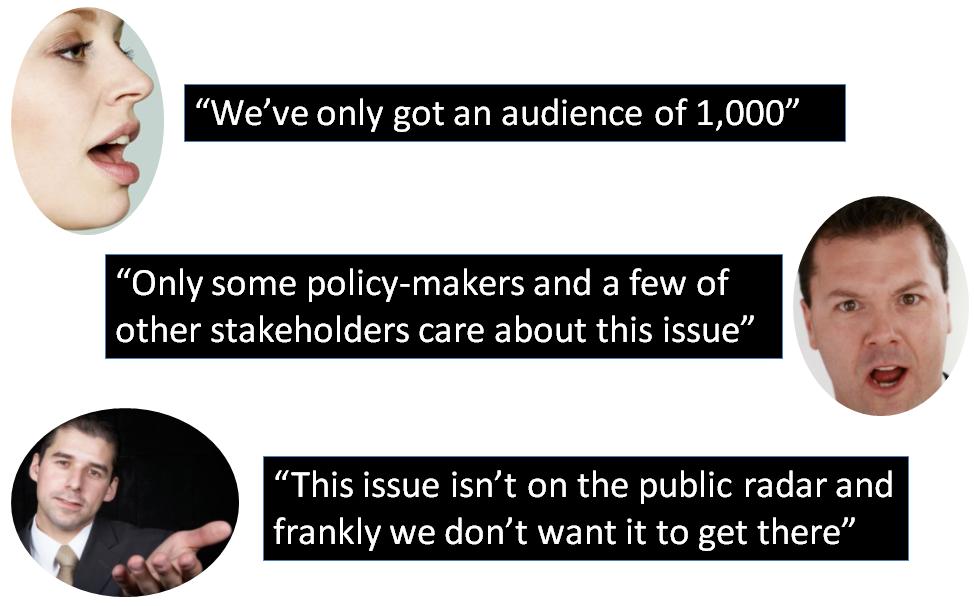
I start off a number of presentations on digital PA with this image, slyly trying to pre-empt the inevitable i.e. PA professionals who have made one (if not both) the following assumptions:

  1. Digital is a mass-market, spray and pray medium
  2. Knowing your audience makes it easy to reach them

In truth, digital is not a spray and pray medium, by any stretch: it can be highly targeted. Think targeted social advertising leading to content specific to a niche audience. And having every audience member’s email address or phone number won’t help if they’re Googling you rather than picking up the phone or reading your emails.