This question was discussed at length in a meeting I attended this week, and no doubt props up all the time elsewhere. The key thing to note is that term X and term Y really weren’t that different. And frankly, who cares? Not the MEPs. One word or another won’t make the difference. As a communicator, it is best to focus on story and substance, and what will resonate with an MEP’s constituents. So instead of terminology, go for the elevator pitch (ick, I hate using the word elevator, but lift pitch doesn’t work does it..?) Think of the 3 key issues and your 3 key responses, and summarise them to perfection in 30 seconds and be prepared to build on them subsequently. Be a salesman, not a poet. Not as sexy? Your loss.
Category: Communications
Are NGOs still the eCampaign benchmark?
The story goes that NGOs were able to mobilise support and spread their message online over a decade ago, when the corporates they were up against barely had any web presence to speak of. This is cited as one of the reasons for their ascendancy in the political power game.
How are they faring these days? This is by no means a long analytical piece: I haven’t combed through hundreds of NGO sites from which I’ll cite dozens of examples; but in short, my general feeling is that NGOs aren’t as effective online as they used to be. To some extent, it’s probably their fault. Some have amazing stories – especially from the field – but are not using social media as well as they could to tell them. Sometimes they use the tools but not in an integrated manner e.g. offline campaigns aren’t backed up online and vice-versa. Big NGOs are often too split along country or regional lines: rather than sharing material across platforms they’re keeping it separate, which is pointless as well as detrimental. Also, some of these same big-time NGOs have sites that are far too pristine and corporate-looking. Meanwhile, others have crammed too much into their toolkit, meaning that they do a little of everything badly rather than a few things well; and others, especially small-time single issue pressure groups, are not using cheap and cheerful tools nearly as much as they should (although I hasten to add that some do!)
To some extent, their loss of the best practice mantle is not really their doing. With their mammoth budgets, their corporate adversaries have played catch-up very well by developing credible CSR programmes and hiring smart agencies that do great communications online, with plenty of effective social media in the mix and winning the search-ranking battle.
Having said that all that, the spirit of the NGO is alive and well, and their message is stronger than ever. However, it’s not necessarily them that’s delivering it. Firstly, “regular folk” are often more militant than most NGOs nowadays, and they’re very active online in forums, blogs etc. I did a little bit of research last week in response to a report from the Food Standards Agency in the UK which claims that organic is no healthier than regular produce, and was astonished to see how many people (with no affiliation to official groups) were taking a stand against the FSA. And they were pretty angry. Secondly, corporations themselves are making noise about the sort of issues only NGOs seemed interested in until recently.
Conclusion? Having mobilised people to such an extent over the last 10 or 20 years to the point where they have actually radically altered the common man’s sensibilities over a range of issues and leading ultimately to far more responsibility in corporate-land (as well as politico-land of course) is no doubt a great triumph and impressive legacy. It probably might not seem to matter so much that they’re not good with Twitter: that’d be taking a myopic view of the global challenges we still face and which they can contribute to. Still, I think they should brush up a little online.
Building a story offline and online
I spent a fair few hours today taking “story-lines” and hooks that have been developed for media work by someone else and seeing if I could build an online approach based on these same ideas.
Result in a nutshell? To some extent yes: what works for journalists can work for online audiences. Makes sense, as journalists are looking to write stories that attract the same people we’re looking to reach online.
There are some differences though:
- What will resonate with online audiences or might go viral is much broader than what could work with the press. Again, makes sense. There’s not that much actual space in traditional media and journalists have editorial guidelines and so on. Online, there’s millions of people out there and the publication space is endless. So whereas with the press you need a certain type of story and quality to get them interested, all sorts of other things will work with a global online audience, from a one-line joke on Twitter, a comment on someone else’s blog, to a video on YouTube etc etc.
- The scope of what you can get your target to do is far broader. With media relations you’re trying to get your target – the journalist – to print a story. What happens after that is a bonus. Online, there’s getting someone to reproduce or forward your story, so the same sort of thing, but on top of that you can get them to do lots of other things, be it vote, comment, mobilise or participate in whatever other way you can dream up.
- At the same time, you need to be a little more careful. Send a journalist a bad pitch and it’s binned. Put something rubbish or inaccurate online and the magic of cut-and-paste and instant publication might mean it does the rounds globally before you get up the next morning.
A Brussels agency model
Here’s a very short internal presentation I did at ZN recently showing how I think the PA/Corp Comms agency model will develop in Brussels, as well as some thoughts on how ZN can become the “agency of the future” (sorry, I’ve blacked out three of the slides that outline the latter.)
Any thoughts?
Reaching a legislator before and now
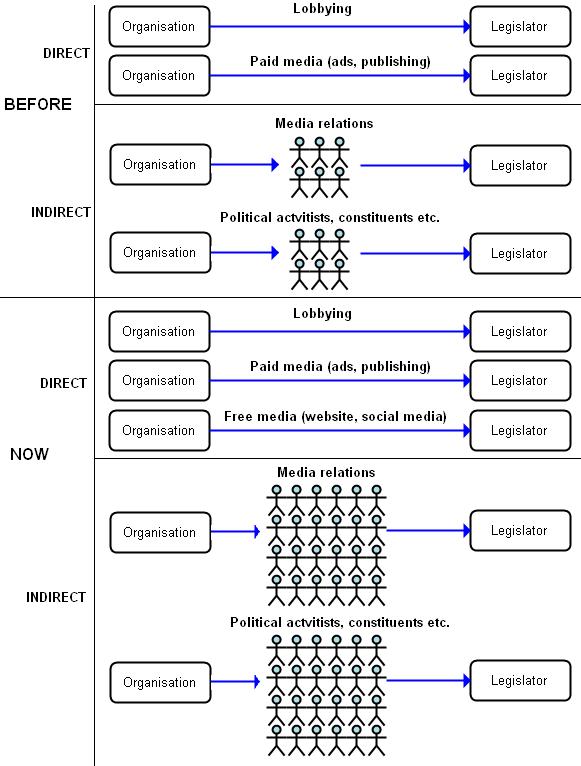
A few months ago, I posted a simple diagram to highlight that organisations should not overlook the importance of being able to communicate directly to their audiences. I’ve taken that diagram a little further to show how tactics to reach legislators have developed in the age of the Internet.
The two key elements that are different now are: 1) being able to reach legislators via content and search i.e. organisation X publishes on its website, blogs, posts a release on an eWire etc. and a legislator picks it up via Google; and 2) the main indirect influencer i.e. the press via media relations has now expanded to include all sorts of other influencers e.g. bloggers, while far more people can become engaged in political activism that might influence legislators (online advocacy via communities, ePetitions and so on.)
Any thoughts? Have I missed anything?
Eurobloggers are not the Brussels press corp
This entry is prompted by a recent post by Julien on his mistrust of Brussels PA/PR agencies and their attempts to connect with him; and an even more recent conversation I had with a consultant who asked how to best “harness” Eurobloggers (p.s. I told him to not hold his breath.) Yes, Brussels communicators are trying to engage with Eurobloggers to push their stories. Will it work? No. Eurobloggers aren’t journalists. They blog because they’re into politics. If pitching journalists is hard, pitching bloggers is much harder because they usually only have a personal, not a professional stake.
Lost opportunity? No, blogging is important, but for Brussels communicators, it shouldn’t be about the Eurobloggers, at least when it comes to a blogger relations strategy. It should be about getting clients to dip their toes into blogging etc. themselves and then trying to tentatively build relationships with people who write about their issue, not those most likely to be read by MEPs. As a consultant or communications adviser, your role should be guidance, not doing the blogging yourself.
Here’s an extract of the comment I wrote in reply to Julien’s post in which I describe in brief how best practice blogger relations should be carried out (and in turn how it should mean Brussels agencies won’t be pestering him for much longer!)
I work on social media strategies for clients… I can honestly say that my approach to blogging, Twitter et al (and ZN’s too) centres on how I can best help clients use the tools themselves… Why? Frankly, it works better… you’re far better off helping clients build constructive relationships themselves, and generally not with eurobloggers but preferably with issue or sector experts…(.)
Although some agencies no doubt make the mistake of simply transferring media relations to the web and seeking out people most likely to be read by legislators, I suspect this practice will fizzle out. Why? Because an article in the FT is undoubtedly worth more in “PR dollars” than a far better article in a relevant trade publication, whereas online, impact can be determined more by quality than by reach because of search, hyperlinking and aggregation.
To spell it out, here’s two (very simplified!) scenarios I could propose to clients (no prizes for which one I think is most likely to work.)
1) We’ll write a post on our blog saying you’re great. We’ve hooked up with Julien Frisch and the other 30 popular eurobloggers – maybe one of them will pick up your story (but don’t hold your breath, none of them have ever written about your issue.)
2) Your 3 experts could blog or tweet (assuming they want to.) We’ll help them out with the dos and don’ts, but they have to do the writing and it has to be honest. We’ll do some research to identify other people (academics, scientists, companies, pressure groups, students etc.) writing good content on your issue (whether for or against) and run them by your experts. In due time, we can add them to our blogroll, your experts could link to them in posts or comment on their blogs, and maybe we can build relationships with them if they’re interested, and hyperlink to their content or maybe even get them to be guest bloggers.
The difference is obviously that it’s the organisation’s experts and not the agency that is telling the story, and you’re promoting good quality content and interaction rather than throwing a story at someone who happens to have MEPs amongst his/her readers and hoping that it will stick… (.)
Communities require plenty of work, I'm afraid
In the four pillars I’ve been raving about recently, I speak of an almost “organic” growth towards a community if you have the right building blocks in place and do the right things. Meaning that if you listen and bring together information, start using social media effectively, enabling stakeholder dialogue, this can eventually develop into a community of people who act as mobilisers on your behalf.
Abstract example of how the model should ideally work:
- My organisation does wonderful things but nobody knows.
- I start finding out what people are talking about in my sector or on my issue and who might be interested in the things I do. I bring them together.
- I start engaging with them online, humbly, and they like me and get excited about what I do because they feel I have something to offer.
- More people are brought in; they talk and engage.
- Eventually, I have a community of people excited about what I do who help me spread my message, attract members or maybe even advocate my take on an issue.
However, this is the point at which I want to announce my warning: it’s really not that easy; your community will not be totally self-sustaining. Maybe it won’t need you, but fact of the matter is that you need someone to “feed” the community. Even community benchmarks from across the field from say Ben and Jerry’s Facebook group to Barack Obama’s online platform worked because people engaged and spread the word, but they both needed people from the campaigns themselves to listen, respond, feed information, and generally animate. Again, it needn’t be you; it just needs to be someone who takes charge. On Firefighternation (one of my personal favourites) it’s active firefighters who are not necesarrily the founders who have taken the lead in animating their community.
Political wonks vs. communicators in Brussels
A point raised in a recent client meeting by a head of communications: it’s hard to find people who both get the issue and are real communicators; it tends to be either one or the other.
I haven’t been at it for that long in Brussels but my inkling is that this is true and that the balance is heavily skewed in favour of policy wonks. Most comms professionals have a background in politics, policy, regulation etc. How many have PR, marketing, advertising, branding, corporate communucations or media backgrounds? Hardly any.
Makes sense. Clients and members need people in Brussels who get the stuff and can open the right doors (and know what to say). They also however need people who can build ambitious communications programmes that help shape the regulatory landscape in the long-term. Does the current Brussels balance address this? Probably not, given how archaic most communications activity I’ve seen is, but I’m open to challenges.
Getting you story out: the FT alone won't do
At least once a month, we hear a Brussels-based communicator state that their goal is to get their organisation’s story into the Financial Times. I get it, and I agree to the extent that if I had to choose to have my best story appear in just one place, it’d be the FT. Please don’t think “mission accomplished” if your story gets coverage in FT though, or any top-tier publication for that matter. It’s simply not enough; people – and this includes legislators – need more: individuals view 8 sources of media per day and on average need to hear a story 3-5 times to believe it (Richard Edelman.)
So what do you do about it?
- You open your eyes and acknowledge that the list of credible news sources has grown exponentially, and it’ll often include people you’ve never heard of. Edelman speaks of dispersion of authority, meaning that figures of authority aren’t just main stream media and the like anymore, but also other experts or aficionados in any given sector or issue who might not reach 100,000s of readers like the FT, but will reach everyone who matters within their niche.
- You extend your monitoring so that it refelects this shift to niche content providers, whether online (usually) or offline.
- Extend the scope of your editorial work so that you’re present in all the spaces that matter. Whether that means responding to blog comments on someone else’s blog or writing your own tweets doesn’t matter. What does matter is that your editorial plan reflects “dispersion of authority” and the shift to niche.
- People don’t find information by having it sent to them or by picking up a paper. They look it up on Google, so you really need to have a search strategy in place. It’s the dullest part of the job but arguably the most important (remember: +90% of MEPs use search daily!) Get an SEO agency in to help you, and produce content that will mean people find you online when they look for information on whatever issue you’re working on. Tip: publish far more press releases on your site and on eWires only than you do at present as it’ll mean you provide more good value content and improve your search engine ranking without bothering journalists. For more on this, I’d recommend David Meerman Scott‘s eBook, New Rules of PR.
Don’t listen to smug online consultants
 The web is the greatest communications tool ever invented. It allows for more engagement than anything that’s come before, it has low barriers to entry thus allowing anyone to take part and making it more democratic, it fosters innovation, it’s transnational and transoceanic. It’s quick, sometimes instant, and most of the stuff on it is free. It’s revolutionised the way we access information, what it takes to do business, shopping and other forms of commerce, all communications disciplines, publishing and the music industry. And we’re just at the beginning.
Having said all that, don’t listen to smug online consultants who tell you TV and print are old and web is new; the former is out of sync and out of date while the latter will help you take over your sector. It’s not the case: TV is still huge, radio is bigger and better than ever, plenty of people trust print over the web, lots of people read papers offline and not online, trade publications are largely offline, and meeting people face to face remains the best way to get your message across.
So what should you do as a communicator? Three things:
- Build a strategy backwards from your objectives and stakeholders and select the right communications channels for each scenario. This will help ensure that you pick the right toolkit. Sounds simple but to be honest plenty of communicators do it the wrong way around.
- Include the web in that mix but make sure you make the most of it rather than treating it as a another communications channel. It’s not just an outreach tool. It’s potentially your best engagement tool, your best reputation management tool, your best crisis management tool, your best market research tool, your best polling and surveying tool, your best measurement tool. And so on.
- Use the web as your overall campaign or communications programme integrator, meaning that everything you say and do – online and offline – should be directed from or link to your online hub in some way. Issue a press release? An advertorial? Host an event? Make sure you make it all come together online.
 Steffen Moller