Get off your high-horse PA folk

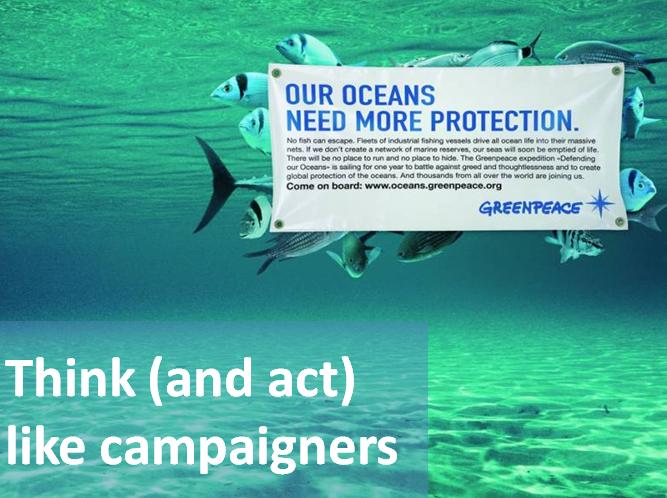
I use this image frequently when presenting on how Public Affairs is developing in Brussels (usually in the context of Public Affairs and digital specifically). It’s not a particularly novel or intricate notion: campaigners/pressure groups, have influenced policy making beyond what their resources should have permitted because they have told a better, and simpler, story. They’ve aligned with public opinion – and later driven public opinion – sometimes by pulling at the heart-strings, always using compelling, simple messages, oft-repeated – and plenty of visualisation. In the PA context, industry has famously been poor at doing just that: telling a simple story that resonates with people – including policy makers.

There’s usually a fair bit of nodding in the room at this point followed by one or more of the following inevitable rebuttals:

  • Yes, but you see, they can get away telling tales, we can’t.
  • Yes, but you see, our customers, directors, etc. expect us to be credible, scientific, cerebral, fact-based etc.
  • Yes, but you see, we can’t talk openly about our issues, they’re tip-top secret.

Tosh. The suggestion that pressure groups merely make up tales which gullible folk fall for is overemphasised. It happens, sure, but you need to give them more credit. Pressure groups do their groundwork: analysing audiences, developing storylines based on insights gained from their analyses, testing messages, delivering them through multiple channels and multiple forms of media with a fairly good inkling that they’ll succeed. They don’t do every issue, or attack every opponent: they focus on where they’re most likely to win.

Also, being story driven rather than fact driven need not imply fluff: it can simply mean talking about issues in an everyday context, openly and honestly, using real people, and language which people understand. It implies dropping the condescension and perhaps showcasing information in summary form or visually. It can mean talking to local community leaders and retirees rather than just policy-makers and the FT about things which resonate with them. In short, communicate about things people care about, in a language they understand, and be nice doing so.

Potential client in pitch: you need to understand our issues REALLY well

A colleague and I were recently discussing what organisations operating in Brussels look for in agencies in pitches, and we both agreed that the one thing we hear the most from their side is this: “we want the agency to understand our issues REALLY well.”

I wonder though: clearly, it’s absolutely key when an organisation is looking for policy counsel and support on other core government relations activities. However, they’re saying the same thing when they’re asking for help in areas like positioning and pan-European awareness raising.

Does a detailed understanding of the pertinent issues and industry matter as much as expertise in the relevant fields of communication (campaigning, branding, positioning etc.) I’d say no: if they’re looking for help in getting stakeholder group X in Greece and Finland to wake up and smell the coffee, who ultimately cares about Regulation Y. Surely an understanding of how to identify, target and engage audiences in far-flung places matters more?

Then again, it’s only natural that government relations professionals in Brussels see things through their prism: when their consultants speak their language, they feel more comfortable when judging them; more so than they do when they are recommending a programme that encompasses areas of communication which Brussels folk have managed to steer clear of for so long.

The challenge is for consultants to not simply frown and grumble in unison – “they don’t get it” – and instead improve the sell. Clearly demonstrate value: develop insights based on real facts and figures e.g. break-down audiences in Greece and Finland and determine what message, and who and what channel, is likely to reach them. Use case studies. And most of all, show them how you’ll make it happen, clearly, and step by step. This latter point is crucial: if people are out of their comfort zone, the best thing you can do is reassure them by demonstrating that you have what it takes to guide them, and not make it appear too complicated.

Develop a content strategy to succeed in Public Affairs

As PA professionals, we know our issues. Intelligence is our lifeblood: we understand the multitude of factors which determine how an issue might progress over time, we know who’s who, and so forth. However, we’ve developed a habit over the years of going straight from knowing our stuff to delivering it. We’ve kidded ourselves into thinking we’re not like marketing, corporate communications or consumer PR folk who need to tell a good yarn.

Meaning what? That our output often isn’t adapted to our audiences. We provide a 100 page document when someone wants 10 bullet-points. We talk about clean air when people would rather hear about the economy. We try to get a meeting when our target audience is looking us up on-line.

So what should we do about it? Learn from the marketers, corporate communicators et al: use insights to better analyse our audiences, differentiate the message, develop a gripping and relevant storyline, test the message, vary the output, vary the channel. In short, develop a content strategy which turns your intelligence into a compelling narrative, and then deliver.

PA and corporate communications converging: comparing London and Brussels

One of the running themes of this blog is that PA as we once knew it – the government relations centric model – is being superseded by one where government relations lives side by side with a range of other communications disciplines. An organisation’s reputation, often beyond Brussels, is increasingly important in determining how that organisation is perceived by decision makers, as is the extent to which it is aligned with public opinion on any given issue.

However, when I was asked just last week by a London-based Public Affairs professional to what extent corporate communications and PA are converging in Brussels, my reply was: probably not as much as in London.

That is not to say that I’ve done a volte-face on the statement above. However, the extent to which corporate communications and PA converge is not consistent: it depends on the nature of the issue. The more the issue is in the public domain, the greater the convergence, and the fact of the matter is that fewer issues are in the public domain in Brussels than in London.

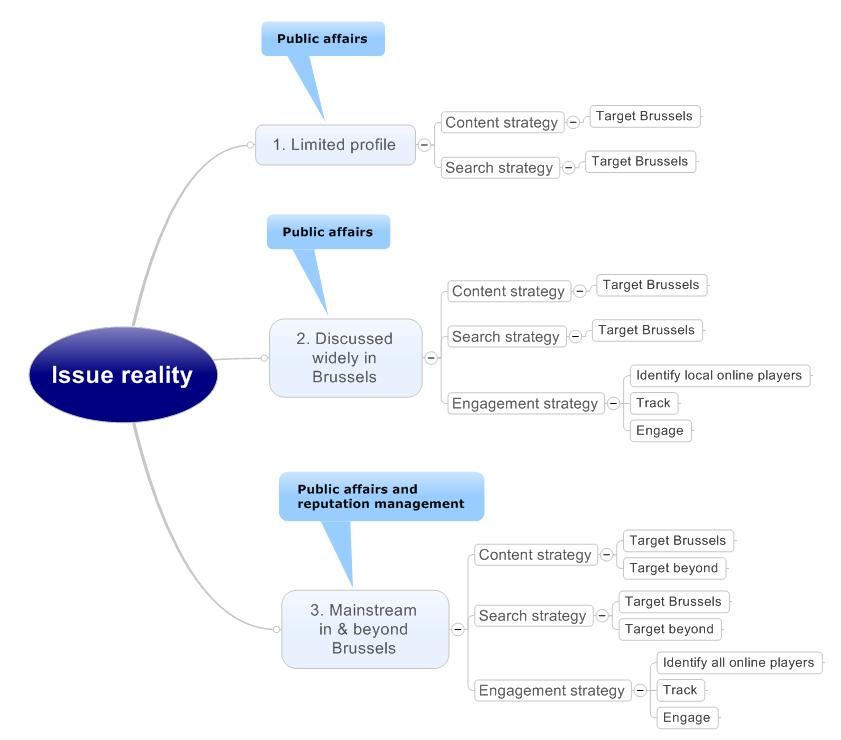
In a previous post, I outlined three issue realities and the appropriate digital response, and I think the same separation is pertinent here. The three are, in short, the very technical issue which only a few policy wonks know about, the slightly less technical issue which is being discussed widely in policy circles, and the issue which affects a lot of people and has people talking beyond policy circles.

Arguably, only the latter reality requires highly proactive corporate communications, and the fact of the matter is that more issues fall into that bracket in London than in Brussels.

Why? Generally, because there is less interest in and scrutiny of the legislative process in Brussels than there is in London. Here are a few reasons why that might be:

  • Many of the meatier issues which tend to attract public interest are beyond the EU’s remit (immigration, tax, social security, most foreign policy etc.) Instead, the EU deals with many highly technical and – in the eyes of most people – dull dossiers.
  • MEPs have low profiles nationally and in their constituencies: they don’t necessarily need to prove themselves to their electorates based on issue alignment and so probably make decisions based on facts and figures more so than their MP counterparts, who are perennially busy courting voters.
  • The way legislation is put together in Brussels is based heavily on compromise and attaining the lowest common denominator in a drawn-out process, which is frankly less interesting (slow; fewer dog-fights).
  • A red thread here is the fact that the UK media has little interest in EU affairs, meaning most stuff passes under the radar in any case.
Anything I’ve left out?

Pan-European campaigns need to be local

Quick thought. I’ve just reviewed an audit on an issue in three European countries for a client. Can’t give the details, but here’s the gist:

  • One country is broadly pro and the other two are anti.
  • In the pro country, however, media and blogosphere, which are both very active, are not aligned: the blogosphere is pro because of reason X, media because of reason Y.
  • In the two anti countries, one country is virulently anti (media, blogosphere, academia, politicians, government bodies) even though it is only minimally affected by the issue. And the reason it’s anti is not even on the radar in the pro country.
  • The other anti country is less anti, but as with the pro country, media and the blogosphere are not aligned: the blogosphere is very anti while media is fairly balanced. And as opposed to the other countries, industry has a significant voice.

OK clearly without the details, this might not sound too enthralling, but the point I’m trying to make is this: pan-European campaigns exist and can be a success if planned and executed well, but only the overarching framework can be uniform. Everything from research and monitoring through to message and channel selection has to be done at a more local level. And local might not even mean national: micro-targeting of groups within countries needs to take place, and the groups may be determined by local geography or demography.

So in short, when thinking pan-European, think overarching goals, but then break down the campaign into multiple sub-campaigns. And feel free to set the campaign goals centrally and retain some control, but avoid local groundwork and ongoing intelligence at your peril.

Public Affairs and Digital: 3 realities

This is how I’d summarise the realities of organisations operating in the Brussels regulatory space and how they need to apply digital, developed a little further than done in my previous post entitled Digital in PA: two client types.

Couple of points:

  • There may be plenty of overlap – an issue may be mainly 1 with a bit of 2 looming; or an organisation may be dealing with an issue that’s 1 but overall very much fit into 3 due to issues beyond the PA bubble.
  • Most organisations operating in Brussels probably think it’s all about 1 but should be thinking a lot more about 3 (read my post on the “constituent consumer”).

It’s a content strategy you want, not social media

This recent post by Will Davis entitled “Why Companies That Say They Want Social Media Really Want Content Marketing” struck a chord. A lot of times, organisations operating in the Brussels regulatory space will ask me: “how do we start engaging in social media?” rather than “should we engage in social media?”

FH’s survey on how Members of the European Parliament – clearly a key Brussels constituency – use the web, illustrates in no uncertain terms that MEPs mainly look for content, not engagement. For instance, we found that while only 34% use Twitter (and only 31% state that it is effective or very effective as a means of communication – presumably because they use it as a megaphone rather than a mechanism for dialogue), 99% of them use a search engine several times a week to find content on policy.

Sure, in some policy areas, like ICT, MEPs, Commissioners, officials and other people engaging on the issues are fervently exchanging information via social media/social networks. In the majority of areas, this is not the case. And anyhow, you still ideally need content as a starting point for feeding information into the engagement loop to provide value and ensure that people take notice of you.

So if you’re doing online outreach in Brussels, take these steps:

  1. Develop a relevant content strategy and make sure you’re found via search.
  2. Figure out who is active in social media amongst your key audiences on your issues and track them.
  3. Determine how these people choose to engage: if they are demonstrably open to listening and sharing, by all means engage with them, but don’t jump straight in the deep end.7BMA5AEWAW6

Posts I’ve published elsewhere

I’ve written a few posts on PublicAffairs2point0 recently which might be of interest to some of the readers of this blog who don’t follow it:

A somewhat lazy post, apologies, normal service will resume shortly.

“We can’t do that”

Was just inspired by Nicholas over lunch. He said he’s fed up of hearing people say “we can’t do that”. So am I, so I thought I’d list some “we can’t do thats” I particularly detest. Feel free to add more:

  • We can’t do communication, our remit is just government relations (since when is government relations not communications and no it’s not your remit, your remit is success, and that might require stuff beyond GR.)
  • We can’t do digital, we’re not ready for it (well get ready.)
  • We can’t do digital, our boss/board/member is conservative (digital doesn’t have to be whacky geo-location stuff, it can just be content creation and you’ve done that for years. In any case, your audience isn’t conservative, so who cares if your boss/board/member is? Check FH’s MEP survey if you’re not convinced.)
  • We can’t do digital, our industry is conservative (so what?! Same reasoning as boss/board/member fits in nicely here too.)
  • We can’t do digital, our audience is older (we’re not saying develop an app aimed at 4 year olds on Facebook. Every demographic uses the web in some way.)
  • We can’t do digital, we don’t have internal support (prove value to them and use facts and figures e.g. the aforementioned MEP survey.)
  • We can’t do digital, we don’t have the resources (no one is saying do a global blogger engagement programme; digital is huge – start small and then scale.)
  • We can’t do digital, we only have an audience of 50 (no it’s never just 50; in any case, if it were just 50, they’ll still look you up online.)