The Public Affairs professional, present and future

Explanatory note: I don’t mean that the PA pro will be out of work and forced to do construction, but rather, that the role of the PA pro will move from putting out fires i.e. dealing with short term regulatory crises, to working with other communications units within organisations to build reputation and brand. The PA pro will still be responsible for communicating to policy makers and their influencers, but focusing on wider issues, not just immediate policy concerns. Ultimately, it’ll mean they’ll need to put out fewer fires in the long run.

Image credits 1 & 2

Public Affairs: best use of websites and positions papers

Two staples of the PA comms suite in Brussels are policy focused websites and position papers. They’re usually chockerblock with useful stuff, but in most cases, fall prey of being too detailed. A majority of your audience will not be experts, although some will, so a range of knowledge levels must always be respected. As my colleague Aaron frequently says: most MEPs are lawyers – not scientists, engineers or economists.

Hardly rocket science, but these two triangles illustrate what I mean in a tad more detail.

On websites, a site visitor should first be presented with easy access to basic information, and if he or she wants more detailed information, or even highly advanced information aimed at experts, they’ll find it by clicking further. Some sites do this, but most don’t: they’ll either not cover all levels of detail, or they’ll be overly detailed from the off.

Position papers are always detailed by nature, albeit to varying degrees. That’s fine, but the issue is that they’re frequently left unread because of it. What’s missing is that the position paper is never broken down into smaller bits. There are real opportunities here, given that a position paper represents an organisation’s detailed and virtually complete vision of an issue, so the building blocks are all there. Meaning what? Take the information and do one or more of the following:

  • Create an alternative version in 10 bullet points or structured like an FAQ
  • Create an executive summary in visual form (infographic)
  • Feature the author(s) in a video, podcast (or series of) describing its contents
  • Create a series of online news items, blog posts or whatever, each highlighting one section of the position paper
  • Publish a series of tweets highlighting the key points and a link through to the detailed paper
  • … And market each item heavily

Public Affairs and corp comms: making them work in tandem in a policy town

Organisations, including agencies, often have separate public affairs and corporate communications functions in Brussels (not Fleishman-Hillard). It’s a tad peculiar, given that PA is a communications discipline, and that the comms piece is increasingly important: good PA must incorporate more elements of disciplines such as reputation management and branding than before, while the proliferation of channels means there are far more ways to reach policy-makers, and often in more markets. Combined, there’s no doubt that success isn’t easily attained with traditional PA tactics alone.

So why are the functions often still kept separate?

  • Culture. By and large, PA professionals tend to value knowledge (policy-based), while comms people think communications strategy and output (audiences, content, engagement, measurement etc.)
  • Comms people weren’t required back in the day: there were fewer target audiences and channels, even PA people could do it properly! These same PA people still rule the roost and are loath to change their ways.
  • Structurally, the fact that the disciplines were separate means separate silos developed. Hence the Brussels phenomenon where companies have their European HQs out by the airport and a PA office near the Parliament.

So what should organisations looking to assimilate their PA and corporate communications functions in a PA town do? As is often the case in this blog, there’s no definitive answer, but a series of thought starters:

  • The bleedin’ obvious: combine the corp comms and PA teams.
  • Bring in new blood to stir things up, especially senior corp comms talent.
  • Focus on avowed generalists who bridge the PA and corp comms gulf most comfortably.
  • Position the corp comms folk as thought leaders and have them lead a series of first-rate internal training sessions (PA folk are smug and will inherently think they’re more cerebral – this may help!)
  • When possible, make a corp comms specialist head of PA too…
  • Make it about more than corp comms and PA: build bridges with marcomms, even if they’re in a different country.
  • Do the boring stuff to support this: create processes e.g. monthly calls, annual meetings to exchange best practice (based on very clear templates and agendas to ensure relevance).

Thoughts on the Brussels blogosphere debate

The debate around the Brussels’ blogosphere has tended to centre on the relative lack of good quality blogs, especially within the policy realm. Over the last couple of weeks, the debate, spearheaded by Ron Patz and elaborated by others such as Bruegel, has been about the shortage of interaction within the Brussels blogosphere, especially the paltry number of links that eurobloggers seem to include to each other in their posts.

My (very belated) two pence worth:

Obviously, the premise is correct: when a blogger engages on subject matter that is being debated more widely, they should aim to reference and respond as far as possible. However, at the risk of stating the bleedin’ obvious, looking at the  Bloggingportal.eu Editor’s Choice posts, it appears that a fair number of the bloggers in question wrote in isolation i.e. on topics which were not being debated very widely in other euroblogs at that moment in time. Not always, but often.

In a sense, the “Brussels” or “EU” blogosphere is irrelevent to many eurobloggers. Given the nature of the beast, people’s core area of interest is often a specific issue or policy area, say energy, ICT, financial services and so forth. Generalists who work across various sectors or even just regular citizens interested in the EU, but not a specific issue or policy area per se, are relatively limited. So rather than the Brussels blogosphere, their real interest is a niche e.g. the EU energy stakeholders’ blogoshere, the EU ICT stakeholders’ blogoshere etc.

Ideally, this is where the national-EU factor should come into play: creating communities that connect national and EU-level niches on specific issues or policies is where we want to go, but it’s fair to say we’re not quite there yet. The language conundrum and the splendid isolation which the Brussels bubble has grown accustomed to play a part and I for one admit candidly that I should make more of an effort to connect Brussels based clients looking to engage online with players in the national sphere.

Ultimately, although many bloggers should no doubt make more of an effort to avoid operating in splendid isolation, the issue of critical mass is no doubt rearing its head. Sure, there are a fair few euroblogs in absolute terms (+900 on Blogginportal) but within each niche, there may only be a handful that hit the sweet-spot i.e. regular, relevant, good quality posts (and in a language others understand!) I’d candidly admit that as a blogger I don’t link enough, but arguably I fall into a niche as well i.e. Brussels, the practice of Public Affairs and digital comms is an odd mix and not widely debated (an excuse on par with “my dog ate my homework..?”)

Is this state of affairs indicative of the failure of the EU blogosphere? Hardly. I know purists will disagree vehemently, but there’s still room for well written blogs even if they don’t connect to a wider blogosphere especially well: if the relevance and quality of content in a blog means it is read and appreciated by lots of people who matter, then that’s a good first step. “Then it’s just a website,” I hear. Not really, the nature of the blog allows for greater flexibility of style and formats i.e. short post vs. long post, reference vs. original content, more personal vs. less personal and so forth.

Where will we be ten years from now? My somewhat rosy vision is as follows. The EU blogosphere for generalists will probably still be whinging about the lack of an EU blogosphere for generalists, as the EU as a general construct will still not have captured the public imagination. More critical mass overall will have resulted in niches interested in EU related stuff, such as specific policy areas, accruing critical mass too: the EU blogosphere will be larger, but it will be made up of lots of smaller communities i.e. the EU energy stakeholders’ blogosphere etc. that are more connected than at present, and yes, link to each other more so than at present.

And the EU itself? It’ll be part of the mix, but at niche level i.e. Commission officials who work on energy related stuff will be part of the EU energy stakeholders’ blogosphere and so forth. Communications generalists at the EU will no longer communicate on behalf of the EU, but will merely act as evangelists and advisers to the subject matter experts, who themselves will be doing the communicating.


Digital PA does work but you need to tick all the boxes

Heard in the trenches in Public Affairs land in Brussels:

“I’m on Twitter, but no one is following me”.

“I have a site (or blog) but I don’t get any traffic”.

“I spend loads on advertising but people leave my site as soon as they get there”.

And so forth.

The fact of the matter is that doing one thing without the other doesn’t work.

You may produce good content, but you need to market it to drive traffic. You may be active on Twitter within the right community, but you need to lead to good content. You may market to the right audiences locally but there’s no use if what you drive them to is dull and/or irrelevent.

In short, you need to hit the sweet-spot in the middle. Hardly rocket-science, but worth re-iterating.

Web purists vs. web realists

People who may be regarded as experts in online communications often fall within one of two categories: web purists and web realists.

How do they differ?

Purists insist on intricate strategy before any tactics are put in place, realists are a little more flexible.

Purists have a holy grail: engagement, two-way conversation and community. Realists aren’t afraid to say, let’s tell a story first, we’ll converse later on.

Realists will get people to play around as a means to get them accustomed to using the tools. Purists do not let people anywhere near the tools unless they’re fully with the programme (and a strategy is in place.)

Purists are right; I know theirs is best practice. In future, they’ll rule the roost. I confess I’m a realist though. I can feign being a purist and I can do whatever they can, promise. And in many cases, the purists’ approach is already viable i.e. when dealing with organisations or individuals that get it and/or are determined approach digital properly. Having spent years struggling to get online comms off the ground at a variety of organisations, I think a little realism is needed sometimes, however much purists remain loath to admit it.

What is negative coverage? Past, present and future

Based on a conversation with a seasoned corporate communicator:

In the mid 80s, when the person in question started their career, any adverse reporting was deemed harmful. Press-clipping syndrome was very prevalent, meaning that anything published that could be deemed critical was taken very seriously indeed. This was an age when NGOs were just starting out and industry-bashing was in its infancy, so the fuss was probably all a little pointless.

In the nineties, and the noughties especially, with the web and social media taking off, the issue of loss of message-control was very prevalent. The fact that Tom, Dick and Harry could say whatever they wanted and gain an audience was seen as an existential threat. Press-clipping syndrome remained somewhat prevalent, and coupled with the might of the NGOs that were supporting Tom, Dick and Harry in their endeavours, critical reporting was deemed very dangerous indeed and increasingly hard to manage given the proliferation of channels.

In 2012, it’s all still pretty frightening, although not ALL stuff that is published and in the public domain is deemed as potentially dangerous. We’ve got better at differentiating: high-influence, high-quality influencers we care about, trolls, less so. This probably stems in part from the fact that industry has got better at using the channels itself and so essentially understands them and the threat that a single event may represent far better than just a few years ago.

In the future? 2012 evolved: adverse coverage will continue, but it will seldom come as a surprise. Organisations will be fully ingrained in the social media space, and numerous people will be entitled to track and respond, not just a couple of spokespeople. Individually, that which is deemed harmful will also develop. For instance, while we now hear of firms not hiring someone because they’ve found pictures of them on an all-night bender, in future, surely, people’s records online will be so comprehensive that we’ll expect nothing less!

How does a PA pro become content-driven and creative?

I frequently speak to fellow Public Affairs professionals who tacitly agree that we’re all a little dull (not personally, but the PA function within our organisations). This is problematic because the evolving nature of the PA function demands that we become more interesting. Gone are they days when we speak to a miniscule audience of fellow experts. Increasingly, we need to be winning over hearts and minds that may not know that much about the subject matter, in a market where they are exposed to far more information than ever before. This in turn obliges us to be more thought-provoking, amusing and, god forbid, emotional.

No, PA is not too cerebral to be any of the above: enough of the endless data, position papers no one reads and press releases no paper picks up; instead, bring on smart summaries of issues, layman’s terms and information presented in forms other than small print.

Easier said than done though: how does the PA function, which traditionally has focussed on subject-matter expertise alone rather than how to communicate it effectively, suddenly become thought-provoking, amusing and emotional by embracing creative content production?

There’s no right or wrong answer, but here are a few thought starters.

How isolated is the PA function within the organisation in question? If it’s very isolated, it’s unlikely to have been in contact with more creative elements it could probably pick up a few tricks from (usually the ones involved more closely in targeting customers). And by the way, the old “we’re traditional, there’s no one creative in the whole company” claim doesn’t fly: creative doesn’t mean comic books and trapeze artists, it can just mean smart, strategic thinking done with a twist. Talk to the brand, marketing, corporate communications teams, even if they’re somewhere else, and even if you’re a bank or produce unpronounceable chemicals.

You can try to change things from within but the people onboard have “traditional” PA profiles? That’s fine, but next time you hire someone, maybe look beyond the person with a political science degree, experience in government or similar sectoral experience in a different setting. Hire someone who has a proven track record in communications outside a policy town. Clearly they should understand PA, but it shouldn’t be their bread and butter. This sort of profile will also usually be better at grasping PA within a business and reputation context, which is getting ever more essential as we veer towards a model where Public Affairs becomes less about government relations alone.

“Hire someone creative” may be a bit of a push, not least because the barriers to creativity often stem from internal hurdles placed by traditionalists within the PA function in an organisation. How can they be won over? Start with two simple things which we for some reason often overlook in Public Affairs although they are staples in other areas of communication: benchmarking and polling. Yes, benchmark other organisations, other industries, even other functions within your own organisation. I suspect many of them will have produced smart and effective material that isn’t in Times New Roman font size 8. By polling I don’t just mean professional polling (although clearly if you can, do so). Ever asked friendly members of your target audience (officials, assistants, press) what they really want from you? In many cases, it won’t be another position paper.

If you work with agencies, as yourself a couple of questions. First, is your agency the right one? You need policy expertise but you may also need really good communications nous. Does your agency provide both? If not, maybe look beyond it. Second, do you use an agency that is part of a larger network? If so, make sure your agency thinks of other parts of its network when servicing you. They may have a design magician in Paris and a former journalist come story-teller par excellence in Berlin who could be really useful to you, but neither is being called on because “they don’t do PA”.

Anything I’ve forgotten?

Sometimes it’s ok to talk tactics before strategy

Every communicator shudders at the mere mention of tactic-centricity. To the seasoned professional, there is no worse sin that deciding on a channel for delivering communications before developing a strategy for it.

I agree wholeheartedly, in principle. Just sometimes, however, it’s ok to go the other way around, especially in the realm of digital. Why? Simply put, people are still uncomfortable with digital because they’re not quite sure what it’s going to look like. If your starting point is: give me time and resources to develop the smartest approach, then once we know, we’ll decide on tactics (or delivery channels), plenty of non-connoisseurs will be uneasy.

Starting the other way around, by saying, look, here’s the channel we’ll most likely use and this is how others have used it before, but give us time before we launch to develop a strategy for how to best utilise it – it becomes an easier sell. So it’s worth sidelining those principles, just once in a while.

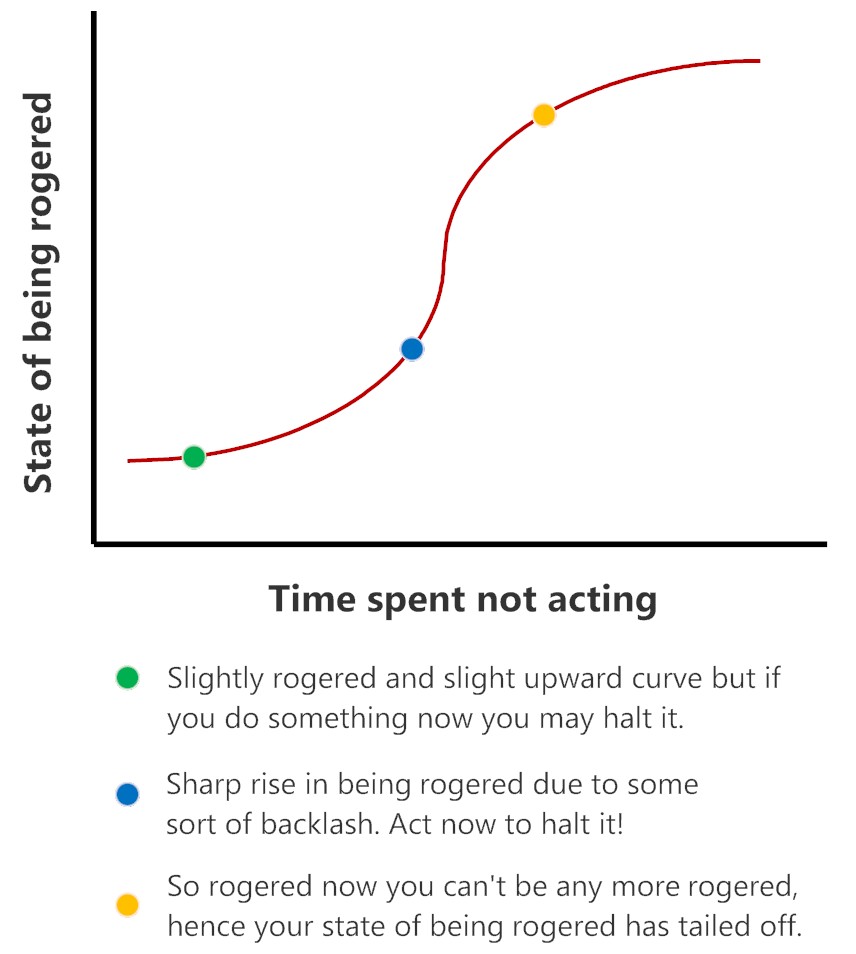
Communicate before it’s too late: the state of being rogered graph

In Brussels, we often find industries and organisations being battered by regulation and complaining: it’s not fair, we’re safe/clean/beneficial to the economy/a major employer/innovative/etc.

Yet often, the said industry or organisation failed to communicate that it was safe/clean/etc. to anyone before it started getting battered. In fact, often, an organisation or industry goes even more silent once it starts getting battered.

The highly scientific state of being rogered graph shows that the state of being rogered (defined as the likelihood of detrimental regulation being imposed) increases over time if one fails to communicate.

Moral of the story, if you indeed are safe/clean/innovative/etc. don’t wait for us all to find out on our own.