Social media fatigue in Brussels

Not long ago, Brussels was wildly excited about the potential of social media, from two perspectives:

  1. Social media = EU saviour: proponents of the EU construct believed that social media could help bridge the divide between member states and Brussels, connect citizens and the institutions, and generally make the EU more visible, democratic and transparent.
  2. Social media = Public Affairs tool extraordinaire: organisations operating in policy-land believed they had a wealth of new options at their disposal, whether they were looking to reach out to policy-makers, build coalitions, or generally raise visibility and momentum around issues that mattered to them.

In both respects, we’re experiencing social media fatigue, as even the most ardent enthusiasts are appreciating that social media is no silver bullet without the right building blocks. Meaning what?

Social media ≠ EU saviour

The EU is dull: it remains uninteresting to many because it’s distant and deals with issues that most people don’t care about. Tax, education and healthcare are more interesting than REACH and fish.

The constitution debacle and now Eurozone has dealt a massive reputational blow: the fact that EU enthusiasts often seem to not care much invariably fuels accusations of it being elitist and undemocratic.

Leadership and communications: many leaders and others responsible for communicating Brussels to the world frequently struggle to articulate its significance without coming across as – again – elitist, pompous and/or uninteresting (some, not all!)

The piñata effect: given that the EU leadership and those responsible for communications don’t articulate their activities and raison d’etre especially well, they’re an easy target for national level politicians, media and others wanting to pin the blame for everything – rightly or wrongly – on Brussels.

Language: last but not least, we may now have channels that allow for instant, barrier-free communications, but we don’t all understand each other.

Conclusion in short: the building blocks aren’t right i.e. if we don’t have the right people saying interesting and relevant things, to the right people, at the right time, in the right tone, who cares if we have shiny social media channels at our disposal?

NB: Mathew has written about EU communication and social media in far more detail and quality than I have here – have a look at his blog if you’re interested in this topic (although he’s stopped blogging for now).  

Social media ≠ Public Affairs tool extraordinaire

Organisations often aren’t allowed to say anything interesting: when talking to policy audiences, or audiences that are affected by policy, it helps to be permitted to talk about policy. Sometimes the lawyers, or company and/or industry culture won’t allow it.

Public affairs functions within organisations often have no strategic communications capability: they operate in a policy silo, blissfully unaware of the fact that communications (on or offline) can actually be pretty effective when done well. Net result: limited use of data, analysis and measurement, and thus poorly targeted and ineffective output.

Structure and resources: linked to the previous point, organisations may think communications is fab but simply don’t have the right organisational structure, people or outside support to conduct it well.

Organisations sometimes really don’t have anything interesting to say: sometimes there’s a lull when no particular dossiers affect an organisation and they have nothing remotely interesting to say that would interest policy audiences (NB: this is only the case with utterly uncontroversial industries, of which there are only a few e.g. if the Financial Services industry had nothing on going at the moment – utterly hypothetical of course – they’d still have lots to do to mend their reputation and thus to communicate).

Conclusion in short: again, although some digital PA is very good, the building blocks often aren’t right  i.e. as above, if we don’t have the right people saying interesting and relevant things, to the right people, at the right time, in the right tone, who cares if we have shiny social media channels at our disposal?

Dodgy to amazing: where do Brussels communicators lie?

I recently helped a client develop a framework that defines multiple phases of development in digital comms, broadly and in specific disciplines (e.g. content marketing, social media or search, for instance). The thinking is that it’ll show where the organisation currently lies and where it ultimately wants to get to – a very useful exercise indeed.

For my own amusement (I’m that sad) I’ve drawn up a simple (and slightly sardonic) grid for communications and communicators in Brussels

NB: I treat comms and policy work – i.e. traditional advocacy – as separate activities given that it’s usually how they’re approached in Brussels. The pedant in me would say advocacy is just one channel in an organisation’s communications suite.

  Dodgy Half decent Good Amazing
Mind-set Comms is for idiots who don’t get policy We understand the value of comms in informing traditional policy audiences We appreciate the value of comms in shifting the pin in Brussels and beyond, which in turn can affect policy-land Comms will be as important – often more important –  than traditional advocacy, if it isn’t so already
Brussels bubble Nothing matters outside Brussels Sometimes stuff outside matters, but we tend to ignore it Stuff outside matters, and we work actively with people at national level We make no distinction between Brussels and national level interests when necessary
Structure for communications No structure (or the intern does it all) Mid-level comms manager and limited support Senior level comms manager and good support Senior level comms manager fully integrated in organisation’s leadership
Channel strategy Comms = press releases to the entire Brussels press corp Mainly owned and earned media (e.g. events, website, newsletters, media relations that isn’t spray and pray) Full array of channels (paid, earned, shared and owned media) i.e. include more marketing and social media Full array of channels, part of a single overarching strategy, fully integrated
Integration with traditional advocacy There’s policy work, then separately from that we’ll do a press release when we host an event We have our basic positions available publicly but don’t update regularly We regularly communicate around our policy work in all comms channels Policy work and comms are fully aligned
Targeting “Decision makers and the general public” i.e. no idea who we’re talking to and why We have given serious thought to who we’re talking to and why but don’t have data We did some initial analysis (polling, focus groups, interviews) to understand our audience We did initial analysis and do ongoing tracking based on specific KPIs to make sure our comms is always relevant
Content production What’s content? Regular content updates, but ad hoc and limited senior level input Regular scheduled content updates, some senior input Very regular scheduled content. Senior expertise apparent in all content items
Measurement Huh? Basic KPIs for core activities measured manually or with basic tools e.g. media coverage, event attendance, website hits – but tracking without consequences KPIs for an array of activities and use data to inform future comms activity KPIs for an array of activities and use data to inform comms activity AND overall strategy

Thoughts welcomed.

PA professionals: picking the right “influential” people

A Public Affairs staple, as with all fields of communications, is to seek out “influential” people who support your side of the story and are willing to say so. This gives you and your side of the story credibility, so the logic goes.

So who is usually sought out as “influential” in PA? Often, the academic (or scientist) for clearly these are highly credible folk: smart, independent and presumably not profit driven. Again, sounds logical, you’d think, and what’s more, the Trust Barometer tells us academics are amongst the most trusted people out there.

Yet as anyone working on issues in Brussels can confirm, you can have scores of cuddly, bearded academics on your side, without the tide changing on your issue.

Why not? Could one reason be that we’re applying rational thinking to an irrational process? You ask someone who they trust: the CEO, the academic, an NGO, someone like you… You’re given time to think, and you’ll provide the rational answer: clearly, I trust academics.

Yet we don’t make decisions rationally, we do so emotionally. Our gut tells us how it is. In a meeting I recently attended, a clever man said that 95% of decisions are “emotional” not rational. Let’s be conservative and cut that down to 80% for the purposes of my little illustration here:

In summary:

  • Academics and scientists appeal to our rational being, which reflects perhaps 20% of decisions.
  • Who could influence emotional decision making? Perhaps a regular Joe like me with a clear link to the issue at hand, ideally an emotional link (I work in industry X which people are trying to shut down; my child suffered at the hands of substance Y). A celeb? Not any celeb, but a well-known person with a less than spurious connection to a cause (OK hardly Brussels fare, but remember Joanna Lumley and the Gurkhas, legitimised by the fact that her father had been in a Gurkha regiment?) Or a community and/or business  leader who, again, might not be just like me or be a celeb, but has taken an issue on board with real fervour.
  • What do these type of influencers have in common? In short, they approach an issue from the heart, not in a cold-blooded analytical fashion, and are thus more likely to influence emotional decision-making.
  • And journalists? Clearly influencers, but they’re hard to place – it depends on the individual, the publication and their approach on the day, so I’ve placed them on the threshold.

Online habits vary: social technographics applied to Brussels

Forrester’s Social Technographics Profile Tool is superb; take a look if you haven’t previously. In short, it breaks down social users into different categories, ranging from inactives (don’t use social) to creators (produce and publish stuff). The figures can be broken down further by demographic variables (age, sex and location) which makes it useful reading for marketers and communicators. Looking to reach German men in their 30s? Focus on content more than engagement, given that they read lots but don’t like to share and interact. Italians? Go for engagement and even user generated material, cos they love the stuff.

What if we applied a similar model to Brussels, with the following variables:

  • Sex
  • Age
  • Nationality
  • Sector/area of expertise (health, financial services, tech, environment, trade etc.)
  • Organisation (Commission, Parliament, Council, Perm Rep, in-house, NGO, agency, trade association etc.)

What would we likely learn? No doubt there’s extremes: a southern European male, aged 45-55, specialised in financial services and working in the institutions would likely be an inactive (although there’ll certainly be exceptions). Meanwhile, a young Swede working at an agency on tech issues would probably be at the other end of the spectrum.

But what about the less obvious middle ground? A 40 year old Hungarian working on trade issues at their perm rep? OK the critical mass of data to get that specific would probably be lacking, but as a basic indicator, I think it’d be fascinating nonetheless.

Stop running communications programmes – run campaigns instead

Too often, communications efforts conducted in support of Public Affairs ends are treated as programmes and not campaigns, making them mundane and less likely to work.

Meaning what? Let’s imagine, in theory, that we’re trying to ban the Internet. What would a programme look like (utterly simplified and wildly hypothetical)?

Standard PA fare no doubt:

  • After planning and strategising, we’d probably build a coalition of likeminded people and organisations (angsty parents, with the backing of responsible newspaper publishers and the music industry perhaps?)
  • We’d develop a series of suitable messages and storylines about how the Internet has led kids astray and destroyed businesses, which we’d test and finalise, and distribute as content/storylines in a variety of channels (on and offline)
  • We’d work with targeted media and bloggers to try to get our side of the story across in their publications
  • Clearly, we’ll have identified make or break policy-makers (an eclectic mix of arch conservatives and anti-business types probably) and developed appropriate programmes for the coalition to engage with them

That’s all very well, but probably won’t help us stand out from the crowd and win over hearts and minds.

What would a campaign look like? Oddly enough, pretty similar, except we’d also have the following:

  • A campaign name (short, memorable, punchy e.g. save our kids, but obviously much better and with no competition in search engines)
  • A 10 (max) word catchphrase to describe the one main campaign goal
  • A striking visual identity (logo, colours etc)
  • Some milestone that represents an end date (X is happening – we have 60 days to save our kids!)
  • A dedicated home online (i.e. not as a sub-page of a larger site, as you’d invariably have with a programme) as well as supporting channels (social media, probably)
  • A champion i.e. an individual who “owns” and is the face of the campaign, be it a business leader, celeb, community leader, or a complete random elevated to champion status because they’re relevant (an aggrieved parent looking to save her cute, buck-toothed son from web wickedness)

Does it all sound a bit gimmicky and unsuitable to the oh so technical and cerebral dossiers most people think they work on? Perhaps, but the type of campaign you choose to run can vary greatly, depending on the nature of the issue. When there’s a clear, simple grassroots angle, you can go boisterous and colourful (like Hugh’s Fish Fight, say). But if your issue is less likely to capture the public imagination or is inherently unpopular, sure, be more staid and low-key. However, the principles remain the same: a campaign trumps a programme every time.

Digital public affairs latest presentation

I gave a presentation to a number of smart and lively communications professionals last week as part of the “EU Federation Knowledge Programme”, organised by EurActiv for their trade association / federation partners. The theme was my usual: applying digital and social media to Public Affairs activities in Brussels. Warning: if you don’t like orange, avoid!

My new blog on Italy

Some readers may remember a number of angry, annoyingly righteous and humourless posts I wrote about Italy a few years back. After a couple of people I know and trust told me that the posts were annoyingly righteous and humourless – and made me appear a bit angry and odd – I got rid of them.

They’re now back in a more appropriate setting: a new blog entitled Occasional Italian, where I’ll write about Italian stuff once in a while. I’m not trying to be an authority on Italy and the Italians but I love the subject matter and enjoy writing, and sometimes getting things off my chest is rather therapeutic.

So to any Italophiles out there, feel free to visit Occasional Italian and if it takes your fancy, comment.

Success in digital communications on issues: the three Cs

A lot of digital issues comms may appear good at first glance, but does not tick enough Cs to succeed, the three being: content, community and campaign.

Here’s a hypothesis representing pretty much any organisation that conducts online communication:

  • Organisation X has a clear story to tell and knows it needs to do so through a variety of content delivery channels (content).
  • It has to speak to a spectrum of people in a variety of contexts in a number channels in order to rebut falsehoods, try to convince the unconvinced, ensure that supporters are informed and motivated, and generally have a clear voice (community).
  • It knows there is lots of competition in the overcrowded communications space, so it needs to have a clear and compelling goal and identity, single core message which people remember, and it needs be splashed everywhere through a variety of channels, and often include advertising (campaign).

To their detriment, organisations will often do one or two of the three. They’ll produce really good content, but they won’t engage with naysayers or supporters in social channels, allowing the other side to dominate the space. Or they’ll engage in social channels but not have convincing content to drive people to. Or they’ll produce content and engage but their programme is not treated as a campaign, meaning it is not as visible as the other side and doesn’t get the pulse racing. Or it’s treated as a campaign and lots of people take note, and then once they dig deeper, they see there’s no convincing story because the content’s poor and there’s a backlash. And so forth.

There’ll be instances where organisations won’t need to focus that much on one of the three Cs. On a niche issue, conversations in social may not be that rife, for instance (this is often the case in digital PA). However, in most cases, organisations are strongly encouraged to tick off all three, or the one or two they do invest in won’t have enough traction to make the programme a success.

Stakeholder mapping = online stakeholder mapping

Despite the various “influential bloggers” lists and the like about, what often escapes the otherwise astute PA professional is that the online world is not a different universe, at least in Public Affairs in Brussels. Citizen blogging or tweeting on the majority of issues that PA folk in Brussels care about has not taken off, meaning that the usual array of politicians, officials and journalists that are artfully mapped out in the hallowed stakeholder maps, a staple of PA, just need an extra couple of columns and it’s an online stakeholder map too.

In short, check if the said individuals tweet or blog or otherwise engage (avid engagement in a certain LinkedIn group perhaps?) and add a couple of extra columns, one for whichever channel they use, and another on how they use it (last tweeted 6 months ago, ignore; avid and insightful blogger, don’t ignore.)

A shame somewhat, but still a reality on the majority of issues. Don’t get me wrong, there are influential people here or there outside the regular offline crowd, especially in tech and energy, and there are a few influential generalists, but the issues based influential crowd in Brussels is pretty much the same whether on or offline.

Influence in Public Affairs

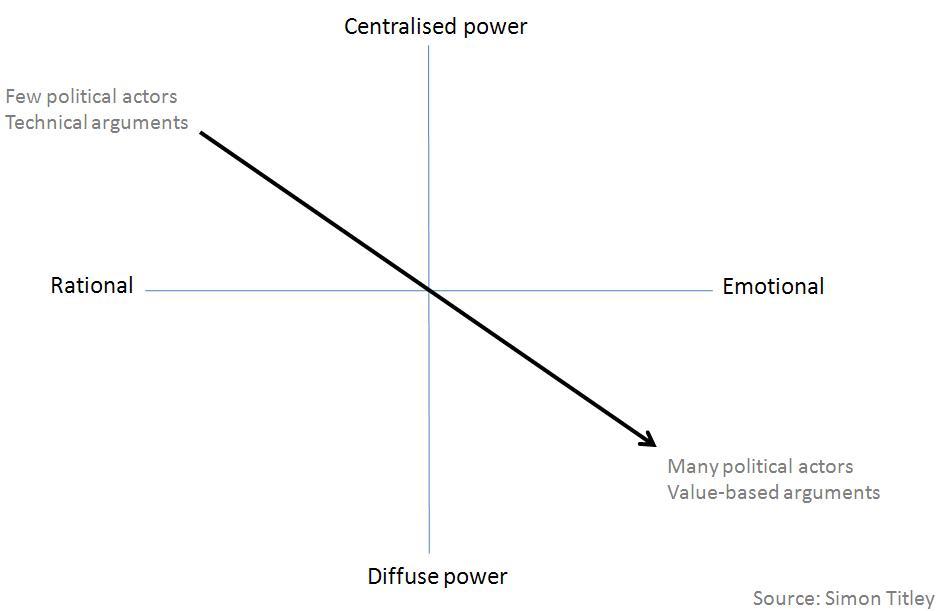
The “new” model of influence graph above was developed a few years back by Simon Titley, a seasoned and often outspoken Public Affairs professional who has long called for PA professionals on the corporate side to take a leaf out of the NGO manual. Namely, to campaign for long-term change rather than engage in short-term policy nitty-gritty only: there must be room for both.

In short, the diagram highlights that:

  • We’ve shifted from an age where power-brokers could be counted on one hand (politicians, big business and media) to one where smaller organisations and often even individuals can yield political clout. This has been accelerated immensely due to the web.
  • In parallel, arguments used to gain political clout have developed from being highly rational (economic, scientific; easily measureable) to being emotional, or irrational even, often dictated by beliefs that are strong yet not so easily measureable, say, environmental protection.

I’ve used the graph in presentations for years and it’s frequently given rise to fierce nodding and other such indications of agreement – thanks Simon.