The evolving practice of EU public affairs

When we discuss EU public affairs, we tend to gravitate towards the issues and the politics rather than the practice of public affairs itself. Fret not, this isn’t another post waxing lyrical about AI. It’s the result of a fun little exercise for a client that is reviewing its public affairs set-up and requested our view on top-line trends in several markets. I contributed to the EU one and was kindly given permission to share a redacted version here. If you note any glaring omissions, do let me know (I’ll pass it on to the client and confess that the internet knew more than me ).

Mastering the political and the technical

With ever more decisions being made in expert groups, public affairs professionals with a high degree of technical knowledge thrive as much as ever. Paradoxically, policymaking is also more political than ever. This is driven by the types of issues handled in Brussels, coupled with a political Commission, a relatively activist and engaged Parliament, and member states that are highly engaged at the EU level to respond to their publics. This shift represents a challenging new discipline for many professionals accustomed to a Brussels that was solely apolitical and technical: an environment beloved by policy boffins where deep expertise on legislative detail was the only currency.

Navigating capitals

As implied, with member states aggressive in the defence of their own positions, much power has shifted to national capitals, especially in larger countries. EU public affairs professionals must now navigate a complex world of party politics, public sentiment, and national media. But it’s not all political at the national level: the prevalence of comitology means delegates flown in from member states are usually key players in the policymaking process, rather than Brussels-based diplomats. So, the boffins still get to practice their craft in capitals too.

A focus on value creation

While still largely a defensive shield to protect business from regulatory threats, public affairs professionals are increasingly being judged on how far they can help the business grow. Given the proliferation of EU funding schemes and the (relative) easing off of large-scale regulation packages, value creation is arguably more important than value protection for many corporate public affairs operators in the EU.

Changing media landscape

Some media players have figured out sustainable business models, allowing them to have more journalists on the ground in Brussels covering more issues. For public affairs professionals, this invariably means more opportunities for media relations. While it’s probably easier to get some form of coverage, the balance between high-quality and sensationalist coverage has changed. It may be easier to garner attention, but it’s harder to generate high-quality coverage that confers greater legitimacy.

Fewer siloes

It is increasingly rare to see a brief asking for just public affairs or policy communications. The two are now usually integrated, giving rise to a channel-agnostic approach. Most organisations have (thankfully) stopped obsessing over specific channels and instead think in terms of objective, people and message, underpinned by a clear strategy (not all, by any means).

A seat at the table

As politics and policy represent an ever-greater existential threat and opportunity to business, we see a shift in where public affairs sits within corporate structures. While by no means ubiquitous, the most common model is public affairs being part of a corporate affairs function that is C-level or one level removed from it. We are also seeing fewer public affairs functions sitting under legal, even in heavily regulated industries.

Process professionalisation

I will not mention AI given the deluge of far better-informed opinion out there, but rather, highlight the digital transformation we are seeing around processes. The widespread uptake of digital platforms to manage public affairs programs (like Quorum, Fiscal Note, and Ulobby) is driving a major improvement in how professionals operate. Managing data, activities, and intelligence gathering in a single, integrated system leads to greater efficiencies.

The evolving role of the consultant

With in-house teams growing and technology commoditising several activities, the role of the consultant is evolving. While they still provide a scale that in-house teams can not always muster, their most valuable contribution often involves advising on complex horizontal issues (like trade or tax) that cut across many sectors, where in-house professionals may lack the requisite experience. Their experience across various organisations also allows them to advise on the management and improvement of the public affairs function itself: management consulting for public affairs, if you will. Several of the briefs I receive certainly involve elements of this, far more so than in the past. And to the point about member states, consultancies that cover several European markets are able to provide the scale required to manage complex programs that in-house PA teams cannot handle alone.

As ever, if I’m missing anything, let me know and I’ll gladly add.
Policy communication: from noise to constituency

The term policy communication is becoming fairly prevalent in Brussels. While it means something else in most other places (communicating about policy to publics), in the bubble it refers to utilising a range of communications activities to support an organisation’s policy goals and build political capital.

Two factors explain why policy communication is on the rise: the need for noise and the need to build constituency (AKA a group of people with shared interests or political opinions).

The need for noise

There are more issues on the agenda than ever before. Competition for attention is, as a result, higher. Generating noise (no negative connotation implied) is therefore useful for those seeking to get noticed and remembered. In other words, organisations should – usually – strive for message repetition across several channels. 

Organisations seeking to influence the Brussels machine are getting more expansive on this front. I’ve recently seen briefs for ambitious out of home (outdoor) advertising and multi-market broadcast media campaigns aimed squarely at affecting policy. 

This is all good, if an organisation’s challenge is lack of awareness and understanding. It very often is. I’m delighted that organisations are getting more ambitious and professional, and dare I say, creative, in how they approach policy communication in order to raise awareness and understanding.

But having said all that, awareness and understanding is often not the challenge. “Policymakers just haven’t heard our message,” we keep hearing. Actually, they have, in scores of meetings, at events, and plastered across Politico and social media. But they don’t care, because no influential or sizeable constituency supports the organisation or sector in question.

The need to build constituency (support)

There are not just more issues on the agenda in Brussels. They are also more ‘political’ in nature given greater EU competency on issues that are inherently political, from climate to health. 

In a sense, the ‘bubble’ is no more. What the proverbial woman and man on the street thinks really matters. We’re even seen that bastion of technical policy making, the Commission, being driven more by politics than ever before.

In practice, it means that organisations seeking to influence Brussels need to demonstrate that they have the support of sizeable and/or influential constituencies. It makes no political sense for policymakers to offer support without constituency, no matter how good an organisation’s message is. We tear our hair out when organisations insist on word-smithing press releases or tweets read by 5 people in Brussels, when their challenge is lack of support amongst key constituencies, usually beyond Brussels.

In other words, organisations should therefore be using policy communication (or whatever they choose to call it to) identify, build and mobilise communities of support for their public affairs activities, rather than just repeat the same message to the same audience.

Organisations are more likely to win over policymakers if they can demonstrate support amongst communities in which they are important employers. Or from lots of people in a profession that relies on the product or service they provide. And so forth. Far more than their lobbyist leading a war of attrition in which they repeat an ineffective message across 7 channels over and over.

“Ah but we do that already”, I hear. “We quoted an academic in proof point 12 and a consumer group expressed support once.” Yes, of course we’ve always identified and leveraged relevant others in the public affairs profession. But not at scale, or with a view to building NEW or BIGGER communities of support that can actually help shift the political tide. 

At Rud Pedersen, we work with NationBuilder, the global leading tech provider for political campaigns, to run public affairs campaigns that look a bit like political campaigns. We try to identify publics that will be affected by an issue but may not know it. We inform them (AKA policy communication) in order to build a community of supporters (even if just a few hundred people). We encourage them (if they so wish) to write letters, make calls, inform their communities, attend meetings and events, or at least to provide testimonials and case studies. 

If trying to shape an issue that is highly political in which ‘demonstrating public support’ is an essential determinant of success, this type of activity is essential.

Yet it remains a tough sell in Brussels. “Let’s just commission another report that AGAIN proves that we’re right and then make lots of noise about it.” You may be right, but it doesn’t matter if no one likes you. 

So in summary: noise is great, and done well, usually makes one more likely to succeed. But if the challenge is political viability, not just awareness or understanding, being more ambitious about building political constituency is key to success.

10 commandments of the PRACTICE of public affairs

In public affairs, subject matter tends to be so complex that we spend most of our time making sense of information and its implications. 

Understandably perhaps, but it does mean we spend less time thinking about the actual practice of public affairs itself. 

At Rud Pedersen, where I work, we clearly know that deep knowledge of sectors, issues, stakeholders, and the political process are paramount. But in parallel, we’d like everyone here to think consistently about the principles and best practices of public affairs, in order to deploy that knowledge most effectively. 

To that end, we have drafted 10 basic commandments to consider when conducting EU public affairs, which lay out some of those principles and best practices. Many are pretty simple and probably applicable to other professional services, but they do help to set a baseline.

1. Thou must not neglect any of the 4 Ps

We must always ask ourselves the following, and ensure we apply a suitable balance of the 4Ps depending on the challenge at hand. The 4Ps are reflected throughout the other commandments.

  • People: Who are the people involved? What motivates them? How do they relate to each other?
  • Policy: What are the relevant public policies? What is the debate? How are they likely to evolve?
  • Politics: What are the motivations of the different groups? What do they want to achieve? How can we help them?
  • Process: What happens next and when? Where are the opportunities for engaging? Which moments will be deciding?

NB: we believe Barry Lynam came up with 4 Ps of public affairs. Thanks Barry.

2. Thou must always be able to make a clear business case

In corporate PA, we must be able to articulate the business benefit that we can bring. A business case usually involves one of two things: 

  1. Risk mitigation e.g. defending a product, commercial freedom, licence to operate. 
  2. Opportunity creation e.g. creating competitive advantage, access to markets, funding. 

3. Thou must not mix up objectives, strategy and tactics

These form the core of a public affairs plan, but are often mixed up.

  • An objective is a specific, intended outcome that is measurable and time-specific. It indicates a change like “increase support for position X among priority audience Y by 100% within six months.” 
  • A strategy is a specific, limiting choice as to how we will meet that objective, say “differentiate organisation based on market power in an important constituency” or “leverage groups x, y and z.” 
  • A tactic is a specific action to support a strategy e.g. meet a decision-maker, publish a report, host an event. 

4. Thou must be channel agnostic

The most effective channel will depend on issue salience, timing, the activities of other stakeholders, and scores of other factors. But we are channel agnostic: we will never inherently favour one over another. A stakeholder meeting isn’t inherently better than a social media plan.

5. Thou must understand what influences decision-makers

Drivers of influence depend on many factors, like party or personal predilections. But there tend to be five overarching triggers of influence, although which of these is most relevant depends on the issue at hand: 

  1. Quality of technical input that can help legislators in their work. 
  2. Being perceived to provide credible solutions to pressing challenges.
  3. Proof of economic or societal impact.
  4. A high-quality coalition or network with well-regarded actors fighting the same battle.  
  5. Proof of popular support amongst important constituencies (wide or narrow).

6. Thou must appreciate that Brussels has become more political 

Brussels deals with more files of public interest, we have more pressure groups, a more engaged citizenry, a Commission that seeks democratic legitimacy, and a more powerful Parliament. More than ever, public affairs plans should reflect a demonstrable public interest angle.

7. Thou must understand how personal values affect opinion 

All people (including policy-makers, for they are human too) have personal values that dictate choices. We must understand these and reflect them in our narrative: is the person we are speaking to left-leaning, moderate, or conservative? Messages must, where feasible, reflect the values of those you are targeting as well as your own position and behaviour. A fine balancing act.

8. Thou must try to get in early 

Early detection and activity is far more desirable than getting involved late, as it enhances the likelihood that one may shape a policy, rather than just optimise it at a point where it is developed and public. Do not just look at what’s on the agenda this year and next but think about what might happen 5-10 years from now.

9. Thou must understand how we measure public affairs

It is often difficult to measure success in public affairs as it is usually long-term in nature, involves multiple actors, and activities are not transactional and therefore inherently harder to measure (how does one evaluate a meeting?) But it is measurable, and we should do our darnedest to assess our work.

10. Thou must mix up large-scale and day-to-day activities

Key to success is usually to mix up appropriate larger scale, ambitious showpiece activities (Strasbourg fly-in, key thought leadership report, major event, launch of initiative) and day to day drumbeat activity (intel analysis, stakeholder engagement, material production, media and social media relations) if and when relevant. Clearly, the balance will depend on the challenge at hand.

Wonder what others think?

Public affairs still lagging in digital transformation 

I worked on what we then called “digital public affairs” fairly early on, when blogs and Google AdWords were the rage, given they provided new means to reach policy-makers and important others. 

Fifteen years on, the use of digital for public affairs sadly remains focused on communications, especially social media (and paid, to some extent). 

While digital means of communications are always important in some shape or form, they only represent a fraction of what digital can offer.  

Digital transformation is about enhancing efficiency and quality across every aspect of a function or business through sensible deployment of relevant technology.

Below, I summarise in brief (very!) some of the areas where digital transformation has already made headway in public affairs, although mainly amongst early adopters.

Managing stakeholders (and other information) more efficiently

The market for technology that helps public affairs professionals manage stakeholders and other information in a single place is already relatively mature, with FiscalNote, Quorum and Ulobby amongst the companies most active in Brussels. Being able to oversee all activities related to issues and stakeholders in one place enhances efficiencies. And given that everyone has the same information, the bar for knowledge is raised, and pointless duplication is reduced.

Faster, better opinion/sentiment analysis

We are now able to now determine opinion by distilling viewpoints through AI-enabled tools. The very clever folks at one of our partner agencies, Tactix, have worked with us on dozens of client assignments, setting up analyses of both wider publics and narrower groups, namely policymakers in Brussels and national capitals, to determine their positions on a certain issue, how strongly they feel about it, and how they are likely to respond to a certain argument. By using their tool – Deep Learning – we no longer need to invest in expensive and often unreliable polling and focus groups. 

Political outcome prediction  

While no predictive technology can ever be perfect, we are now able to predict the likely positions policymakers will take quickly and efficiently by distilling large amounts of data, from past voting behaviour through to public statements. We work with a Budapest based start-up, Eulytix, who specialise in analysing European Parliament data, in particular amendments, enabling them to predict positions, and perhaps more interestingly, co-sponsorship patterns most likely to yield results. As ever, old-fashioned experience, intelligence and gut will likely enable some people to come to some of the same conclusions. But we can now potentially do it faster, more efficiently, and without the need to always call on people who’ve navigated the corridors of Parliaments for decades (although they certainly remain important).

Smarter intelligence gathering

Most monitoring and intelligence tools now come with some form of AI functionality whereby the tools teach themselves to perform more effectively over time, based on user preferences. Essentially this means that a human’s ability to quickly discern what is important vs. irrelevant, or pick out patterns, can now be replicated by technology, meaning we no longer have to plough through reams of intel ourselves, freeing our brains up to do things machines can’t do (yet).

Digital advocacy at scale

In Europe, political campaigners and civil society organisations have for several years used technology like NationBuilder to identify, engage and mobilise advocates. In other words, they build communities that support their advocacy efforts, whether by providing data and case studies, or writing letters, speaking at events, or attending meetings, and so forth. In EU public affairs, we tend to eschew advocacy at scale, preferring smaller activities we still rather archaically call “third parties” or “key opinion leader mobilisation”. But by using technology, we are able to conduct advocacy with far more precision and at greater scale. In other words: we can build far larger, more targeted, more effective communities of supporters. And yes, this works even for industries that may not believe they have many supporters. In the US, some predict that digitally-driven corporate advocacy will outstrip lobbying spend within 5 years. This may never happen in Brussels, given the more technical and consensus-driven nature of policy making here, but digital advocacy will surely witness double-digit growth at some point in the next few years.

Digital transformation is about using technology to create or improve existing business processes and activities. Given that public affairs professionals spend most of their time gathering, managing and analysing information about stakeholders, issues and policy, they should embrace digital in order to conduct these activities more effectively. This is far more sensible than simply viewing digital as a set of communications channels that provide yet another way to disseminate a message. 

Communication isn’t magic

In public affairs land, we often think that decision-makers act a certain way because there’s an information gap that effective communication can fill. We begin a vicious war of attrition: repeat the message often enough and at some point, the decision-maker will succumb.

But on politicised issues on which publics have a strong point of view, decision-makers tend to follow the tide of public opinion. In the interests of keeping their jobs and democratic legitimacy, this makes sense, clearly.

If one is on the “wrong” side of the public debate, describing how brilliant one is, even if one believes that one’s activities align with public interest, will not suffice.

One must: a) demonstrate changes in behaviour in line with public expectations (e.g. improve products or services, or in policy-land alone, a willingness to compromise or self-regulate) AND/OR b) build and demonstrate support from politically relevant constituencies.

On that note, here are two oft-heard fallacies in public affairs:

We just need to get our message out!

Sure, some organisations do not get their way because they have failed to communicate. But usually, foghorn communication will not magically bring about more favourable treatment when an issue is political. The challenge usually isn’t awareness but political viability, and again, one becomes politically viable by changing behaviour (compromising etc.) or showing support from politically potent allies.

We must change the narrative!

When the public narrative is counter-productive, it makes sense to want to change it. But most narratives cannot be changed through communication. I remember once hearing a lobbyist for a sugary drink manufacturer suggest that their company should seek to shift the narrative from the dangers of sugar to the dangers of dehydration. Good luck with that. If a narrative has been determined, it can usually only be altered – again – through behaviour change that demonstrably addresses the other side’s grievances OR building and demonstrating support from a substantial group of allies.

In summary: success in public affairs can and should of course be the result of better facts. And it often is. High-quality information provision remains the key determinant of success in Brussels. But as issues get ever more political, organisations need to be politically palatable if they are to win in the policy arena.

Being politically palatable involves the two items I’ve now repeated ad nauseam in this post:

  1. Behaviour change AKA some sort of operational improvement, or if that is not viable, compromise or self-regulation.
  2. Building and demonstrating wider support so that one is on the right side of the public debate, at least in the view of a substantial number of decision-makers.

But the former cannot be dictated by public affairs folk alone while the latter involves bolder communication that requires the skillsets of campaigners and marketing-communicators working alongside government relations professionals. Herein lies the challenge for public affairs folk in Brussels. Business as usual won’t do: it’s time for us to get out of our comfort zone.

To be a thought leader, one must have leading thoughts

Thought leadership in public affairs circles was all the rage about ten years ago. And then all of a sudden, it wasn’t. Why? Perhaps because, as a former boss of mine often said: “to be a thought leader, one must have thoughts, and they must be leading ones.” But leading thoughts were a very scarce commodity indeed.

10 years on, thought leadership is back. I’ve seen scores of briefs and job descriptions that call for thought leadership. I dug around a bit, and happily, there appears to be less vapid nonsense masquerading as thought leadership than ten years back. My digging also appears to have revealed three categories of thought leadership that are in vogue, and when done well, may very well help organisations build political capital.

  1. Plenty of organisations are providing insight based on their proprietary data. Not self-serving data that shows how important that organisation is, but rather, data the provides insight on behaviour (of customers, patients, energy users etc.) that is politically salient and useful.
  2. We’re seeing lots of smart people within organisations teaming up with external experts to co-create high-quality material that neither party would have been able to create on their own. The concept isn’t especially novel but execution has been spruced up: outputs are often episodic (part of a series rather than ad hoc) and more frequent, and the co-creation process itself has become more dynamic and transparent through digital.  
  3. Last but not least, we’re seeing plenty of organisations building online communities with their closest stakeholders (experts, key customer segments etc.) to think through problems together, policy-related and beyond, and generating substantial outputs collectively. Not too dissimilar to the example above, this concept champions co-creation, but also network building.

(NB: do get in touch if you’re interested in chatting about specific examples of each).

Here’s what’s interesting. Each of the three concepts relies on the input of others, whether data or expertise. Are they really therefore examples of thought leadership? Perhaps thought leadership in 2021 is an anachronism, given that digitalisation gives us immediate access to so much intel and countless communities of experts that no one individual or organisation is likely to have a monopoly on leading thoughts anymore.

In short, nowadays, generating the best ideas, be it on public policy or whatever else, is not about having the smartest people on staff. It demands i) the ability to make sense of data and turn it into something meaningful; ii) identifying and bringing together the smartest minds, facilitating discussion, and managing the outputs. Organisations that are ‘thought leading’ are therefore not necessarily those that have leading thoughts, but those that are best at interpreting data and building networks, and extracting leading thoughts from them.

Using Zoom doesn’t make us ‘digital’

We’ve perhaps been a bit quick to congratulate ourselves in public affairs (and other fields no doubt). Being forced to work remotely has meant we’ve shifted meetings and events to the virtual realm. And we’ve realised it’s pretty doable and we probably should have done it more in the past.

But the self-satisfied back patting (of the virtual sort) is not entirely warranted. We’ve not magically embarked on and completed wholesale digital transformation, by any stretch. 

Embracing digital is not simply about shifting offline activity online. Meetings and events done online remain meetings and events. And arguably poorer ones, in most cases. The situation now reminds me of a few years back, when lots of us thought we were ‘doing digital’ and were great at social media, when all we really did was use it as a replacement for print ads or direct mail. Many of us still do.

Truly embracing digital involves using online means to drastically enhance or scale up activities, not simply replace offline activity. 

In public affairs, the following three areas of digital arguably represent wholesale change far more so than doing stuff remotely:

  1. We can now do advocacy in a highly targeted and methodical manner, and at far greater scale than ever before using data and digital. In Brussels, as issues handled become more political, being able to build, demonstrate and harness support from relevant constituencies is key to success. This is done most effectively through digital. 
  2. We now have a bunch of AI-enabled methods to vastly enhance the quality of intelligence gathering and analysis. We are able to determine public sentiment and likely public responses to policy positions in single constituencies by distilling social and other data. We can also predict positions and coalitions of policy-makers positions more quickly and efficiently by analysing, for instance, past voting behaviour and public statements – at the click of a button. 
  3. Last but not least, digital platforms built specifically to manage public affairs programmes allow us to oversee issues and stakeholders in one place. Consolidated information enhances efficiencies: it saves time and reduces pointless duplication. And it can make us much better. Improved knowledge of what everyone else is up to within an organisation will invariably help raise levels towards the highest common denominator. 

Controversial perhaps, but some of us may even have regressed, convinced we’ve ticked the digital box because we’ve hosted scores of Zoom meetings and spoken on a webinar. Thinking we have is a disservice both to public affairs, which is a far broader and more complex discipline than a bunch of meetings and events, and in particular digital, which should be transforming industries like ours, not just allowing us to do the same old stuff a tad differently. 

3 ways in which digital really is changing public affairs

In EU public affairs, many view message distribution through social and paid media as the end-point for digital communications and campaigning.

A sound digital strategy should probably include elements of content, social and paid media. Done well, they are useful (although done badly, a waste of time).

But most organisations would benefit enormously from having a more ambitious view of what digital can offer, especially across the following 3 areas.

Digital advocacy

As Brussels and the issues handled here become more political, being able to build, demonstrate and harness support from key constituencies is key to success. We can now do advocacy in a highly targeted and methodical manner, and at scale, using data and digital.

Potential advocates in corporate-land are sometimes obvious. Think pharma and patients or agrochemicals and farmers. But advocates can be even closer to home. Employees and your supply chain for starters.

Across the pond, digital advocacy is now an integral part of most public affairs programmes. It has to be, as increasing numbers of policy-makers won’t even meet with corporate lobbyists. No doubt this will be the case on these shores too, yet uptake of digital advocacy remains abysmally slow.

Enhanced intelligence gathering and analysis

Beyond basic commoditised intelligence gathering like monitoring, public affairs professionals now have a series of AI-enabled methods at their disposal. For instance, we can now do the following:

  • Predict positions and coalitions of policy-makers more quickly and efficiently by distilling huge amounts of data, from past voting behaviour through to public statements.
  • Determine public sentiment and the likely public response to a policy position by distilling millions of viewpoints rather than through unreliable and expensive polling.

No need to rely on guesswork any longer.

Online platforms for managing public affairs

Last but not least, digital platforms like Quorum and Ulobby allow us to track and manage issues and stakeholders in one place. All public affairs functions can benefit from using these tools, especially those managing multiple dossiers. Consolidated information enhances efficiencies: it saves time and reduces pointless duplication, clearly. But having intimate knowledge of what everyone else is up to within an organisation will invariably help raise levels towards the highest common denominator. What’s more these tools also include advocacy and intelligence functionality. Using them should be a no-brainer.

So please: move beyond bloody tweets and adopt the elements of the digital toolkit that will truly enhance efficiencies, intelligence, reach and influence.

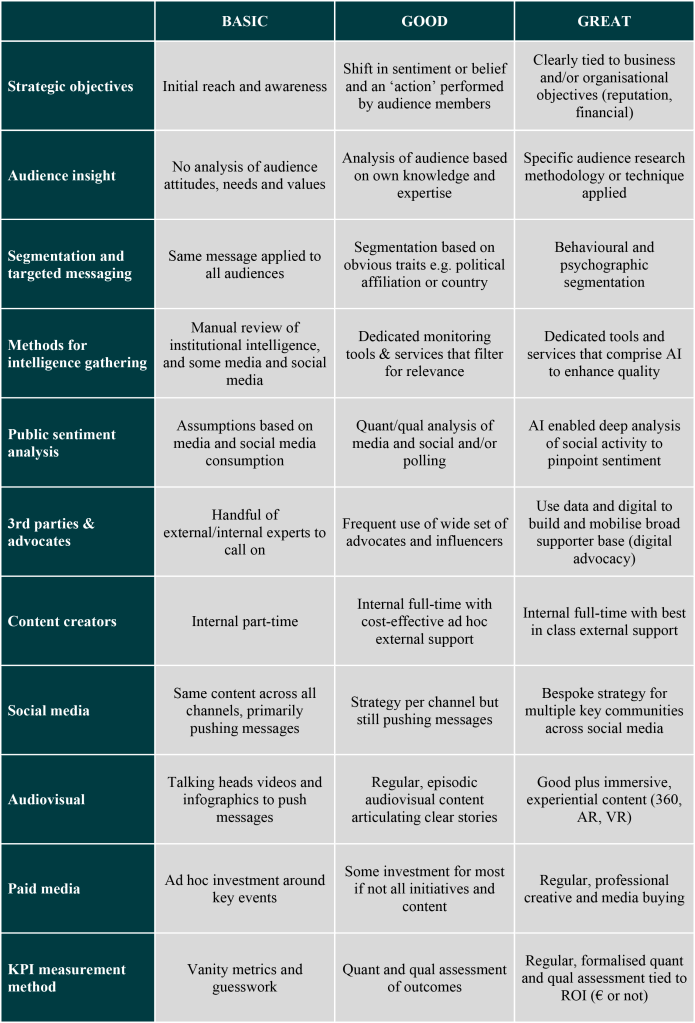
Thinking big in communications for public affairs: basic, good, great

I’ve put some of the communications methods and tactics I listed in my recent post on thinking bigger in public affairs into a grid showing different levels of maturity (basic – good – great).

Maturity matrices are handy. They can help you set benchmarks and determine areas in which you might wish to improve. Clearly, everyone need not be great at everything and what constitutes basic, good and great may vary depending on industry and organisation. But hopefully this is a useful thought-starter.

Communications for public affairs: thinking big

While this is not a post about COVID-19 per se, it is in part inspired by the manner in which public affairs professionals have responded to it. We have been quick to adapt, with most of us generally comfortable conducting our work and exchanges in a more public (albeit virtual) realm.

In a seminal article published back in 2002, ‘How political and social change will transform the EU public affairs industry’, Simon Titley wrote that ‘to survive and prosper, public affairs practitioners need to adopt a holistic view of politics and recognition that winning public trust, acceptance and support is the prerequisite of successful lobbying.’

Nearly 20 years on, Brussels is more political than ever. Political capital and alignment with popular sentiment are key to success in public affairs. Organisations need to be seen to have big solutions to big issues. They need to show genuine purpose and their private interests need to align with public interest.

To be fair, organisations do tend to behave better. And they do on average invest more in efforts to build political capital and public trust. If not in Brussels, at least in key member states where actual ‘publics’ are based.

But investing a tad more will usually not help organisations truly win public trust, acceptance and support. To build political capital in a crowded space, organisations need to ‘think bigger’ in terms of how they communicate.

What might thinking bigger look like in communications for public affairs?

Rather than making folk aware that we exist, we seek to surprise and delight them so that they might actually think we’re unique, and change their views and behaviour accordingly.

Rather than push a bunch of messages repeatedly and hoping one sticks, we commit fully to the single storyline that truly allows us to stand out.

Rather than seeing communications as a means to push messages out across multiple channels, we run creative campaigns with a clear objective and scope that people are likely to remember.

Rather than telling people we are meeting expectations, we tell them how we are exceeding them. ‘We’re contributing to 2050!’ You should be but what ELSE are you doing?

Rather than viewing integration as a comms person sitting with a PA person once in a while, we understand how public affairs can be more impactful when it aligns with corporate strategy and brand.

Rather than assuming the same communications output works for everyone, we apply techniques that campaigners and marketers use every day to break down our audiences by needs and values.

Rather than thinking we do 3rd parties well if we have a couple of testimonials and a decent guest speaker at our event, we do advocacy at scale using data and digital and turn people into active advocates.

Rather than having copy written and edited by the one native speaker in our office, we hire moonlighting reporters, novelists or screen writers.

Once we get back to hosting live events, rather than one-off events featuring a guest with a couple of tried and tested speaking points, we host professionally installed and moderated extravaganzas and permanent exhibitions.

Rather than determining opinion through guess work, we use machine learning that can distill millions of viewpoints and provide us with a pinpoint analysis of public sentiment.

Rather than investing a couple hundred here and there in paid media to direct some online traffic, we professionalise media buying to increase our scale and scope to truly drive reach and influence.

Rather than thinking the peak of audiovisual is talking heads videos, we use AR and VR to give people experiences rather than plain old information.

The list goes on.

We don’t all need to think really big, right away. But if we don’t start thinking bigger, we may as well not communicate. There is too much competition for the spotlight, and attention spans are too short to let bad communications filter through.

The speed with which public affairs professionals have embraced heartfelt LinkedIn exchanges and virtual events over the past few weeks implies that we can adapt fast when pushed.

As more of us feel the need to think big in communications for public affairs, we’ll hopefully be just as versatile.