The ‘conversion’ dilemma: smart yet simple measurement principles in digital public affairs

Plenty of public affairs practitioners who use online channels to communicate are still perfectly happy to “get their message out” without much thought paid to whether they are actually driving any influence or change.

Thankfully, others appreciate that spending time and money on drafting drivel and being followed by a few bots from Vladivostok Is a complete waste of time.

People in the latter group are increasingly asking the question: how do we actually know whether our online communications efforts are having the desired effect?

It’s an important question, and difficult in public affairs, especially if we seek to measure the effect of online communications on the ultimate public affairs goal, namely policy impact.

Marketers are usually able to attribute a conversion (e.g. a sale) to preceding steps in the marketing funnel, especially if they all take place online. For instance: a prospective customer becomes aware by clicking on an online ad, then proceeds to ‘interest’ and ‘consideration’ by clicking beyond a landing page or subscribing to email updates, and ultimately makes a purchase online.

But the ultimate public affairs ‘conversion’ – i.e. policy impact – is harder to put at the end of a funnel. The steps preceding it are less linear, and decision-makers can shift from awareness to interest to total disinterest back to total conviction due to innumerable outside influences, like pressure from parties, constituents, or activists.

It is therefore unrealistic to create a direct line between a decision-maker’s online activity and a political decision.

Having said all that, while we may not be able to create a neat digital public affairs funnel, we can still be smart about how we track impact.

Here are some suggestions:

  • Do not over-elaborate. Set KPIs tied to fairly basic objectives that are achievable through online means e.g. building a community of relevant supporters or attracting positive interest from previously disinterested targets.
  • Similarly, set conversions that are perhaps less ambitious than ‘policy impact’ but make sure they are genuine ‘actions’ e.g. a key target subscribes for information by email, signs up to an event, or downloads a key position/publication.
  • Integrate on and offline metrics. I’ve never quite understood why most organisations insist on tracking and reporting separately given the obvious overlaps. Most simply: don’t ignore anecdotal stuff e.g. a key person (decision maker, influencer) cited your content in a meeting. A step beyond: interview people or run polls and insert questions about the reach and effects of your online efforts.
  • Stop attributing value to vanity metrics such as likes, shares or traffic. I’m not as militant as some in my profession in that I still think they’re worth tracking, for three reasons: it’s quite fun, people will invariably ask, and if numbers drop or rise dramatically it is good to try to figure out why. But in terms of effects on influence or change, they are negligible. Why? There are two main problems with vanity metrics: even if you have a simple short-term objective such as ‘building an audience of supporters’ a share or like is too weak an action to genuinely denote interest; while many vanity metrics do not allow you to identify exactly who you are reaching/engaging, meaning you have no idea whether you are actually reaching/engaging your target audiences or our aforementioned friend in Vladivostok.
Digital public affairs: a love-hate relationship

I fell into digital public affairs entirely by accident around a decade ago (I’m by no means an early adopter of technologies). But I stuck with it and remain excited by its impact and potential.

Why I love it

While we often obsess over how digital can deliver information, its effects on the environment in which public affairs operates is the better starting point.

Anyone can communicate to whoever, whenever, making ‘access’ less important, and granting a louder voice to activists. This in turn drives greater scrutiny and increased risk (at great speed, and from farther afield). As citizens, this should delight us. As people in business, it is obviously cause for concern.

Navigating all of this with success requires change within organisations: collaboration between business functions; broader and more aligned risk management; new skills; and often more transparent or just plain better behaviour. Which invariably calls for structural, operational, and cultural change.

An increasing number of public affairs practitioners appreciate that ‘doing digital’ properly involves all of the above, and not just setting up a couple of social feeds. I have helped some of them evaluate the risks and opportunities that digital brings to their organisations from a public affairs perspective, and have subsequently worked with them on appropriate strategies and operational plans. This sort of work is the most stimulating I’ve done over the last couple of years, and helps explain why digital public affairs and I remain an item.

From the perspective of communications execution, digital is of course also really exciting. Given reduced trust and greater scrutiny of business, message and reputation increasingly dictate policy outcomes. The scope for reputation building and environment-shaping on digital are endless, from creative and storytelling techniques, through to social interaction with friends (and foes), and using online tools to manage complex programmes, all underpinned by sophisticated uses of data. As with the digital transformation stuff I outline above, working with clients who make the most of these tools and methods is really motivating.

Why I hate it

‘Hate’ might be overplaying it. But I am disappointed by how low digital maturity levels remain in most public affairs functions. Its impact and scope are appreciated narrowly, as it is seen merely as an ‘awareness’ channel for ‘getting a message out’. More sophisticated uses of digital – the fun stuff I describe above – are usually not considered, which can be rather dispiriting.

Why not? Brussels remains a policy town, where technical knowledge trumps the science of influence and reputation-building, whether on or offline. Few public affairs professionals appreciate the principles of campaigning and marketing that would make them effective beyond the technical components of their work.

And in all honesty, I understand why. The staples of government relations – technical information provision and navigating the policy process – remain the key determinants of success in Brussels. And personal access remains quite easy, so why bother reaching policy-makers online? Moreover, a lot of the exciting components of digital relate to what Americans call grassroots: mobilising supporters to drive bottom-up influence. But European publics are based in member-states, while most PA practitioners have Brussels-only remits (and budgets).

Having said that, there is still plenty of scope for digital even on the most technical and Brussels-only dossier. At its basest, it can be used to analyse competition, monitor, and provide basic information via content and search.

But more importantly, due to digital (and other forces), public affairs is increasingly moving beyond the prism of the technical and Brussels-only. Reputation-building and opinion-shaping activities are prerequisites for success, and a modicum of digital aptitude is required to do either well.


Communications for public affairs: fewer messages and delivery gimmicks, more strategy please

What should you do when developing a communications strategy in support of a public affairs programme in Brussels?

In short:

  1. List what you are seeking to achieve through communications (usually one of three things: support an immediate regulatory priority; build positive reputation amongst key decision-makers; shape public perception around your organisation or industry).
  2. List who specifically you are seeking to influence (keep it as short as possible).
  3. Determine what is most likely to influence them: technical vs. non-technical arguments; reaching them directly or through intermediaries; channel preference; most relevant data points; most viable examples; helping address political needs/challenges.
  4. Develop a strategy likely to deliver on the above. Perhaps a differentiation strategy, building communities of support, leveraging influential individuals. Or whatever.

What NOT to do when developing a communications strategy in support of a public affairs programme?

Write a few vapid messages, have a whacky brainstorm with post-its to devise gimmicks that can help deliver said message as many times as possible, execute the gimmicks, and hope that through a vicious battle of attrition, some will stick.

If you actually speak to the intended recipients of communications material by corporate public affairs folk in Brussels, and ask them what they crave, it’s usually a mix of the following:

  • Useful technical information (especially data)
  • Useful case-studies/examples that align with their world-view and needs
  • Proof of market power
  • Proof of popular support
  • Differentiation i.e. how are you truly ‘better’ than the competition
  • Current impact AND long-term vision
  • Often, proof of commitment to Europe
  • No whinging
  • No bland nonsense about innovation or sustainability (unless you are truly innovative or sustainable)

And it all needs to be tailored, pitched at the right level, easy to grasp, and delivered at the right time.

Yet we too often develop messages and obsess about distributing them without thinking much about our audiences or tailoring delivery to them. Our assumption remains that repeated reach will win the day. “They just haven’t heard our message enough times!” is a common refrain in Brussels.

News alert: message delivery without audience analysis and an appropriate strategy is most likely a complete waste of time.

Digital across three types of public affairs activity

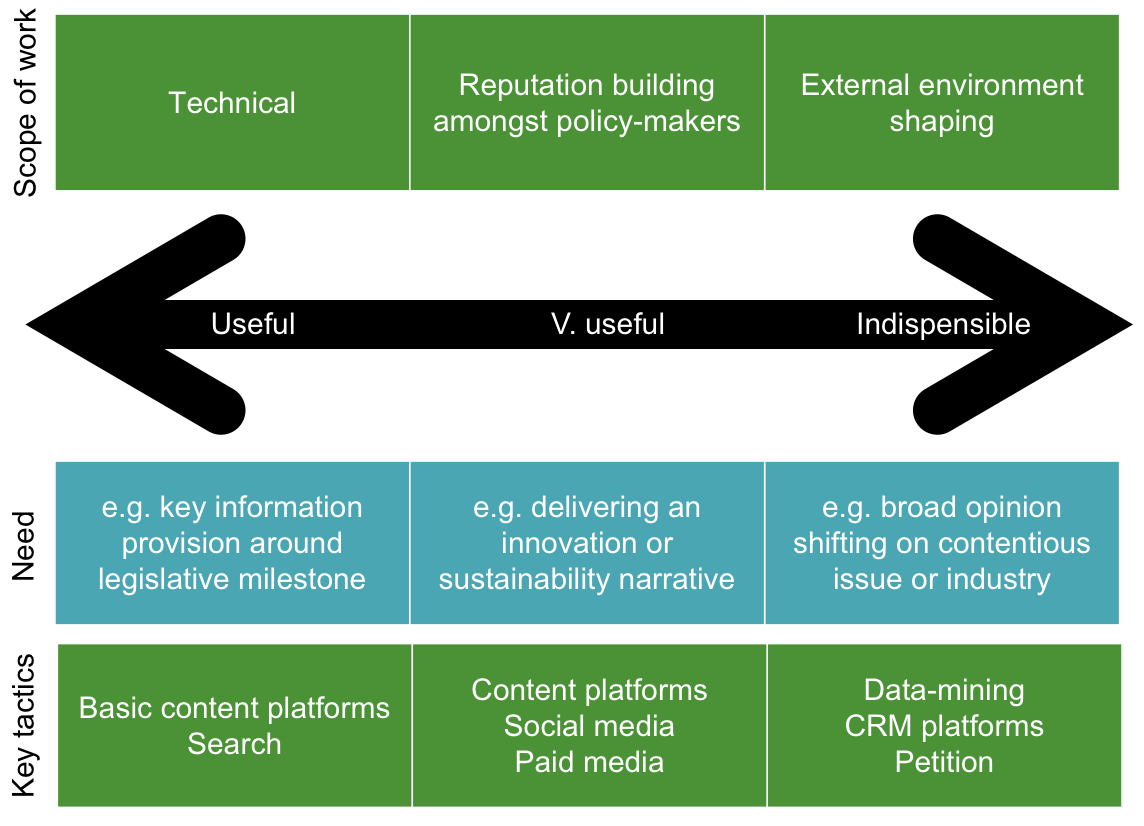
Below is a slide I developed for a recent presentation to a lovely collection of my countrymen.

It summaries viable digital tactics across three ‘types’ of public affairs activity:

  1. Technical i.e. classic government relations on a legislative dossier on which experts on every side are wrangling over the details of key texts
  2. Reputation building amongst policy-makers i.e. when an interest group is seeking to build a relationship with policy-makers beyond the technical wrangling through positioning/differentiation
  3. External environment shaping i.e. what Americans often call grassroots – the attempt to influence publics in order to indirectly influence policy

As ever, kind thoughts or even brutal take-downs would be appreciated.

Digital Public Affairs

The sledge-hammer method in public affairs

In public affairs in Brussels, we frequently skip from message to delivery: we blast our preferred message out through various delivery channels, be it face to face, or media, or digital – with little thought to how it will resonate with a target audience, but hoping that some of it will stick. Call it the sledge-hammer method.

Sadly, the bit in between message and the delivery mechanism is often overlooked – i.e. analysing what will drive influence and developing a corresponding strategy.

Why is this the case?

Perhaps it is cultural: we venerate knowledge, from understanding the complexities of the political process to the intricacies of a highly technical dossier, but are less interested in the communications methods required to drive awareness and influence, like audience scrutiny, testing, or measurement.

Or perhaps it is because successful outcomes in public affairs are less clear-cut than in other communications disciplines. While marketers and political campaigners are purely assessed on their ability to sell a product or a candidate respectively, a successful PA result is less clear-cut. There are unambiguous political outcomes, like policy change or the avoidance of harmful legislation, but there are also looser ones, like building a relationship with a policy-maker or establishing a coalition with useful political players. If we are just expected to deliver the latter, there is little reason to do much strategising.

Whatever the case, it’s a shame, as public affairs sells itself short when fixating on technical detail and relationships over truly delivering influence. And frankly, the strategic planning process does not have to be overly difficult. It can simply comprise the following:

  1. Narrowing down objectives to those that are most important and realistic/achievable.
  2. Narrowing down audiences to just those who makes decisions (being very specific).
  3. Figuring out what will influence them (e.g. data, case studies, technical vs. non-technical, centre-left vs. centre-right values, proof of market power, proof of popular support, local, national) + who will influence them (e.g. you, a constituent, an influential person, media) + how they consume information (p.s. if you do not know or cannot hazard a sensible guess on any of the above, ask them).
  4. Re-assessing how realistic and achievable success is.
  5. If indeed it is realistic and achievable, develop a strategy and a corresponding implementation plan.

Easier said than done?

Digital public affairs: do not rush into information delivery – assess risk mitigation first

This post is an extract from an eBook I shall be publishing soon: watch this space.

When utilising digital to support their programmes, corporate public affairs practitioners often fixate on how it can help deliver information at high speed and volumes. Understandably. Reaching policy folk is a challenge, so the notion of doing it at the click of a button is tantalising.

But it is important to first look beyond information delivery and consider the risks posed by digital, especially its celebrated progeny: social media.

Due to mistrust in elites and shifting societal values, corporations are expected to be paradigms of virtue. If they are not, social media is at hand to let citizens and activists express their discontentment. Moreover, a story can no longer be ‘killed’ given that social media means we have one perpetual news cycle. If a story is big enough, it will keep on running through likes and shares, and be amplified through petitions and campaigns. Social media does not even respect geographic boundaries, with salacious hearsay from a far-away continent likely breaking faster than a less juicy local story.

In public affairs, this all matters because it is now easier for opponents and activists to leverage corporate misdeeds from across the world (real or perceived) to gain political advantage.

Many argue that we should take protest in the digital age with an enormous pinch of salt given how easy it is to express indignation on Facebook or sign multiple petitions (the slacktivist phenomenon). But sometimes online protest does balloon, and with decision-makers eager to convey democratic legitimacy by following the tide of public opinion (and, one would hope, wishing to do the right thing), such protest can sway policy.

The most oft-quoted recent EU examples are the Transatlantic Trade and Investment Partnership (TTIP), the much-vaunted trade deal between the EU and the US, and the Anti-Counterfeiting Trade Agreement (ACTA), a treaty aimed at cementing international standards for intellectual property rights.

I shall not enter into the merits of either package, but merely say that while both had seemed shoe-ins at the offset, they were derailed by large scale protests which would not have escalated so fast and attracted such numbers were it not for online mobilisation and petitions (Avaaz petitions against TTIP and ACTA were signed by 3.5 and 3 million people respectively).

What to do about it all? Beyond being virtuous corporate citizens, being better equipped to handle the risks posed by the spread of potentially perilous information online is the obvious starting point. This involves a melange of operational and cultural remedies which we shall scratch the surface of here:

  • Public affairs should work closely with counterparts globally – EU functions tend to be quite isolated – and with marketing-communications (not just legal, as is frequently the case). Working with marketing-communications – the main brand and reputation ‘owners’ – will ensure alignment and joint plans on reputation-building (proactive), and the ability to act quickly when trouble arises (reactive).
  • Organisations should make crisis mitigation global and cross-functional. Issue monitoring, scenario planning, and messaging should be shared. In practice, this should help public affairs professionals keep track of events outside their backyard which could affect policy. And vice-versa: knowledge of policy developments which could affect broader reputation will help corporate communicators.
  • Organisations should strive to institute greater transparency, including a willingness to be open and publicly engaged around policy priorities and advocacy activities (on and offline).

Three ways to improve the effectiveness of digital public affairs

Many public affairs practitioners who utilise digital and social media to enhance reach and impact, will at some point ask a variation of this question: “this isn’t working well enough – what should I do better?”

Three handy starting points:

  1. Audience first: I come across countless organisations that invest heavily in digital public affairs, but do not know how their audiences wish to consume information. Simple vs. complex? Offline vs. online? If online: social media vs. long-form? Text vs. audio-visual? Determining what is most useful to audiences, ideally by talking to them, and when considering online channels, examining how they currently use them, is the indisputable starting point.
  2. Don’t waste your time: “audience first” leads neatly onto “don’t waste your time”. I’m frequently asked what online channel someone should be on, what tactics work best, or how frequently they should be publishing. I don’t know. Maybe they shouldn’t be on any channels? Maybe they have an audience of 10 and have them all on speed-dial? Every single communications activity (every tweet, speech, press release, meeting) should fulfil a specific audience need, tied to a specific If it doesn’t tick both boxes – then don’t waste your time; focus purely on activities you know bring results.
  3. Understand best in class: within any given sector or issue, someone has probably sussed out what key audiences require, and is communicating effectively. You’ll usually know who. Analyse them in detail: what do they say, how they say it, who says it, where, how often, and in what tone. We don’t benchmark nearly enough. We should: online communications is largely public, meaning best practice is there for all to see.

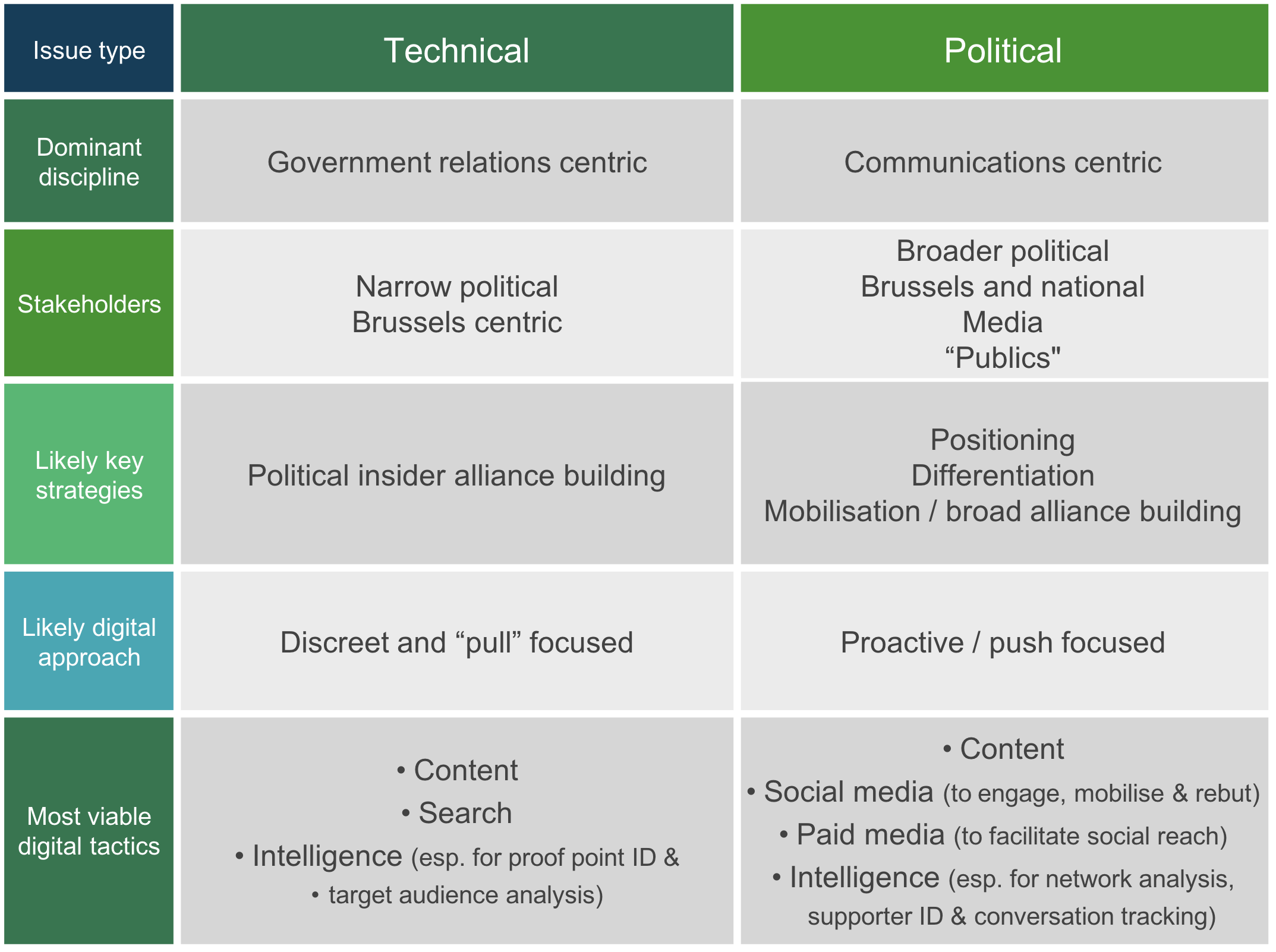
Most viable digital approaches and tactics in technical vs. political public affairs

I’ve recently written about different communications requirements (digital and other) on technical vs. politicised public affairs dossiers here and here.

On the same subject, here is a table that outlines, in basic terms, different viable strategies and digital methods that are most likely to be utilised on technical vs. political issues in EU public affairs. In summary: digital remains relevant on technical dossiers, but on a more discreet level and with fewer tactical options. NB: clearly, items in either column could quite easily also fit in the other, depending on issue, stakeholders and environment. Food for thought, I hope.

digital-pa-tech-vs-political

Internal evaluation of digital public affairs activities

Evaluation of communications activity tends to centre on external reach and impact, measuring basics like awareness, and ideally outcome related metrics like shifts in opinion of target audiences as well as genuine impact on communications, policy and business objectives.

A further useful form of evaluation which we often neglect is internal, revolving around questions like:

  • What should we actually be evaluating from an internal perspective?
  • What constitutes best practice (and poor practice?)
  • How are we performing?

The (hopefully visible) table below lists five core components of digital public affairs along with a short description of what constitutes basic, good and great for each, which I’ve used as a benchmark to assess activity.

I’ve arguably been conservative: some public affairs and communications professionals will likely think that some items in good or great should be considered basic in 2016. Perhaps, but I’d argue that given the cultures inherent in most public affairs functions – technical/legalistic and government-relations centric, and operated by policy wonks rather than marketing-communications professionals – I think it’s realistic. Happy to hear thoughts, as ever.

Digital PA grid

Using digital and social media in technical vs. communications driven EU public affairs

I recently wrote about the nuance between technical/legal and public interest driven dossiers in EU public affairs. In short, high-quality technical information provision is the key determinant for success on technical dossiers, while on politicised issues in which public sentiment plays a role, a successful PA programme will likely need to include more of the marketing-communications toolkit.

This same nuance affects the use of digital and social media in public affairs. On communications-driven dossiers, strategies will frequently have considerable digital components. Run-of-the-mill examples might include:

  • An online-centred rebuttal programme when a public affairs goal is being hampered by a specific item of misinformation.
  • Leveraging public support from a specific constituency – people who live in a certain place, work for an affected company or industry, or have a certain set of values – with the help of online tactics like petitions and social networks.
  • Utilising digital storytelling techniques to raise awareness amongst diverse stakeholders in a cluttered information space.

In legal-technical public affairs activity, like tracking and analysing ramifications of policy or drafting and advising on policy-related texts, such strategies may seem irrelevant. And in all honesty they often are, at least on a large scale.

But by no stretch does that make digital channels as a whole irrelevant, as they remain viable tools across three core components of all public affairs activity:

  1. Intelligence tracking and analysis

While the use of data in public affairs remains rudimentary, quick wins may be found in areas such as proof point identification (e.g. what do people in a key decision-maker’s constituency think of your issue and can this be leveraged) and analysing the opinions, habits and communications preferences of targeted decision-makers active on social media.

  1. Message delivery

Providing policy-related information online is obviously key. Even on the most procedural of topics involving limited stakeholders, information will be sought online. Meanwhile, highly targeted digital marketing methods can help get relevant content to the narrowest of audiences.

  1. Relationship-building

Last but not least, if target decision-makers are engaged in social media, it presents an alternative channel for reach and influence. There are only so many meetings one can attend.

The use of digital and social as one minor cog in technical/legal-centred public affairs programme may seem unexciting and perhaps even irrelevant. Undoubtedly, the options available when campaigning to influence a wider set of influencers will appear more enticing to most communications professionals. But don’t underestimate the value that digital and social can provide in shifting the pin even on under-the-radar PA, be it through a piece of intelligence uncovered online, first-rate content, or because of reputational capital and relationships built up over time in part via social media.